


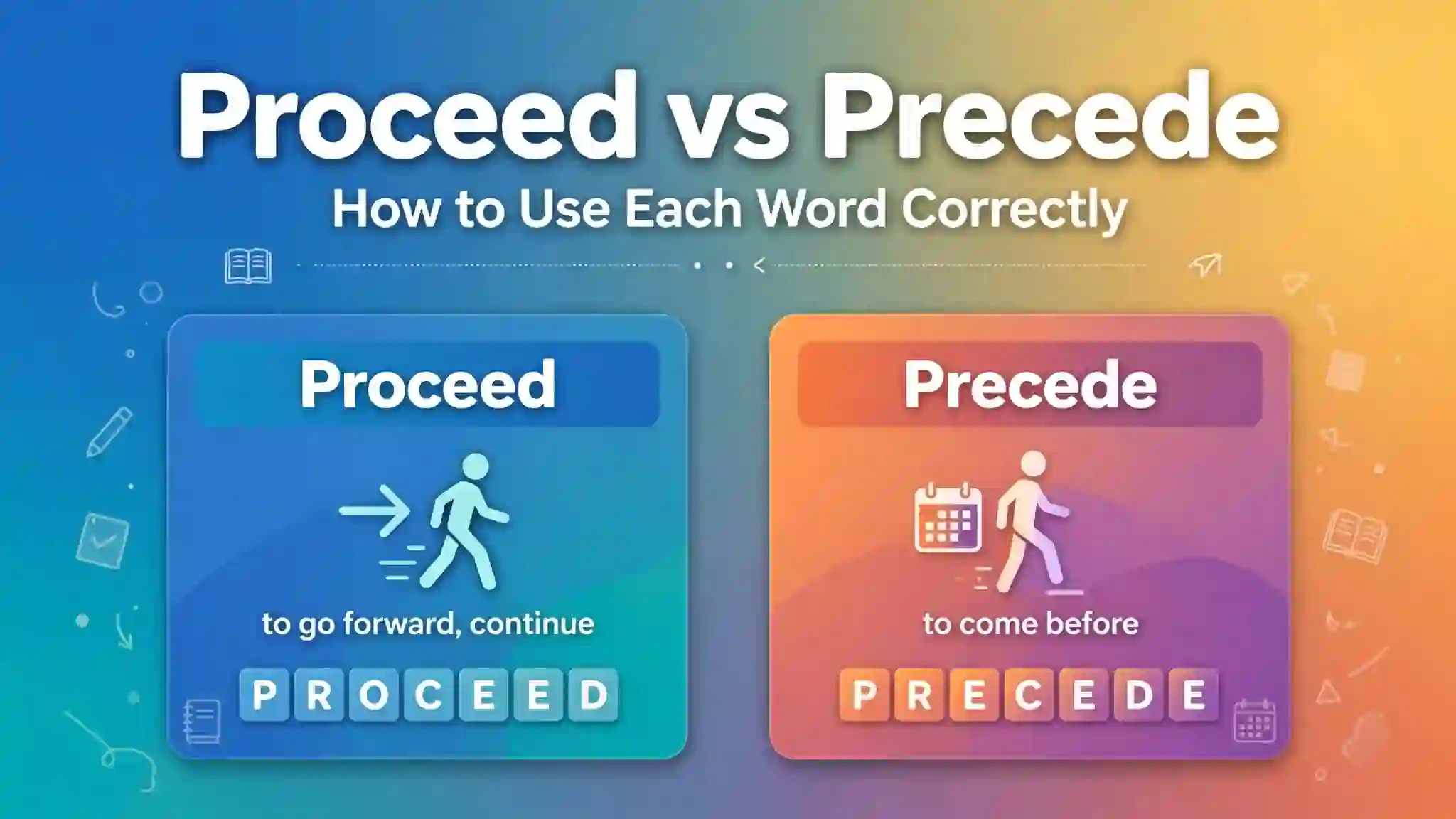
When it comes to English vocabulary, some words look and sound similar but have completely different meanings. Proceed vs Precede is a common example that confuses students, writers, and even experienced English speakers. Both words relate to order, movement, or events, but you cannot use them interchangeably. Proceed means to continue or move forward with an action. Precede means to come before something in time, order, or position. A small spelling difference changes the meaning of an entire sentence. This guide explains both words, their definitions, pronunciation, grammar, and practical uses. You will also learn simple ways to remember the difference and avoid common writing mistakes.
What Does proceed vs precede Mean?
Proceed is a verb that means to continue an activity, move forward, or take the next step. It often describes progress after a pause, decision, or instruction. People use it in everyday conversations, professional communication, directions, and formal writing. The word suggests that someone or something moves ahead rather than stopping.
Definition of Proceed
The word proceed describes the act of continuing or moving forward toward a particular goal. It can refer to physical movement, planned activities, discussions, or official processes.
For example:
- Please proceed with the meeting.
- We can proceed after receiving approval.
- The students proceeded to the next classroom.
- You may proceed with your application.
- The investigation will proceed as planned.
In each sentence, proceed describes an action that moves forward. It does not mean that something happened earlier than another event.
Proceed as a Verb
Proceed functions as a verb in English. It usually appears with a preposition such as with, to, or from, depending on the intended meaning.
Here are common expressions:
- Proceed with: Continue an activity or plan.
- Proceed to: Move toward another place or stage.
- Proceed from: Develop or originate from something.
- Proceed as planned: Continue according to an existing plan.
Examples:
- The manager decided to proceed with the project.
- After lunch, we proceeded to the conference room.
- The discussion proceeded from one topic to another.
- The event proceeded as planned.
Everyday Examples of Proceed
You can use proceed in many everyday situations. It often appears when someone gives permission, explains instructions, or describes the next step in a process.
Consider these examples:
- You can proceed with your homework after dinner.
- Please proceed to the checkout counter.
- The teacher asked everyone to proceed quietly.
- We should proceed carefully because the road is slippery.
- The company will proceed with its expansion plans.
- After checking the documents, the officer allowed us to proceed.
- The conversation proceeded without interruption.
What Does Precede Mean?
Precede is a verb that means to come before something in time, order, rank, or position. It describes an earlier event, person, action, or object. Writers use it to explain sequences, timelines, historical events, and arrangements. Unlike proceed, this word focuses on what happens first rather than what moves forward.
Definition of Precede
The word precede refers to something that happens, appears, or exists before another thing. It can describe chronological order, physical placement, or a sequence of events.
For example:
- A short introduction will precede the main presentation.
- Monday precedes Tuesday.
- The announcement preceded the ceremony.
- A warning should precede any dangerous activity.
- The opening speech preceded the award presentation.
Precede as a Verb
Precede also functions as a verb. It often takes a direct object because the word identifies what comes before something else.
Common sentence patterns include:
- Something precedes something: One event comes before another.
- Someone precedes someone: One person comes earlier in a line or order.
- An event precedes another event: One activity happens before the next.
Examples:
- Breakfast precedes the morning meeting.
- The first chapter precedes the second chapter.
- A brief introduction precedes the lecture.
- The eldest child precedes the younger children in birth order.
Everyday Examples of Precede
Precede appears in conversations about schedules, routines, history, instructions, and organized activities.
Here are some practical examples:
- Sunrise precedes the beginning of the working day.
- A warm-up should precede intense exercise.
- The opening ceremony preceded the competition.
- Chapter one precedes chapter two.
- The invitation preceded the wedding celebration.
- A warning sign preceded the dangerous road section.
- The final exam preceded the graduation ceremony.
Proceed vs Precede: What Is the Main Difference?
The main difference between these words lies in their meanings. Proceed describes continuing or moving forward. Precede describes coming before something else. Their similar spelling can cause confusion, but their grammatical roles and meanings remain distinct. Understanding their relationship with time and action makes choosing the correct word easier.
Proceed vs Precede Meaning Comparison
The following comparison highlights the most important differences:
| Feature | Proceed | Precede |
| Meaning | Continue or move forward | Come before something |
| Word type | Verb | Verb |
| Main idea | Progress | Earlier order |
| Focus | Next action or movement | Previous event or position |
| Common use | Instructions and processes | Timelines and sequences |
| Example | Proceed with the plan. | The introduction precedes the speech. |
Both words describe relationships between actions or events. However, proceed focuses on what happens next, while precede focuses on what happened first.
Difference in Time and Sequence
Time provides one of the easiest ways to understand these words. Proceed usually describes an action that continues after a starting point or pause. Precede describes an event that occurs before another event.
Consider this example:
“The introduction precedes the presentation, and the speaker proceeds with the main topic afterward.”
This sentence uses both words correctly.
- The introduction comes before the presentation.
- The speaker continues with the main topic.
The first part describes sequence. The second part describes progress.
How to Use Proceed in a Sentence
Using proceed correctly becomes easier when you understand the situation. Choose this word when someone continues an activity, moves forward, or begins the next stage of a process. It works in conversations, business writing, academic instructions, and official announcements.
Proceed With Something
Use “proceed with” when someone continues an activity, decision, or plan.
Examples:
- We decided to proceed with the construction.
- The school will proceed with its annual event.
- You can proceed with the payment.
- The team agreed to proceed with the proposal.
This expression is common in professional settings. Managers use it when approving projects. Teachers use it when giving instructions. Customers may also hear it during online transactions.
Proceed To Something
Use “proceed to” when someone moves to another place, stage, or activity.
Examples:
- Please proceed to the reception desk.
- The winners will proceed to the final round.
- We proceeded to the next chapter.
- After registration, proceed to the examination hall.
This construction often appears in directions and step-by-step instructions. It tells someone where to go or what stage comes next.
Proceed in Formal and Professional Writing
Proceed is particularly useful in professional communication. It sounds clear and direct when discussing decisions, approvals, and ongoing activities.
Examples:
- The department will proceed with the recruitment process.
- We cannot proceed without the required documents.
- The committee agreed to proceed with the recommendation.
- The application will proceed to the next review stage.
You should avoid using it when a simpler word communicates the same idea more naturally. For example, “continue” may sound friendlier in casual conversations.
How to Use Precede in a Sentence
Use precede when you want to explain that something comes before another event, person, or object. It works well in academic writing, storytelling, schedules, historical explanations, and descriptions of ordered activities.
Precede in Chronological Order
Chronological order describes events according to the time they happen. Precede helps establish which event occurred first.
Examples:
- Childhood precedes adulthood.
- The announcement preceded the official launch.
- The first meeting preceded the final decision.
- Ancient civilizations preceded modern societies.
Precede in Written Content
Writers often use precede when describing the structure of books, reports, articles, and presentations.
Examples:
- The abstract precedes the introduction in this report.
- A short explanation precedes each exercise.
- The table of contents precedes the first chapter.
- A safety notice precedes the instructions.
This word can make formal writing more precise. It explains the position of different sections without requiring a longer description.
Precede in Formal Communication
Precede also appears in business documents, academic papers, legal writing, and official reports.
Examples:
- The final agreement was preceded by several discussions.
- The interview was preceded by a written assessment.
- A formal notice must precede the cancellation.
- The announcement was preceded by a detailed review.
These examples show how precede helps explain the order of professional activities.
Common Mistakes When Using Proceed vs Precede
Many writers confuse these words because they share several letters and have similar pronunciations. The best way to avoid errors is to focus on the intended meaning. Check whether your sentence describes continued action or an earlier event before choosing either word.
Using Proceed When You Mean Precede
This mistake happens when someone uses proceed to describe an event that comes before another event.
Incorrect: The introduction will proceed the main speech.
Correct: The introduction will precede the main speech.
The introduction comes first. It does not continue the speech or move forward with it.
Another example:
Incorrect: Monday proceeds Tuesday.
Correct: Monday precedes Tuesday.
Monday comes before Tuesday in the weekly calendar.
Using Precede When You Mean Proceed
This mistake happens when someone uses precede to describe continuing an activity.
Incorrect: Please precede with your application.
Correct: Please proceed with your application.
The instruction asks someone to continue the application process.
Another example:
Incorrect: We will precede with the meeting after lunch.
Correct: We will proceed with the meeting after lunch.
The meeting will continue or begin after lunch.
Confusing Their Different Sentence Structures
Both words function as verbs, but they often appear in different sentence patterns.
Proceed commonly appears with prepositions:
- Proceed with the plan.
- Proceed to the next stage.
- Proceed from the entrance.
Precede commonly takes a direct object:
- The introduction precedes the article.
- The ceremony precedes the celebration.
- The warning precedes the instructions.
Learning these patterns helps prevent spelling and grammar mistakes.
Easy Ways to Remember Proceed vs Precede
A simple memory trick can help you choose the correct word without checking a dictionary. Focus on the first letters and the meaning of each word. Connect proceed with progress and precede with something that comes before. These associations make the distinction easier to remember.
Remember Proceed With Progress
Proceed begins with “pro,” which can remind you of progress. When you proceed, you continue moving forward or take the next step.
Think about these examples:
- Proceed with your studies.
- Proceed to the next level.
- Proceed with the plan.
Each sentence describes forward movement or continued activity.
Remember Precede With Previous
Precede begins with “pre,” a prefix that often means before. You can see the same prefix in words such as preview, preschool, and prearrange.
For example:
- A preview comes before the full presentation.
- Preschool education comes before regular school.
- A short introduction precedes the main article.
This connection makes it easier to remember that precede means to come before something.
Proceed vs Precede: Practice Sentences
Practice helps you recognize the difference between similar words. Read each sentence and decide which word fits its meaning. Pay attention to the action, timeline, and relationship between events. The answers below explain why each choice works.
Examples in Everyday Contexts
Here are additional examples that show how both words work naturally in different situations.
| Situation | Example |
| School | Please proceed to your next lesson. |
| Business | The review will precede the final approval. |
| Travel | Proceed straight along this road. |
| Events | The welcome speech precedes dinner. |
| Technology | The system cannot proceed without confirmation. |
| Writing | The introduction precedes the conclusion. |
| Meetings | We will proceed with the discussion. |
| History | The industrial revolution preceded the digital age. |
Other Words Related to Proceed and Precede
Several English words share similar meanings or spelling patterns with proceed and precede. Learning these related terms can improve your vocabulary and help you express time, order, and movement more accurately.
Synonyms of Proceed
Proceed has several synonyms. The best choice depends on the sentence and situation.
- Continue: Keep doing something.
- Advance: Move forward or make progress.
- Move on: Continue to another subject or activity.
- Go ahead: Begin or continue an action.
- Progress: Develop or move toward a goal.
- Carry on: Continue an activity.
Examples:
- Please continue with your work.
- The project will advance to the next stage.
- We can move on to another topic.
- Go ahead with your presentation.
These alternatives often sound more natural in everyday conversations. Proceed remains useful in formal instructions and professional communication.
Synonyms of Precede
Precede also has several related words. Each one describes something that comes before another thing.
- Come before: Occur earlier in time or order.
- Lead: Come first or guide others.
- Predate: Exist or happen before something.
- Antedate: Date from an earlier time.
- Forego: Come before in a sequence, though this use is less common and often confused with “forgo.”
Examples:
- The introduction comes before the conclusion.
- The guide led the group into the building.
- These historical records predate the modern period.
- The earlier version antedates the revised document.
Remember that synonyms do not always fit every sentence. Consider their meanings and grammatical patterns before replacing either word.
Frequently Asked Questions About Proceed vs Precede
These frequently asked questions address common spelling, grammar, and usage concerns. They provide quick explanations for readers who want to understand both words and use them correctly in everyday writing.
1. What Is the Main Difference Between proceed vs precede?
Proceed means to continue or move forward with an action. Precede means to come before something in time, order, or position. For example, you proceed with a project, but an introduction precedes the main discussion.
2. Is proceed vs precede the Same as Continue?
Proceed and continue have similar meanings, but they do not always sound identical. Continue means to keep doing something. Proceed often suggests moving forward to the next step or stage. Both words can describe ongoing activities.
3. Does proceed vs precede Mean Before?
Yes. Precede means to come before something in time, order, or position. For example, Monday precedes Tuesday. The word functions as a verb and describes the relationship between two things.
4. Can Proceed and Precede Be Used in the Same Sentence?
Yes. You can use both words in one sentence when describing an earlier event and a later action. For example, “The introduction precedes the lecture, and the speaker proceeds with the main discussion afterward.”
5. What Is the Opposite of Precede?
The opposite of precede is usually follow. Precede means to come before something, while follow means to come after it. For example, Monday precedes Tuesday, and Tuesday follows Monday.
6. How Can I Remember the Difference Between Proceed and Precede?
Connect proceed with progress and precede with previous. Proceed describes moving forward or continuing an action. Precede describes something that happens before another event. This simple association can help you choose correctly.
Conclusion: Proceed vs Precede
Understanding Proceed vs Precede becomes simple when you focus on what each word describes. Proceed means to continue, move forward, or take the next step. Precede means to come before something in time, order, or position. Both words function as verbs, but they serve different purposes in sentences.Remember the connection between proceed and progress.
Use this word when discussing ongoing activities, instructions, plans, and physical movement. Connect precede with previous to remember its meaning. Use it when explaining timelines, event sequences, and the order of written content.Pay attention to context before choosing either word. Read your sentence carefully and ask whether it describes forward movement or an earlier event.
