


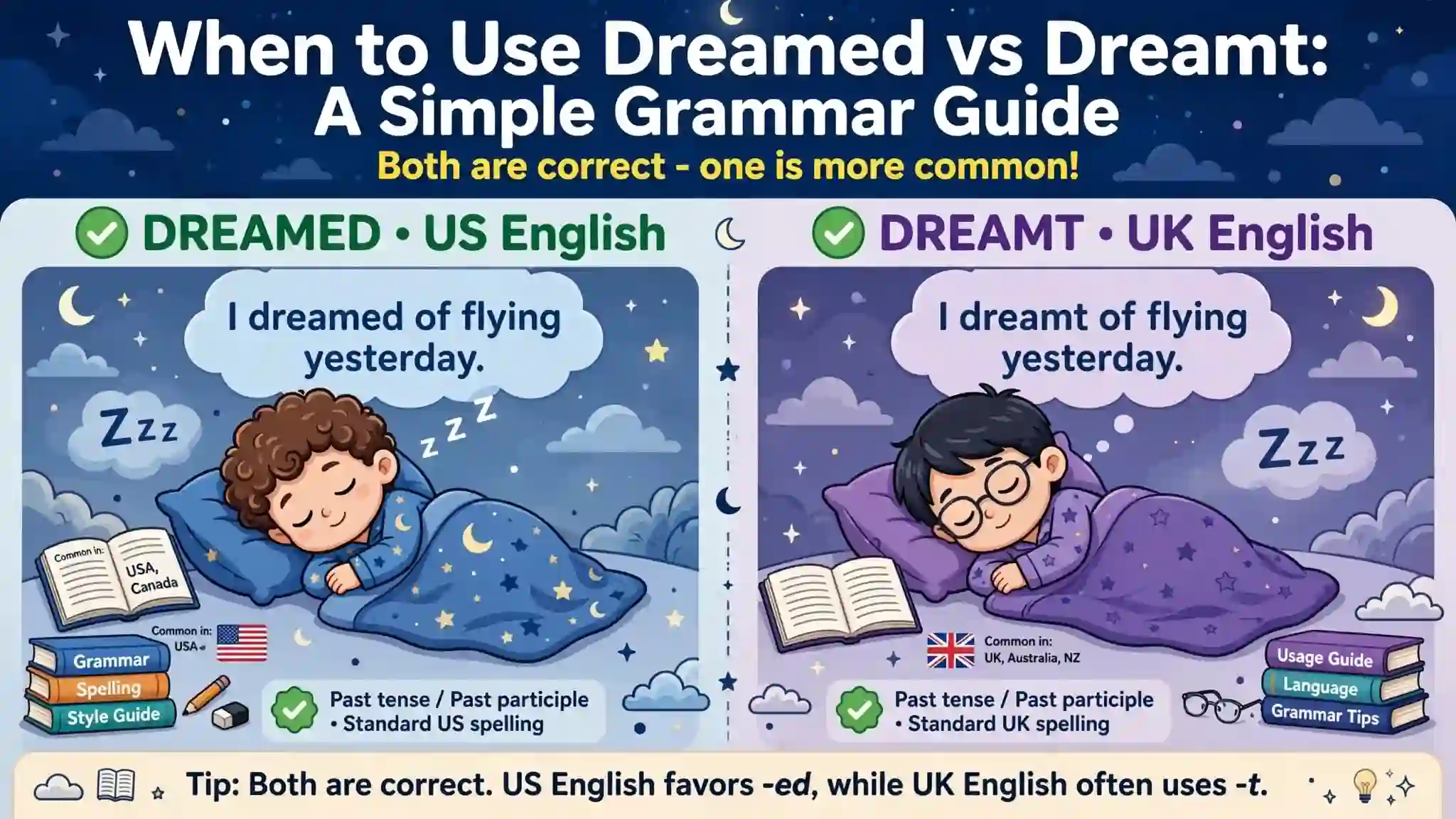
When it comes to English grammar, some words have more than one correct form. Dreamed vs Dreamt is a common example. Both words describe something you experienced in your sleep or imagined while awake. They also work as the past tense and past participle of the verb dream. Many writers feel unsure about which form to choose. The good news is that both forms are correct. The main difference comes from regional preferences and writing style. This guide explains their meanings, grammar rules, and everyday uses. You will learn how to choose the right form, avoid common mistakes, and write clear sentences with confidence.
Dreamed vs Dreamt: What Is the Difference?
The words dreamed vs dreamt have the same basic meaning. Both are past forms of the verb dream. You can use either word to describe a dream you had during sleep or a hope you held in the past.
The main difference is regional usage. American English often favors dreamed. British English uses both forms, but dreamt appears more often in some contexts. Writers can choose either form based on their audience and preferred style.
Consider these examples:
- I dreamed about flying last night.
- I dreamt about flying last night.
- She dreamed of becoming a doctor.
- She dreamt of becoming a doctor.
Each sentence is grammatically correct. The meaning does not change.
Are Both Spellings Correct in dreamed vs dreamt?
Yes. Both forms appear in standard English dictionaries and accepted writing. Neither spelling is wrong. You can use either one in casual messages, stories, essays, and other types of writing.
The choice depends on your location, audience, and personal preference. Some writers use dreamed because it follows a regular spelling pattern. Others prefer dreamt because it sounds shorter and feels natural.
You should focus on consistency. Pick one form and use it throughout the same piece of writing. This makes your work look polished and professional.
Why Does English Have Two Past Forms?
English has several verbs with different past forms. Some verbs follow regular patterns. Others have irregular forms that developed through the history of the language.
The verb dream originally developed a regular past form. Over time, the shorter form dreamt also became common. English speakers accepted both forms, and both remain in use today.
Other verbs follow similar patterns:
| Base verb | Regular past form | Alternative past form |
| Dream | Dreamed | Dreamt |
| Learn | Learned | Learnt |
| Burn | Burned | Burnt |
| Spell | Spelled | Spelt |
| Smell | Smelled | Smelt |
These pairs show how English can accept two forms of the same verb. Their popularity often depends on regional habits.
2. When to Use Dreamed in a Sentence
Use dreamed when you want the regular past form of dream. It works in American English and is also correct in British English. Many writers prefer it because readers recognize it easily.
The word can describe a sleeping experience, a personal goal, or an imagined situation. Its meaning depends on the rest of the sentence.
Here are common examples:
- I dreamed about my childhood home.
- He dreamed of traveling around the world.
- They dreamed about starting a small business.
- We dreamed of living near the ocean.
- She dreamed that she could fly.
In each example, dreamed describes something that happened or existed in the past.
Use Dreamed for Sleeping Experiences
A sleeping dream is a series of images, thoughts, or feelings that you experience while asleep. You can use dreamed to explain what happened during the night.
Examples:
- I dreamed about an old friend last night.
- She dreamed that she was walking through a forest.
- He dreamed about losing his phone.
- We dreamed of visiting a beautiful island.
- My brother dreamed about his school days.
These sentences describe events that happened during sleep. You can use dreamed whether the dream felt happy, strange, frightening, or realistic.
Use Dreamed for Hopes and Ambitions
The verb dream also describes a strong wish for the future. It can refer to a goal that someone wanted to achieve.
Examples:
- She dreamed of becoming a successful writer.
- He dreamed about opening his own restaurant.
- I dreamed of studying abroad.
- They dreamed of building a peaceful home.
- My parents dreamed of giving us a better life.
These examples do not describe sleeping experiences. They describe hopes and ambitions.
The phrase dreamed of often introduces a goal or desire. The phrase dreamed about can also introduce an idea or situation that someone imagined.
Is Dreamed Better for American English?
Yes, dreamed is generally the more common choice in American English. It follows the regular pattern of adding -ed to a verb.
American writers often use it in school assignments, newspapers, books, and everyday communication. However, dreamt remains correct and understandable in the United States.
If you write for an American audience, dreamed is a safe and familiar choice. It helps maintain a consistent American English style.
3. When to Use Dreamt in a Sentence
Use dreamt when you prefer the shorter, irregular past form of dream. It has the same meaning as dreamed. The form appears in British English and other varieties of English.
Many writers like dreamt because it creates a compact sentence. It can also give a sentence a traditional or literary tone.
Examples include:
- I dreamt about my grandmother last night.
- She dreamt of becoming a famous singer.
- He dreamt that he was flying over the city.
- We dreamt about our future together.
- They dreamt of owning a beautiful house.
All these sentences are correct. You do not need to change the meaning when you choose this form.
Use Dreamt in British English
British English accepts both dreamed and dreamt. However, dreamt is a familiar choice in British writing and conversation.
For example:
- I dreamt about the holiday all night.
- She dreamt of becoming a teacher.
- He dreamt that he had won the competition.
- They dreamt about moving to London.
These examples sound natural in British English. The regular form dreamed is also correct.
Use Dreamt for a Shorter Writing Style
Some writers prefer dreamt because it uses fewer letters. This can make a sentence look shorter without changing its meaning.
Compare these examples:
- I dreamed about the ocean.
- I dreamt about the ocean.
Both sentences communicate the same idea. The second sentence is simply shorter.
You can use this form in personal stories, creative writing, and informal communication. It also works in formal writing when it matches your chosen English variety.
Does Dreamt Sound More Literary?
Sometimes. Writers may choose dreamt in poems, novels, and reflective stories because of its sound and rhythm. It can fit well into sentences that describe memories, hopes, or imagination.
For example:
- She dreamt of a world filled with peace.
- He dreamt beneath the stars.
- I dreamt of places I had never seen.
These sentences have a slightly different rhythm from versions with dreamed. However, the word itself does not automatically make writing more poetic. The surrounding language creates the overall effect.
4. Dreamed vs Dreamt in Different Tenses
Understanding verb tenses helps you use both forms correctly. Dreamed and dreamt can function as the simple past tense and the past participle.
The base form is dream. The present participle is dreaming. Both past forms work with helping verbs in perfect tenses.
| Verb form | Example |
| Base form | I dream every night. |
| Simple past | I dreamed last night. |
| Alternative simple past | I dreamt last night. |
| Past participle | I have dreamed about it. |
| Alternative past participle | I have dreamt about it. |
| Present participle | I am dreaming now. |
Dreamed vs Dreamt: Examples in Everyday English
Real examples make grammar easier to understand. You can use both forms in conversations, personal messages, stories, and professional writing.
The following examples show how each form works in different situations.
Examples About Nighttime Dreams
Use either form when you describe something that happened while sleeping.
- I dreamed about a talking dog last night.
- I dreamt about a talking dog last night.
- She dreamed that she was swimming in the sky.
- He dreamt about meeting his favorite actor.
- We dreamed of walking through a quiet garden.
These sentences describe sleeping experiences. You can use dreamed or dreamt without changing the message.
Examples About Future Goals
Use the verb when you discuss a hope or ambition.
- I dreamed of becoming a teacher.
- She dreamt of starting her own company.
- He dreamed about playing professional football.
- They dreamt of living in a peaceful town.
- We dreamed of building a better future.
The word often appears with of or about before a goal. Both prepositions can work, but the sentence meaning and natural phrasing matter.
Examples in Questions
You can also use both forms when asking questions about past dreams.
Examples:
- Did you dream about me?
- Did she dream of becoming famous?
- Did they dream about the same place?
- Have you ever dreamed about flying?
- Have you ever dreamt of living abroad?
Notice the first three questions use did followed by the base verb dream. Do not write Did you dreamed? or Did she dreamt?
Examples in Negative Sentences
Use did not or didn’t with the base form dream to make a simple past negative sentence.
Examples:
- I did not dream about anything last night.
- She didn’t dream of becoming an artist.
- He did not dream about that place.
- They didn’t dream of moving overseas.
For present perfect negatives, use have not or has not with the past participle:
- I have not dreamed about it before.
- She has never dreamt of becoming famous.
6. Common Mistakes When Using Dreamed or Dreamt
Both forms are correct, but some sentence structures can still cause errors. Most mistakes happen when writers confuse the simple past with the base form or use the wrong helping verb.
Learn these rules to make your sentences clear.
Mistake 1: Using a Past Form After Did
Incorrect: Did you dreamed about me?
Correct: Did you dream about me?
The helping verb did already shows past time. Use the base form of the main verb after it.
More examples:
- Incorrect: Did she dreamt about the ocean?
- Correct: Did she dream about the ocean?
- Incorrect: Did they dreamed of success?
- Correct: Did they dream of success?
Mistake 2: Mixing Both Forms in One Piece
Using both spellings is not always a grammar error. However, switching between them without a reason can make your writing inconsistent.
For example, you might write:
- I dreamed about my childhood.
- She dreamt about her childhood.
- We dreamed about our childhood.
The sentences are correct, but the spelling changes without a clear style choice.
Choose one form for the whole article, essay, or story. This keeps your writing consistent.
Mistake 3: Thinking Dreamt Is Incorrect
Some learners believe that dreamt is a spelling mistake. That is not true. It is an accepted past form of dream.
You can use it in a grammatically correct sentence:
- I dreamt about my future last night.
- He has dreamt of this opportunity for years.
Do not correct this form simply because you usually write dreamed.
Mistake 4: Confusing Dreamed With Dreaming
The word dreaming is the present participle. It often appears with forms of be.
Examples:
- I am dreaming about my vacation.
- She was dreaming about her childhood.
- They are dreaming of a better future.
Use dreamed or dreamt for past forms. Use dreaming for continuous tenses.
Mistake 5: Using the Wrong Past Participle
Both past forms work with have, has, and had.
Correct examples:
- I have dreamed about this before.
- I have dreamt about this before.
- She had dreamed of success.
- She had dreamt of success.
The key is to use a past participle after the helping verb.
7. Dreamed vs Dreamt in American and British English
Regional English differences explain why one spelling may seem more familiar than the other. Both forms are standard, but their frequency can vary by country.
American English generally favors dreamed. British English uses both forms, with dreamt often appearing more frequently than it does in American writing.
| Feature | American English | British English |
| Common past form | Dreamed | Dreamed and dreamt |
| Alternative form | Dreamt | Dreamt |
| Grammar status | Both correct | Both correct |
| Formal writing | Both accepted | Both accepted |
| Everyday use | Dreamed is common | Both forms are familiar |
Which Form Should American Writers Choose?
American writers can usually choose dreamed. It follows a common spelling pattern and fits the preferences of many American publications.
For example:
- I dreamed about the vacation.
- She dreamed of becoming a scientist.
- He had dreamed of that moment for years.
You can still use dreamt if it suits your style. It is not an error in American English.
Which Form Should British Writers Choose?
British writers can use either form. Dreamt is a common option, especially in everyday and literary writing.
Examples:
- I dreamt about the holiday.
- She dreamt of becoming a writer.
- They had dreamt of visiting Scotland.
The regular form dreamed also works. Follow the spelling preferences of your publication or organization when they provide a style guide.
What About Other English-Speaking Countries?
English speakers in countries such as Australia, Canada, and New Zealand may encounter both forms. Their preferences can vary by region, publication, and individual writer.
There is no need to treat one form as universally correct. Readers can understand both. Consistency matters more than choosing one spelling for every English-speaking audience.
8. Simple Tips to Remember the Correct Form
You do not need to memorize a long list of grammar rules. A few simple habits can help you choose the right form every time.
Remember That Both Forms Are Correct
Start with the most important rule: dreamed and dreamt have the same meaning. Neither form is wrong.
If you remember this point, you will avoid correcting a valid spelling by mistake.
Follow Your Audience’s English Style
Think about who will read your writing. Use dreamed if you want to follow common American English preferences. Choose dreamt if it better matches your British English style.
Both choices work in general English.
Check the Helping Verb
Look at the words around the verb.
- After did, use dream.
- After have, use dreamed or dreamt.
- After had, use dreamed or dreamt.
- With am, is, or are in a continuous tense, use dreaming.
This simple check can prevent many grammar mistakes.
Frequently Asked Questions
1. Is dreamed vs dreamt grammatically correct?
Both forms are grammatically correct. They are the simple past and past participle forms of dream. The choice depends on regional preference and writing style.
2. Is Dreamt British or American English?
Dreamt is common in British English, but American English also accepts it. American writers generally use dreamed more often.
3. Can I use dreamed vs dreamt in the same article?
You can, but it is better to choose one form and use it consistently. This creates a clear and professional writing style.
4. Which form should I use in formal writing?
Both forms are acceptable in formal writing. Follow your organization’s style guide or your audience’s regional preference. Use dreamed for a familiar American English style.
5. Is Dreamt the past tense of Dream?
Yes. Dreamt is an accepted past tense form of dream. You can write, “I dreamt about my family last night.” You can also use dreamed in the same sentence.
6. Do dreamed vs dreamt have different meanings?
No. Both forms have the same meaning. They can describe something you experienced while sleeping or something you hoped to achieve.
Conclusion: Choosing Between Dreamed vs Dreamt
The choice between dreamed vs dreamt is simple once you understand their meaning. Both words are correct past forms of the verb dream. They describe sleeping experiences, hopes, and imagined situations. The main difference is regional preference. American English generally favors dreamed, while British English commonly uses both forms.
Your audience and writing style should guide your choice. Pick one form and use it consistently throughout your work. Do not assume that dreamt is incorrect or that dreamed is the only acceptable spelling. Both forms have a place in modern English. With regular practice, you can use them naturally in conversations, schoolwork, stories, and professional writing.
