


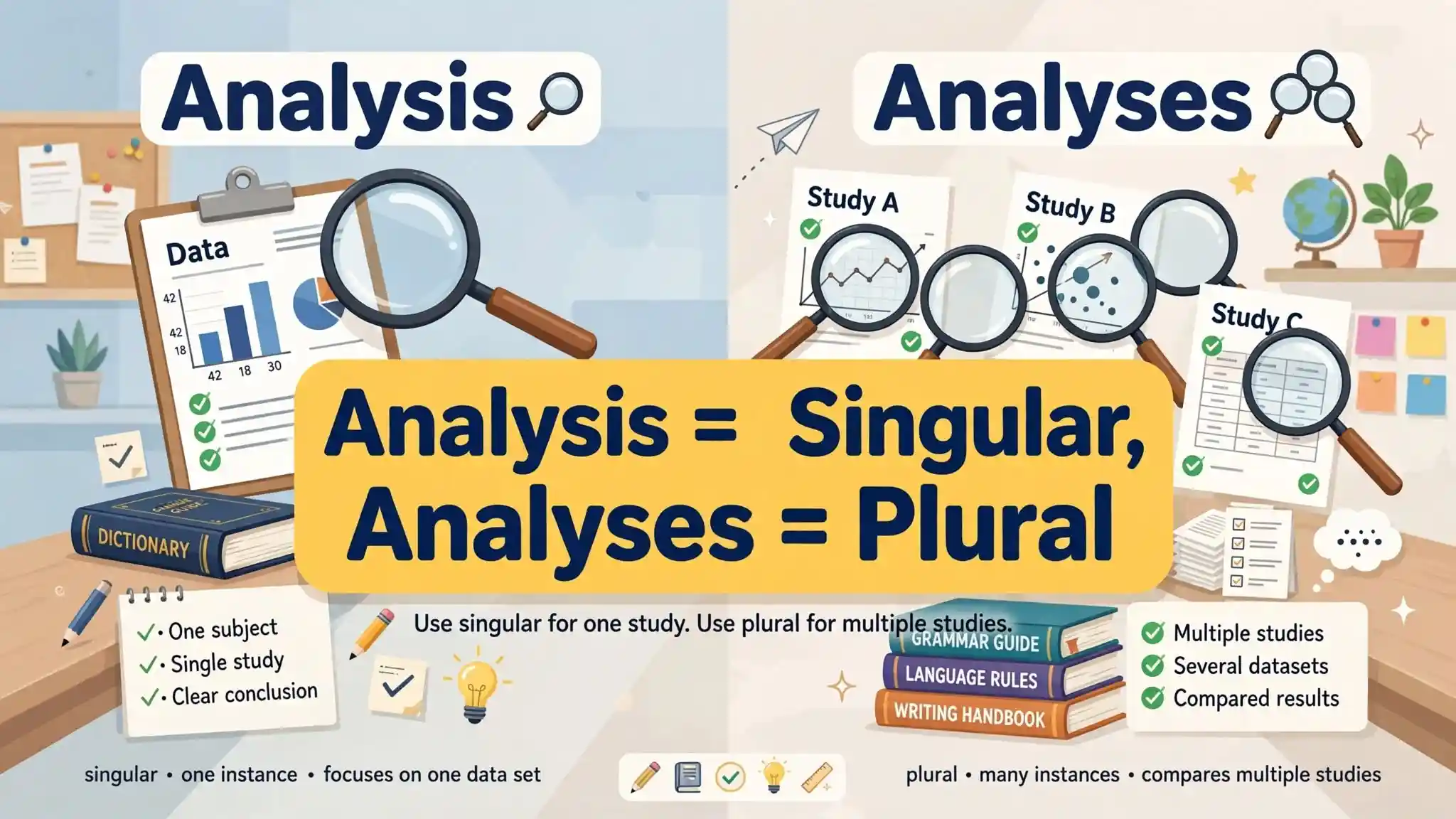
Analyses or analysis comes down to a simple count. Analysis is singular and means one careful examination, such as one study, one report, or one breakdown of a problem. Analyses is the plural and means two or more of those examinations. So you write “The analysis is finished” when there is one, and “The analyses are finished” when there are several.
This pair trips people up because English does not make this plural in the usual way. We normally add -s, so you might expect “analysises” or even “analysis” for both. Instead, the word follows an older Greek pattern, where -is at the end changes to -es. Add the fact that “analyses” is also a verb in British English, and it is easy to see why writers hesitate.
In this guide, you will learn the meaning of each word, where the plural comes from, how to pronounce both, and how to avoid the most common errors. The analysis or analyses choice is simple once you know the rule, and you will find tables, examples, a memory trick, practice questions, and FAQs below.
Analysis Meaning
Analysis is the process of breaking something into parts to understand it better. The word covers a whole range of work, from checking a spreadsheet to examining a poem. A good analysis looks at the structure, causes, patterns, or key features of its subject and then concludes.
- In research: examining collected data to find patterns and answer a question.
- In business: studying performance, costs, or markets to support a decision.
- In science and medicine: testing a sample, such as a blood analysis or a chemical analysis.
- In writing and literature: a close reading of a text, such as an analysis of a novel.
The analysis meaning stays the same in every field: take something apart so you can see how it works. It is a singular noun, so it takes a singular verb: “The analysis shows a clear trend.”
Analysis Meaning in Everyday Speech
Outside the lab, the meaning of analysis is looser. A sports commentator gives an analysis of a match, a mechanic gives an analysis of a strange engine noise, and a friend gives an analysis of a text message. In each case,, someone is breaking a situation into parts and explaining what they see, which is exactly what the Greek origin suggests.
Analyses Meaning
Analyses is the plural of analysis. Thananalyses’s meaning is simply “more than one examination.” It is used when a researcher, company, or writer has carried out several separate studies, or when you want to refer to a group of reports.
- “The team ran three separate analyses on the survey.”
- “Earlier analyses reached a different conclusion.”
Because it is plural, it takes a plural verb: “The analyses were reviewed.” In British English, analyses can also be a verb, which we cover below.
Analyses Meaning in Research
In research writing, the analyses meaning is especially precise: several separate tests, models, or checks run on one dataset or across many. A paper might report “primary analyses” (the planned tests) and “secondary analyses” (extra checks). Counting these correctly matters, because readers use the plural to judge how much work was done.
Analyses or Analysis: Key Differences
| Feature | Analysis | Analyses |
|---|---|---|
| Number | Singular | Plural |
| Meaning | One examination or study | Two or more examinations |
| Ending | -is | -es |
| Pronunciation | uh-NAL-uh-sis | uh-NAL-uh-seez |
| Verb agreement | The analysis is… | The analyses are… |
| Example | “Her analysis is detailed.” | “Their analyses differ.” |
The quick rule: one thing is analysis; more than one is analyses.
The Plural of Analysis and the Greek Pattern
The plural of analysis is analyses, and it follows a pattern shared by many words borrowed from Greek: the ending -is becomes -es.
| Singular | Plural |
|---|---|
| analysis | analyses |
| crisis | crises |
| thesis | theses |
| hypothesis | hypotheses |
| diagnosis | diagnoses |
| basis | bases |
| axis | axes |
| oasis | oases |
| parenthesis | parentheses |
| emphasis | emphases |
Once you know this pattern, you can work out the plural of analysis and of dozens of similar words without memorising each one. It also explains why “analysises” is always wrong: the word is not following the ordinary English -s or -es rule.
Where the Word Comes From
Analysis comes from the Greek word análysis, which means “a loosening” or “a breaking up.” It joins ana (up, throughout) and lysis (loosening). The idea is that you loosen a problem into its parts so you can study them, and that idea still shapes the analysis meaning today. English borrowed the word in the 1500s, and it kept its Greek-style plural. The same -lysis ending appears in words like paralysis and catalysis, and their plurals also end in -es: paralyses and catalyses.
How to Pronounce Analysis and Analyses
The spelling difference is small, but the sound difference helps you hear which word you need.
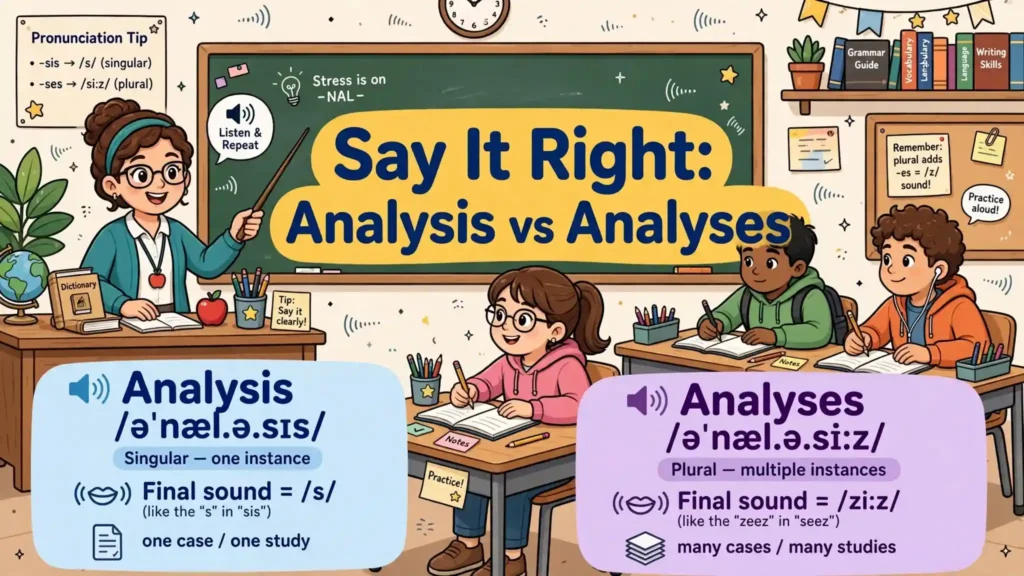
- Analysis: uh-NAL-uh-sis, with the last syllable like “sis.”
- Analyses (plural noun): uh-NAL-uh-seez, with the last syllable like “seez.”
- Analyses (British verb): AN-uh-lye-ziz, which rhymes with “analyzes.”
A tip: the plural noun ends with a long “ee” sound. If you hear “seez,” you are hearing the plural.
Analyses as a Verb in British English
Here is something many guides miss. In British English, the verb “to analyse” ends in -se, so the third-person form is “analyses.” In American English, the verb is “to analyze,” and the form is “analyzes.”
- British: “She analyses the figures every Monday.”
- American: “She analyzes the figures every Monday.”
This means the word “analyses” can be a plural noun or a British verb. Context makes it clear: “The analyses are complete” uses it as a noun, and “He analyses the data” uses it as a verb. The noun forms, analysis and analyses, are spelled the same in both varieties of English. Only the verb differs.
Data Analysis or Data Analyses
The phrases data analysis and data analyses follow the same rule, but with one extra twist.
- Data analysis is used for one overall examination of data, and also for the general field or skill: “Data analysis is a key skill for researchers.”
- Data analyses is used for several separate examinations or methods: “The paper reports three data analyses using different models.”
In a job advert or a school subject, the singular form names the field as a whole. When you describe specific tests run on a dataset, the plural is the right choice. The same applies to related terms: a single meta-analysis becomes two meta-analyses.
When Analysis Has No Plural
Analysis is sometimes uncountable, which means it names an activity in general rather than one specific study. In that case, you do not need a plural at all.
- “Careful analysis is the foundation of good research.”
- “The report spends little time on analysis and more on description.”
Here “analysis” means the general activity of analysing, so it stays singular. You only switch to analyses when you are counting separate pieces of work. A quick check: if you can put “a” or “one” in front of the word and it still makes sense, it is countable. If it only works with no article at all, you mean the general activity.
Analysis Synonyms
Depending on the context, you can replace analysis with another word. Each has a slightly different feel.
- Examination: a close look, often in detail.
- Evaluation or assessment: a judgement about quality or value.
- Investigation: a search for facts or causes.
- Study: a broader piece of research.
- Review: a look back at something that already exists.
- Breakdown: a division into parts, often used for numbers.
- Interpretation: an explanation of what the findings mean.
For the plural, simply make each one plural: examinations, evaluations, assessments, and so on.
Examples in Context
- Email: “Please review the analysis before Friday’s meeting.”
- Email, plural: “I have attached two analyses so you can compare the results.”
- News: “A new analysis shows rents rising faster than wages.”
- News, plural: “Several analyses published this week reach the same conclusion.”
- Academic: “The analysis supports the hypothesis.”
- Academic, plural: “Previous analyses did not control for age.”
- Social media: “Great analysis in this thread.”
- Workplace: “Our analyses of customer feedback will guide the next release.”
Possessive Forms
Possessives cause a second layer of confusion.
- Singular possessive: “The analysis’s main finding was surprising.” (Many writers also accept “analysis'” but “analysis’s” is more common.)
- Plural possessive: “The analyses’ conclusions agreed.”
If this feels clumsy, reword the sentence: “The main finding of the analysis was surprising.” That is often clearer.
Common Phrases With Analysis
- In the final analysis: when everything has been considered. “In the final analysis, the plan was too costly.”
- Paralysis by analysis: getting stuck because you think too much.
- Under analysis: being examined at present.
- Meta-analysis: a study that combines the results of several earlier studies.
How to Remember the Difference
Here are three quick tricks.
- Match the endings. Analysis ends with -is, like “this” (one). Analyses ends with -es, like “es” in “series” (many).
- Count first. Before you write either word, ask how many examinations you mean. One means analysis. More than one means analyses.
- Listen for “seez.” If the last sound is a long “ee,” it is the plural.
When you are unsure about analyses or analysis, count the studies and the answer follows.
Common Mistakes
Most errors in analyses or analysis come from the unusual plural.
- “This analyses shows the result.” Wrong. One study needs “analysis.”
- “We completed several analysis.” Wrong. Several needs the plural, “analyses.”
- “Analysises.” Wrong. The plural is not formed by adding -es to the whole word.
- “The analyses is complete.” Wrong verb agreement. Use “The analyses are complete.”
- “The analysis were reviewed.” Wrong. Use “The analyses were reviewed.”
- Pronouncing both words the same. The plural ends in “seez,” not “sis.”
Tricky Cases
A few analyses or analysis situations need extra care.
- Singular or plural verb: the field takes a singular verb, but several separate pieces of work take a plural verb.
- British “analyses” as a verb: do not mistake it for the noun. “She analyses” has a subject doing the action.
- Analysis of several things: if you do one combined study of many items, it is still one analysis. “An analysis of five datasets” is one study, while “five analyses of one dataset” is five studies.
- Names in titles: keep the original form in a title, such as “Meta-Analyses of Sleep Research.”
Quick Practice
Test your analyses or analysis skills. Fill in each blank with analysis or analyses.
- The ___ of the survey revealed three trends.
- Multiple ___ confirmed the same result.
- Their ___ disagrees with earlier findings.
- The lab ran five separate ___ on the sample.
- Careful ___ is the key to good research.
Answers: 1 analysis, 2 analyses, 3 analysis, 4 analyses, 5 analysis (uncountable).
FAQs
What is the difference between analyses andd analysis? Analysis is singular and means one examination. Analyses is plural and means two or more.
What is the plural of analysis? It is analyses.
Is “analysises” ever correct? No. The plural follows the Greek -is to -es pattern, not the usual English rule.
Is analyses used in both American and British English? Yes. The noun is the same in both. Only the verb differs: British “analyses” and American “analyzes.”
Is “data analysis” singular or plural? It is singular when it names the field or one examination. Use “data analyses” for several separate ones.
How do you pronounce analyses? The plural noun is uh-NAL-uh-seez. The British verb is AN-uh-lye-ziz.
Can I say “many analysis”? No. Use “many analyses.”
Whadoeshe analyses ” mean in simple words? It means more than one examination, such as several studies or tests.
Is analysis countable? Yes, when you mean separate studies. It is uncountable when you mean the general activity.
Conclusion
The analyses or analysis question is a matter of counting. One examination is an analysis, and more than one is analyses, following the Greek rule where -is becomes -es. Remember that the plural ends in a long “ee” sound, that the singular phrase names the field while the plural names several pieces of work, and that in British English “analyses” can also be a verb. Count what you mean, and the right word will follow.
