


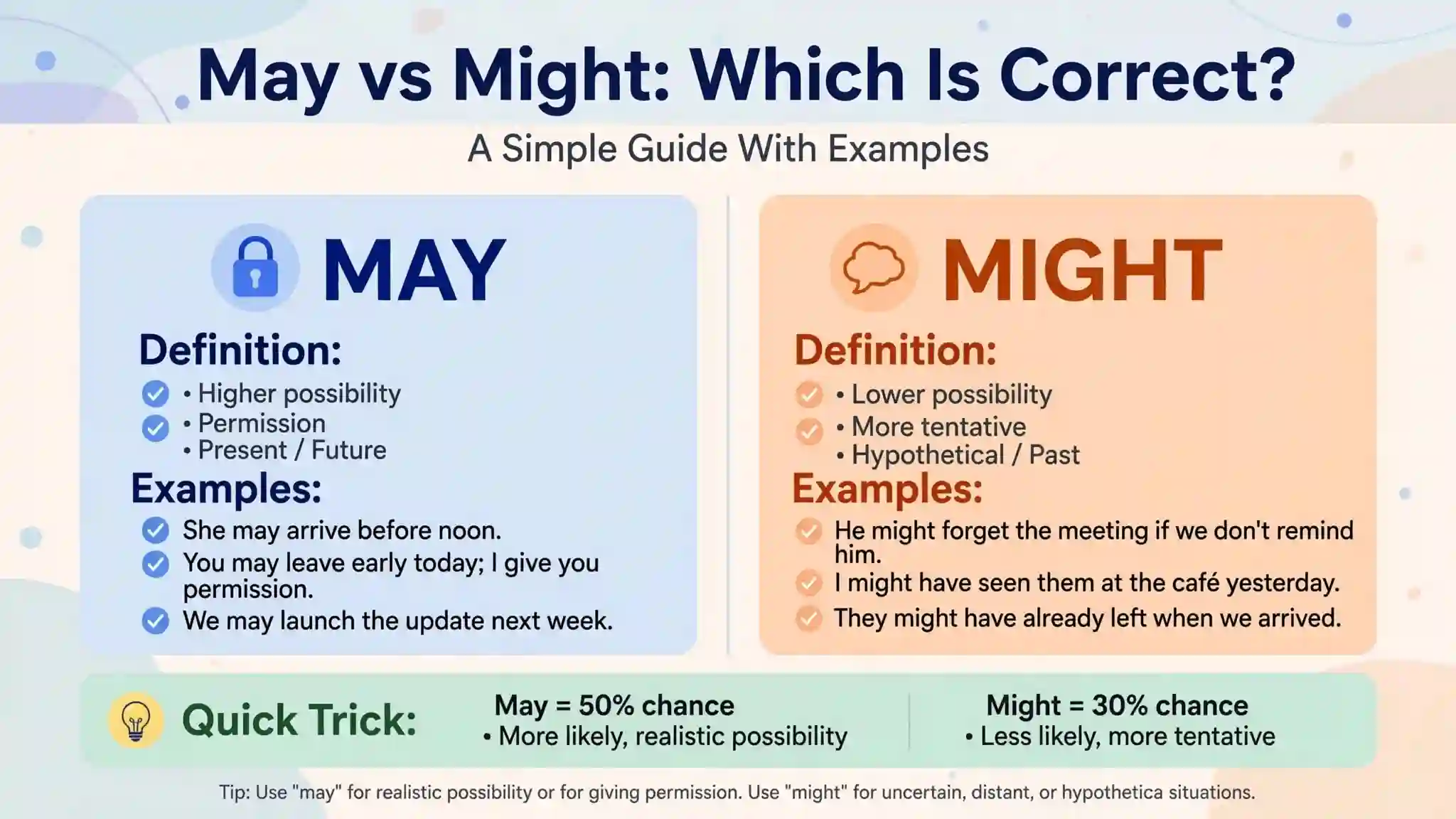
May vs might is a question about how sure you are and what kind of situation you are describing. Both words talk about possibility, but may is used for real, open possibilities and for permission, while might is used for weaker or less likely possibilities, for situations that did not happen, and for the past in reported speech. So “It may rain tomorrow” sounds like a genuine chance, and “It might rain, but I doubt it” sounds more doubtful.
The confusion is understandable. In many everyday sentences, the two words are almost interchangeable, and even careful writers swap them without anyone noticing. But there are cases where only one of them is correct, especially when you talk about something that did not happen, or when you ask for permission in a formal way.
In this guide, you will learn what each word means, how to choose between them, and how to avoid the mistakes that show up most often. The may vs might choice becomes simple once you know a few rules, and you will find tables, examples, a memory trick, practice questions, and FAQs below.
What Does May Mean?
May is a modal verb. It has three main jobs.
- Possibility: something could happen or be true. “The flight may be delayed.”
- Permission: you are allowed to do something, especially in formal speech. “You may leave when you have finished.”
- Wishes and blessings: a hope for someone. “May you have a long and happy life.”
May also appears in formal requests, such as “May I have your attention, please?” It is also the name of the fifth month of the year, but that is a separate word.
What Does Might Mean?
Might is also a modal verb, and it has its own jobs.
- Weaker or less likely possibility: “She might call, but she’s very busy.”
- Past form in reported speech: “He said he might join us later.”
- Unreal or imagined situations: “If I had left earlier, I might easily have caught the train.”
- Polite, tentative suggestions: “You might want to check the dates again.”
Might is also a noun meaning power or strength, as in “He pushed with all his might.” That noun is a different word from the modal verb, though they share the same spelling.
May vs Might: Key Differences
| Feature | May | Might |
| Main meaning | Real possibility, permission | Weaker possibility, unreal situations |
| Strength of chance | Often stronger | Often weaker |
| Permission | Yes, formal | Very formal and rare |
| Past reference | Possible past facts | Reported speech and things that did not happen |
| If-clauses about the past | Not used | Used |
| Example | “It may snow tonight.” | “It might snow, though I doubt it.” |
As a rough guide, may suggests a real chance and might suggests a smaller chance. This is not a strict rule, because both words are used flexibly in everyday English.
Both Are Modal Verbs
May and might belong to the group of modal verbs, which also includes can, could, will, would, shall, should, and must. Modal verbs follow a few fixed rules, and these rules apply to both words:
- They never take -s in the third person: “she may go,” not “she mays go.”
- They are followed by the base form of the verb: “he might arrive,” not “he might to arrive” or “he might arrives.”
- They do not have an -ing form or a to-infinitive.
- They form questions by moving the modal to the front: “May I sit here?” “Might it rain?”
Knowing that both are modal verbs makes them easier to use correctly.
Where the Words Come From
May comes from the Old English magan, which meant “to be able” or “to have power.” Might began as the past tense of may, from the Old English mihte. That history explains why might still works as the past form in sentences like “She said she might come.” Over time, might also developed its own meaning of a weaker or more remote possibility.
Possibility: Which One Should You Use?
For a present or future possibility, both words are usually correct.
- “The meeting may be postponed.”
- “The meeting might be postponed.”
The difference is mostly one of degree. Use may when the chance feels real or open, and might when it feels smaller or more doubtful. If you want to show strong doubt, you can add a word such as “just” or “only”: “It might just work.” In casual speech, many people use might for almost any possibility, and that is accepted.
Permission: May Is Preferred
For permission, may is the standard formal choice.
- “May I use your phone?”
- “Students may leave after the exam.”
In informal English, people often use can instead: “Can I use your phone?” Might is possible in very polite, old-fashioned requests, such as “Might I make a suggestion?” but in everyday writing it sounds stiff. If you want to ask permission and sound polite, may is safe.
Past Possibility: May Have vs Might Have
For possibilities about the past, you use a modal followed by the past participle. This is where the difference matters most.
- May talks about something that could be true, and you simply do not know yet. “He may have missed the bus.” (He possibly did, and we are not sure.)
- Might have can do the same job. But it can also describe something that did not happen: “Had he left earlier, he might just have caught it.” (He did not catch it.)
That second use is the key. When you talk about an unreal past situation, only might works. You cannot use may in “If he had left earlier, he ___ have caught the bus,” because the situation is imagined, not unknown.
Unreal and Imagined Situations
Might is the right choice for hypothetical and contrary-to-fact situations, especially in if-sentences.
- “If I had studied harder, I might have passed.”
- “She might well have been happier if she had stayed.”
In each case, the thing did not happen, so may is not suitable. This is the clearest rule in the whole topic, and it is the one most worth remembering.
Reported Speech and Sequence of Tenses
When you report what someone said in the past, might often replaces may.
- Direct: “I may visit next week,” she said.
- Reported: She said she might visit the following week.
This follows the normal pattern for past-tense reporting. However, if the possibility is still true now, you can keep may: “She says she may visit next week.” In casual speech, both are heard, but might is the more traditional choice after a past-tense verb.
May Not vs Might Not
The negative forms need care, because the first one can mean two different things.
- Permission: not allowed. “Visitors may not enter after nine.”
- Possibility: possibly not. “She may not come tonight.”
- With might: possibly not, and it is never about permission. “She might not come tonight.”
Because it can be unclear, writers often choose might not when they only mean possibility. For example, “He may not be home” could mean he is not allowed to be home, though context usually makes it clear. If there is any risk of confusion, use “is not allowed to” for permission.
The short form mightn’t doesn’t exist, mostly in British English: “She mightn’t know.” It is uncommon in writing. The old short form mayn’t is rarely used today.
May Be vs Maybe
This is a related mix-up that many people search for.
- May be is two words: a modal verb plus “be.” “It may be too late.”
- Maybe is one word, an adverb meaning “perhaps.” “Maybe it is too late.”
A quick check: if you can replace the word with “perhaps,” use maybe. If you can replace it with “could be,” use may be. “Maybe we should leave” works with perhaps. “We may be late” works with “could be.”
May Well and Might as Well
Two common phrases are worth knowing.
- May well means “quite likely”: “She may well win the prize.” It shows a higher chance than may alone.
- Might as well means “there is no good reason not to”: “We missed the bus, so we might as well walk.”
May vs Can
Many people also wonder how may relates to can. Both can express permission, but can usually means ability, and may is more formal for permission.
- “I can swim.” (ability)
- “May I swim here?” (permission, formal)
- “Can I swim here?” (permission, casual)
In everyday conversation, can for permission is widely accepted. In formal writing or when you want to sound polite, use may.
Examples in Context
- Possibility (may): “The package may arrive on Friday.”
- Possibility (might): “The package might arrive early, but don’t count on it.”
- Permission: “You may begin the exam now.”
- Wish: “May your journey be safe.”
- Past possibility: “She may well have forgotten the keys.”
- Unreal past: “She might even have won if she had practised more.”
- Reported speech: “He told me he might be late.”
- Polite suggestion: “You might want to arrive early.”
- Negative possibility: “It might not rain after all.”
How to Remember the Difference
Here are three quick tricks.
- Think “real vs remote.” May is for real, open chances. Might is for remote, unlikely, or imagined ones.
- Ask whether it happened. If the situation did not happen, use might. If you simply do not know, either word works.
- Think of permission as may. “May I?” is the polite classic, so permission belongs to may.
Whenever you are unsure about may vs might, ask yourself whether the situation is real, unknown, or imagined. Real or unknown allows may. Imagined needs might.
Common Mistakes
Most mistakes in may vs might involve unreal situations and negatives.
- “If I had known, I may have helped.” Wrong. The situation is imagined, so use “might” instead.
- “She mays come.” Wrong. Modal verbs never take -s: “She may come.”
- “He might to leave.” Wrong. Modal verbs are followed by the base verb with no “to”: “He might leave.”
- Confusing a ban with a guess. If you only mean possibility, use might not instead.
- “Maybe be late.” Wrong. Use “may be late” when “may” is the verb.
- “May of” or “might of.” Wrong. This comes from a sound-alike error. Use “may have” or “might have.”
Tricky Cases
A few may vs might situations need extra care.
- Strong doubt: “It might work” shows more doubt than “it may work.”
- Mild criticism: “You might at least have called!” shows mild complaint about something that did not happen.
- Formal documents: legal and official writing uses may for permission and shall or must for duty. “The tenant may sublet” gives permission, while “must” would make it required.
- Hedging in research: writers often use may or might to avoid overclaiming. “The results may suggest” is more cautious than “the results show.”
Quick Practice
Test your may vs might skills. Choose the best word for each blank. In some sentences both work.
- ___ I borrow your pen? (permission)
- If she had called, I ___ have answered.
- It ___ rain this evening, so take an umbrella.
- He said he ___ attend the meeting.
- Students ___ not use phones during the test.
- We ___ as well leave now.
Answers: 1 may, 2 might, 3 may or might, 4 might, 5 may (not allowed), 6 might (or may).
FAQs
What is the difference between may vs might?
May expresses real possibility and permission. Might expresses a weaker possibility, unreal situations, and the past in reported speech.
Can I use may and might interchangeably?
Often yes, for present and future possibility. Not for imagined past situations, where only might works.
Which is more polite, may or might?
May is the standard polite choice for permission. Might I is very formal and sounds old-fashioned.
Is “may have” or “might have” correct?
Both are correct. Use the first when you do not know what happened, and the second for things that did not happen.
What does “may not” mean?
It can mean “not allowed” or “possibly not.” Prefer might when you only mean possibility.
Are may and might modal verbs?
Yes. They never take -s, they are followed by a base verb, and they have no -ing form.
What is the difference between maybe and may be?
Maybe is an adverb meaning perhaps. May be is the verb may plus “be.”
Is “might” ever a noun? Yes. It means strength or power, as in “with all his might.”
Conclusion
The may vs might question comes down to how real the situation is. Use may for real possibility and for permission. Use might for weaker possibility, for reported speech, and above all for situations that never happened. Remember that both are modal verbs with no -s and no “to,” that the past forms fit unknown facts with may and imagined ones with might, and that maybe is one word while may be is two. When you are unsure, ask whether the situation is real, unknown, or imagined, and the right word will follow.
