


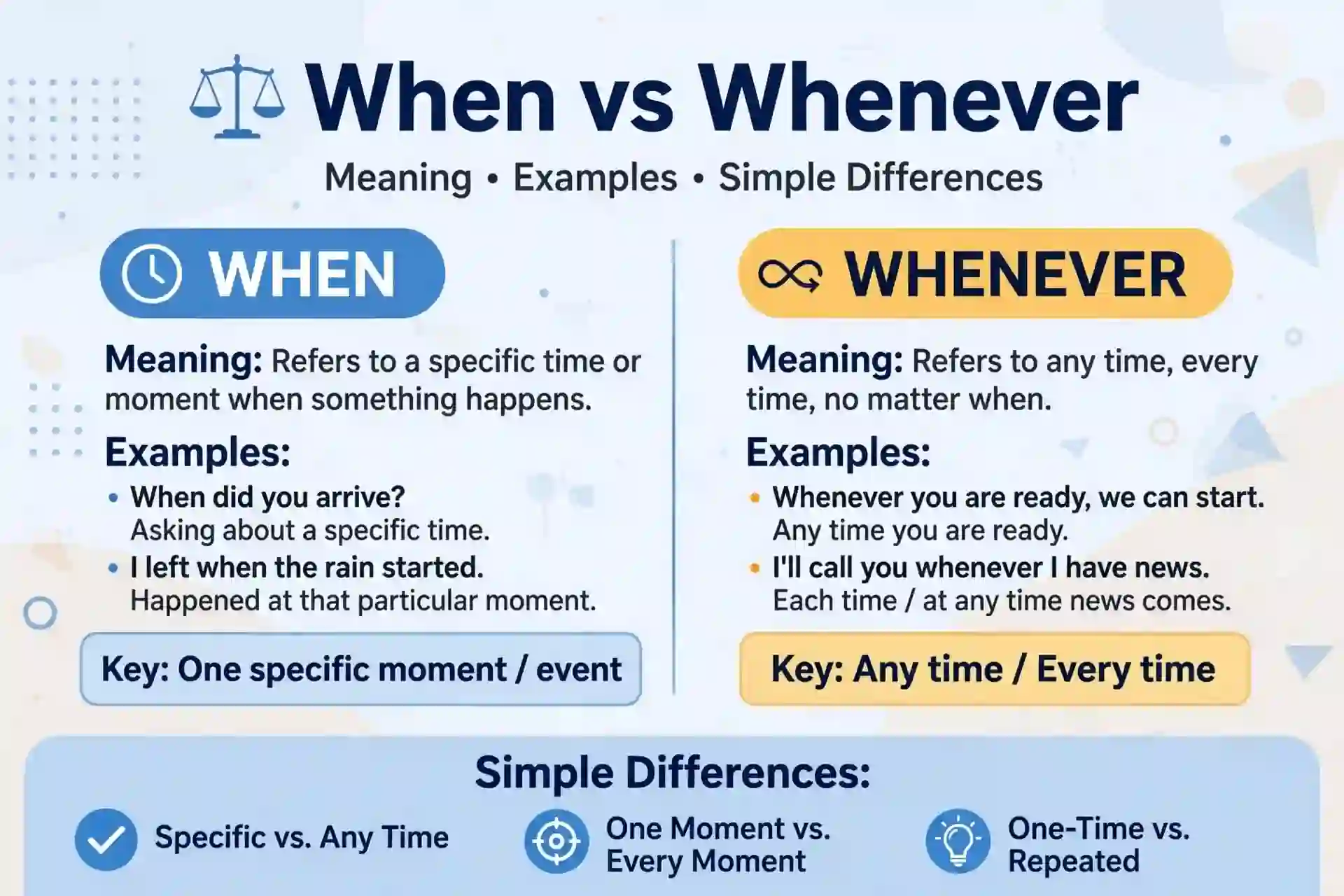
When it comes to English grammar, small words can create big differences in meaning. when vs whenever are two common words that often confuse English learners. Both words relate to time, but they do not always work in the same way. Knowing the difference can help you speak and write more clearly.
The word when usually points to a particular time, event, or situation. Whenever often refers to any time something happens or every time a condition occurs. Their meanings can overlap, but their uses depend on the sentence.
What Does When Mean?
The word when is commonly used to ask about time or connect two events. It helps readers understand when something happens, happened, or will happen. It can refer to a specific moment, period, or situation.
For example:
- When does your class start?
- Call me when you arrive.
- I was sleeping when the phone rang.
- Do you remember when we first met?
In each sentence, when connects an action with a time or asks about the timing of an event.
When as a Question Word
People use when to ask questions about time. It helps them find out the date, hour, or moment of an event.
Examples:
- When is your birthday?
- When will the meeting begin?
- When did you finish your homework?
- When are you planning to travel?
- When does the store close?
These questions expect an answer about time. Someone might reply with a date, an hour, or a general period.
For example:
Question: When does the movie start?
Answer: It starts at 7:30 p.m.
Here, when asks for the exact time of the movie.
When as a Connecting Word
When also joins two parts of a sentence. It explains the relationship between two events.
Examples:
- I smiled when I saw my friend.
- She was cooking when I arrived.
- We will eat when everyone gets here.
- He called me when he reached home.
In these examples, one action happens at the same time as another or follows it.
When for Past, Present, and Future Events
You can use when with different verb tenses. The tense depends on the time of the event.
- Past: I felt happy when I received the gift.
- Present: I feel relaxed when I listen to music.
- Future: I will call you when I reach the office.
What Does Whenever Mean?
The word whenever means “at any time,” “every time,” or “no matter when.” It refers to an unspecified time or repeated situation.
People use it when the exact time does not matter or when something can happen at different times.
Examples:
- You can visit whenever you want.
- Whenever I hear this song, I remember my childhood.
- Call me whenever you need help.
- She smiles whenever she sees her dog.
Whenever for Any Time
One common use of whenever is to give someone freedom to choose a time. It does not set a fixed date or hour.
Examples:
- Come whenever you are free.
- You can start whenever you feel ready.
- Visit us whenever you have time.
- Send the documents whenever you can.
- We can meet whenever it suits you.
In these examples, the speaker does not require a specific time. The other person can choose a suitable moment.
Whenever for Repeated Events
You can also use whenever to describe something that happens every time another event occurs.
Examples:
- Whenever it rains, the roads become slippery.
- I feel hungry whenever I exercise.
- He laughs whenever he watches that show.
- Whenever she visits us, she brings flowers.
- My dog barks whenever someone knocks on the door.
Here, whenever shows a repeated connection between two events.
Whenever to Show No Time Restriction
Sometimes, whenever means that timing does not matter. It gives a sentence a flexible or open meaning.
Examples:
- You can ask me whenever you have a question.
- I will support you whenever you need me.
- The library welcomes visitors whenever it is open.
- You may contact the team whenever necessary.
This use appears in friendly conversations, instructions, invitations, and professional communication.
When vs Whenever: What Is the Main Difference?
The main difference between these words is how they describe time. When usually identifies or asks about a time. Whenever refers to any time or every time an event happens.
Both words can introduce time clauses. However, they do not always communicate the same idea.
| Feature | When | Whenever |
| Main meaning | At what time or at the time that | At any time or every time |
| Time reference | Often specific or connected to an event | Usually flexible or repeated |
| Question use | Yes | Rarely used for direct time questions |
| Repeated actions | Possible | Very common |
| Time flexibility | May suggest a particular time | Often suggests freedom |
| Example | Call me when you arrive. | Call me whenever you need help. |
Difference in Meaning
Consider these two sentences:
Sentence 1: Call me when you arrive.
This sentence connects the phone call with a particular event. The speaker expects a call after the person arrives.
Sentence 2: Call me whenever you arrive.
This sentence sounds less natural in many everyday contexts if the speaker means a single planned arrival. However, it can suggest that the person may call at any arrival time, especially when arrivals happen repeatedly or at different possible times.
A more natural example is:
“Call me whenever you want.”
This gives the listener freedom to choose the time.
Difference in Time Flexibility
When can point to a planned or expected event. Whenever often removes the need for a fixed time.
Compare:
- Tell me when you are ready.
- Tell me whenever you are ready.
Both are correct. The second sounds more flexible and relaxed.
When vs Whenever: Examples in Everyday English
The best way to understand grammar is to see how people use words in real situations. These examples show how the meaning changes depending on the word you choose.
Examples in Daily Conversations
People use both words in everyday conversations with friends, family, and coworkers.
Examples with when:
- When are you coming home?
- Let me know when you finish work.
- I was happy when I saw you.
- When does your school reopen?
- We can talk when you have time.
Examples with whenever:
- Visit me whenever you like.
- Call whenever you feel lonely.
- I drink tea whenever I feel tired.
- Whenever I travel, I take pictures.
- You can sit wherever you feel comfortable.
The final example uses wherever, not whenever. It shows why you should pay attention to the meaning of each word.
Examples at Work and School
Both words also appear in professional and educational settings.
| With When | With Whenever |
| Submit the form when you finish. | Submit the form whenever you are ready. |
| Tell me when the meeting starts. | Contact me whenever you need support. |
| Ask questions when the lesson ends. | Visit the office whenever necessary. |
| I study when I get home. | I review my notes whenever I have free time. |
The first column often connects an action with a particular event. The second column often allows flexibility or describes repeated actions.
Examples in Questions
When is the natural choice for most direct questions about time.
Examples:
- When will you visit us?
- When did the event happen?
- When is your next exam?
- When should I call you?
- When does the train leave?
Whenever can appear in questions that ask about a flexible or repeated time.
Examples:
- Whenever do you get the chance to relax?
- Do you visit your grandparents whenever you can?
- Can I call you whenever I need advice?
The first example sounds unusual in standard everyday English. A more natural version is, “When do you get the chance to relax?” Use whenever mainly in statements or questions about repeated or unrestricted situations.
Grammar Rules for Using When and Whenever
Both words can introduce dependent clauses. These clauses add information about the time or circumstances of an action. Understanding their grammar makes it easier to use them correctly.
Rule 1: Use When for a Particular Event
Use when when you want to connect an action to a particular event or moment.
Examples:
- I will text you when I get home.
- She started crying when she heard the news.
- We left when the rain stopped.
Each sentence links an action to another event.
Rule 2: Use Whenever for Any Suitable Time
Use whenever when the exact time is not important or someone can choose the time.
Examples:
- You can visit whenever you want.
- Start the project whenever you are ready.
- Call me whenever you need assistance.
These sentences do not require a fixed time.
Rule 3: Use Whenever for Repeated Situations
Use whenever when something happens each time a condition occurs.
Examples:
- Whenever I see him, he waves.
- She drinks water whenever she feels thirsty.
- Whenever the alarm rings, the dog barks.
The word shows a repeated relationship between two actions.
Rule 4: Use Present Simple in Future Time Clauses
English usually uses the present simple after when and whenever when the clause refers to the future.
Correct:
- I will call you when I arrive.
- You can start whenever you feel ready.
- We will leave when the guests arrive.
Incorrect:
- I will call you when I will arrive.
- You can start whenever you will feel ready.
The main clause can use will, but the time clause normally uses the present simple.
Rule 5: Use Commas When Needed
Punctuation depends on the position of the time clause.
When the time clause comes first, use a comma before the main clause.
Examples:
- When I finish work, I will call you.
- Whenever she visits, we prepare dinner.
When the main clause comes first, a comma is usually unnecessary.
Examples:
- I will call you when I finish work.
- We prepare dinner whenever she visits.
These punctuation rules help readers understand the sentence structure.
Common Mistakes When Using when vs whenever
English learners sometimes use these words interchangeably. Their meanings can overlap, but the wrong choice may change the message or make a sentence sound unnatural.
Mistake 1: Using Whenever for a Direct Time Question
Incorrect: Whenever is your birthday?
Correct: When is your birthday?
Use when to ask for the date or time of an event. Whenever does not normally replace when in direct questions.
Mistake 2: Using When Instead of Whenever for Repeated Actions
Consider this sentence:
“I smile when I hear my favorite song.”
This sentence is correct. However, if you want to emphasize that you smile every time you hear it, you can say:
“I smile whenever I hear my favorite song.”
The second sentence makes the repeated meaning clearer.
Mistake 3: Adding Will After When or Whenever
Incorrect: I will help you whenever you will need me.
Correct: I will help you whenever you need me.
English normally uses the present simple in future time clauses. Avoid adding will after these time words when the clause refers to a future event.
Mistake 4: Forgetting the Meaning of the Sentence
Some learners focus only on grammar rules. They forget to consider the message.
Compare:
- I will visit you when I have free time.
- I will visit you whenever I have free time.
The first sentence can suggest a future visit when free time becomes available. The second places more emphasis on visiting at any available opportunity.
When Can You Use When and Whenever Interchangeably?
In some sentences, both words work correctly. Their meanings may overlap, but they can create slightly different emphasis.
For example:
- I feel happy when I see my family.
- I feel happy whenever I see my family.
Both sentences are correct. The first connects happiness with seeing family. The second emphasizes that the feeling happens every time.
Another example:
- Call me when you need help.
- Call me whenever you need help.
Both sentences are natural. The second sounds more open and flexible. It tells the listener that they can call at any time they need help.
Situations Where Both Words Work
You can often use either word when:
- You describe a repeated feeling or reaction.
- You connect an action with a common situation.
- You give someone permission to contact you.
- The exact time is not important.
- You describe a habit or regular activity.
However, the choice depends on the message you want to communicate.
Situations Where They Are Not Interchangeable
Some sentences need one word rather than the other.
| Sentence | Correct Choice | Reason |
| ___ is your appointment? | When | Asks for a specific time |
| Visit me ___ you like. | Whenever | Gives time freedom |
| ___ did you arrive? | When | Asks about a past event |
| I smile ___ I see her. | Both | The second can emphasize every time |
| Call me ___ you need help. | Both | Both can express a suitable time |
Simple Tips to Remember the Difference
Learning grammar becomes easier when you remember a few simple rules. You do not need to memorize complicated definitions to choose the correct word.
Use these practical tips:
- Remember “what time”: If you are asking about a date, hour, or moment, use when.
- Remember “any time”: If someone can choose the time, use whenever.
- Think about repetition: If an action happens every time another event occurs, whenever is often the better choice.
- Check the sentence meaning: Ask yourself whether you mean a particular event or an unrestricted time.
- Read your sentence aloud: Listen for the meaning and natural flow.
- Practice with examples: Write short sentences about your daily routine using both words.
Frequently Asked Questions (FAQs)
What is the main difference between when and whenever?
When usually refers to a particular time or event. Whenever means at any time or every time something happens. The correct choice depends on whether you mean a specific event, a flexible time, or a repeated situation.
Can I use whenever instead of when?
Yes, you can use both words in some sentences. For example, “Call me when you need help” and “Call me whenever you need help” are both correct. However, whenever adds a stronger sense of flexibility.
Is whenever a formal or informal word?
Whenever works in both formal and informal English. You can use it in everyday conversations, professional emails, academic writing, and instructions. Its meaning stays the same across these settings.
Does whenever mean every time?
Yes. Whenever can mean “every time” when you describe repeated actions or situations. For example, “Whenever I visit my grandmother, she makes my favorite meal” means she does this each time you visit.
Can whenever be used in a question?
Yes, but it is not usually used to ask directly about a specific time. For example, “When is the meeting?” is natural. You can use whenever in questions about repeated or flexible situations, such as “Can I visit whenever I want?”
Which word should beginners learn first?
Beginners should learn when first because it appears in common time questions and sentences. They can then learn whenever to express flexibility and repeated events.
Conclusion: When vs Whenever
Understanding the difference between these two words can improve your English speaking and writing. Both relate to time, but they express different ideas.When usually asks about a particular time or connects an action with an event. You can use it for past, present, and future situations. It is also the natural choice for direct questions about time.
Whenever means “at any time” or “every time.” It gives people more freedom to choose a time. It also describes repeated actions, habits, and situations that happen under the same condition.The easiest way to remember When vs Whenever is to think about the meaning you want to express. Use when for a time or event. Choose whenever when you mean any time or every time.
