


When it comes to English grammar, small words can create big confusion. You To or You Too is a common question among people who write messages, emails, social media posts, and everyday conversations. Both phrases sound almost the same, but they have different meanings and uses. One can show direction or connect an action to a person. The other adds the meaning of “also” or “as well.” Choosing the correct phrase helps you write clear sentences and avoid common grammar mistakes.
You To or You Too: What Is the Difference?
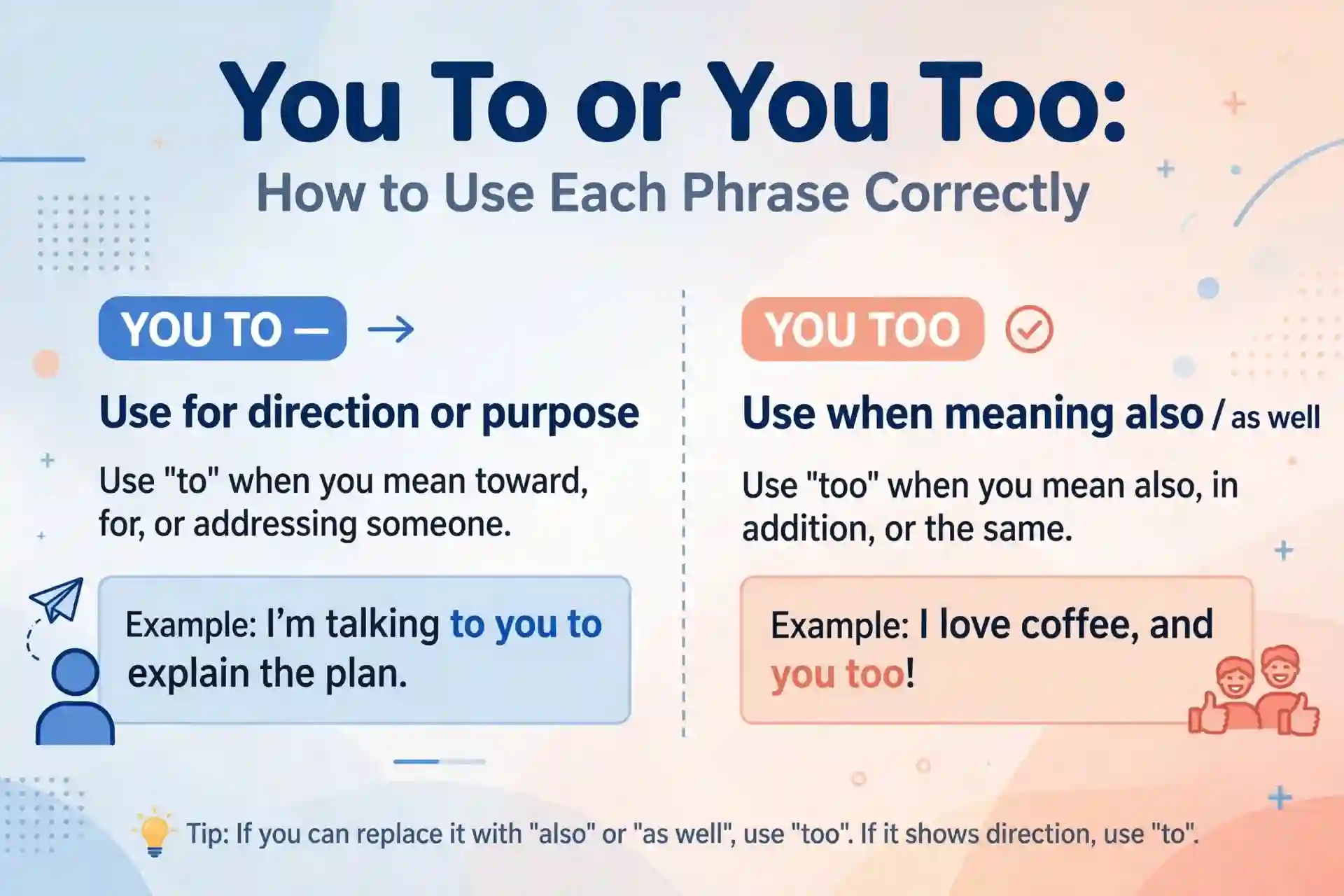
The main difference between these phrases comes from the words “to” and “too.” One shows direction or purpose, while the other means also or more than needed.
You To uses the word “to” as a preposition or part of an infinitive. It connects a person with an action, place, or purpose. For example, “I want to talk to you.”
You Too uses “too” to mean also or as well. It often appears when someone shares the same feeling, action, or situation. For example, “I love you too.”
Both phrases are correct in English. The right choice depends on the meaning of your sentence.
| Phrase | Meaning | Example |
| You to | Direction, connection, or action | I sent the message to you. |
| You too | Also or as well | I miss you too. |
The easiest way to understand the difference is to look at the role each word plays.
What Does “You To” Mean?
“You to” usually appears when the word “to” connects an action with a person. It can show who receives something or who takes part in an action.
Consider these examples:
- I want to speak to you.
- She gave the invitation to you.
- It is important to listen to you.
- I need to explain this to you.
- Can I come to you tomorrow?
In these sentences, “to” helps connect the action with the person.
The phrase does not usually work alone as a complete expression. It needs other words to make the sentence clear.
What Does “You Too” Mean?
“You too” means “you also” or “you as well.” People use it to agree, return a kind wish, or show that another person shares the same experience.
Here are some examples:
- I miss you too.
- Have a wonderful day! You too!
- I love you too.
- I am happy for you too.
- It was nice meeting you too.
The word “too” adds another person or thing to an existing idea.
For example, if someone says, “I am excited about the trip,” you can reply, “Me too!” You can also say, “I am excited too.”
When Should You Use “You To”?
Use “you to” when the sentence needs the preposition “to” or the infinitive marker “to.” It often follows verbs that involve speaking, giving, sending, or explaining.
You To or You Too becomes easier to understand when you identify the action in the sentence. If the sentence shows direction toward someone, “to” is usually the correct choice.
1. When Showing Direction
Use “to” when an action moves toward a person or place. It can show who receives something or where someone directs an action.
Examples:
- I sent the package to you.
- He passed the ball to you.
- She brought the documents to you.
- I will forward the email to you.
- They gave the responsibility to you.
Each sentence shows movement, delivery, or transfer toward another person.
2. When Talking About Communication
Many communication verbs use “to” before the person receiving the message. These verbs include talk, speak, explain, write, and listen.
Examples:
- I want to talk to you.
- She needs to speak to you.
- Can I explain this to you?
- I wrote a letter to you.
- He was listening to you carefully.
The word “to” connects the communication action with its listener or receiver.
3. When Expressing a Plan or Request
Use “to” before a base verb when you describe an intention, plan, or request. This use is called an infinitive.
Examples:
- I want you to understand.
- She needs you to help her.
- They expect you to arrive early.
- I would like you to join us.
- We need you to complete the task.
Notice that these sentences do not use the exact phrase “you to” in the same way as “talk to you.” Here, “you” comes before the infinitive verb.
This is another important use of the word “to” in English grammar.
When Should You Use “You Too”?
Use “you too” when you want to say that something applies to another person as well. It works well in friendly conversations, text messages, greetings, and everyday replies.
The phrase is especially common when someone gives you a compliment, wish, or kind message.
1. When Returning Good Wishes
People often use “you too” to return a friendly wish. It makes conversations natural and polite.
Examples:
- Have a great weekend! You too!
- Enjoy your holiday! You too!
- Have a nice evening! You too!
- Good luck with your exam! You too!
- Take care! You too!
The phrase means that you wish the same thing for the other person.
2. When Sharing Feelings
Use “too” when you feel the same way as someone else. It shows agreement or shared emotions.
Examples:
- I miss you too.
- I love you too.
- I am excited too.
- I feel the same way too.
- I am happy to see you too.
In each example, “too” adds your feelings to the situation.
3. When Agreeing With Someone
“You too” can also work as a short reply when someone shares an opinion or experience.
Examples:
- “I enjoyed the movie.” “Me too!”
- “I am tired today.” “You too?”
- “I like this song.” “I like it too.”
- “I want to visit that place.” “Me too!”
Remember that “you too” and “me too” do not always mean the same thing.
“You too” refers to the other person. “Me too” refers to yourself. Choose the phrase that matches the meaning you want to express.
You To or You Too in Texting and Social Media
Text messages and social media make these phrases even more important. People often write short replies without checking their grammar. A small spelling mistake can change the meaning of a message.
In casual conversations, both phrases appear frequently. Your choice should depend on what the other person says and what you want to communicate.
Common Texting Examples
Here are some everyday situations that show the correct usage.
| Situation | Correct phrase | Example |
| Returning affection | You too | I love you too ❤️ |
| Sending a message | To you | I sent it to you. |
| Returning a greeting | You too | Good morning! You too! |
| Asking to speak | To you | I need to talk to you. |
| Sharing feelings | You too | I miss you too. |
| Giving something | To you | This gift is for you. |
These examples show why context matters more than pronunciation.
Short Replies in Online Conversations
Short replies are common on platforms such as Instagram, Facebook, WhatsApp, and TikTok.
You might see messages like:
- “Happy birthday!” — “Thank you! You too!”
- “I hope you feel better.” — “Thank you. You too!”
- “I want to tell you something.” — “What do you want to tell me?”
- “Sending hugs to you!” — “Hugs to you too!”
The correct phrase keeps your message clear.
Why Context Matters in Text Messages
Some sentences sound similar when spoken. This can make it hard to identify the correct spelling.
For example:
- “I want to come to you.”
- “I want you too.”
The first sentence describes a desire to visit someone. The second means that you want that person as well.
The words may sound alike, but their meanings are different. Read the full sentence before choosing your spelling.
You To or You Too: Common Grammar Mistakes
Many English learners confuse these phrases because they have similar sounds. Some native speakers also make typing mistakes, especially when writing quickly.
Understanding a few common errors can help you avoid them.
1. Writing “Too” Instead of “To”
This mistake happens when someone uses “too” to show direction or connection.
Incorrect: I want to talk too you.
Correct: I want to talk to you.
The sentence needs “to” because it connects the action of talking with the person receiving the communication.
2. Writing “To” Instead of “Too”
This error often appears in affectionate messages and friendly replies.
Incorrect: I miss you to.
Correct: I miss you too.
The sentence expresses the same feeling. Therefore, “too” is the correct word.
3. Confusing “You Too” With “Me Too”
These phrases have different subjects.
- “Me too” means I feel the same way.
- “You too” means the same applies to you.
Example:
Person A: “I am excited about the concert.”
Person B: “Me too!”
Now consider this conversation:
Person A: “Have fun at the concert!”
Person B: “You too!”
The second reply works when both people can enjoy the same activity.
4. Using Both Words Without Checking the Meaning
Some writers choose a word based on how it sounds. This can create confusing sentences.
Incorrect: I sent this message too you.
Correct: I sent this message to you.
Incorrect: I want to see you to.
Correct: I want to see you too.
Always check whether you mean direction or addition.
Easy Ways to Remember the Difference
You do not need to memorize complicated grammar rules to choose the right word. A few simple tricks can help you remember the difference.
These methods work for students, professionals, and anyone who wants to improve everyday writing.
1. Replace “Too” With “Also”
If the word “also” fits your sentence, use “too.”
Examples:
- I miss you too.
- I also miss you.
Both sentences express the same idea.
Another example:
- I want to join you too.
- I also want to join you.
The meaning stays almost the same.
2. Replace “To” With “Toward”
If the sentence shows direction toward someone or something, “to” may be correct.
Examples:
- I am coming to you.
- I am walking toward you.
- She sent the letter to you.
This trick works for many prepositional uses of “to.” It does not apply to every infinitive use.
3. Remember the Extra Letter
The word “too” has an extra letter “o.” Think of that extra letter as adding something.
For example:
- I like tea too.
- She wants to come too.
- I enjoyed the show too.
This simple memory trick can help you remember that “too” often means something extra or additional.
4. Read the Sentence Aloud
Reading your sentence aloud can help you notice its intended meaning. Ask yourself whether you are connecting an action to someone or adding another person to an idea.
For example:
- “I want to send this to you.” This describes an action.
- “I want this too.” This adds another desire.
A quick review can prevent many spelling mistakes.
More Examples of You To or You Too in Everyday English
Real-life examples make grammar rules easier to understand. The following sentences show how these phrases work in different situations.
Examples Using “To You”
Use these sentences when you want to show direction, communication, or connection.
- I have something important to tell you.
- This invitation belongs to you.
- I want to send a picture to you.
- She explained the rules to you.
- We are coming to you after lunch.
- I need to return this book to you.
- He wants to introduce himself to you.
- I promised to give the information to you.
- Can I speak to you for a minute?
- This message is addressed to you.
Examples Using “You Too”
Use these sentences when you want to express addition or return a kind message.
- I hope you have a great day too.
- I enjoyed talking to you too.
- You look amazing today too.
- I would love to visit that place too.
- I am glad you came too.
- I wish you success too.
- I appreciate your support too.
- I had a wonderful time with you too.
- You are always in my thoughts too.
- I hope everything goes well for you too.
Examples in Questions
Both phrases can also appear in questions. The meaning depends on the sentence structure.
Using “to you”:
- Can I talk to you?
- Is this letter addressed to you?
- Did she send the invitation to you?
- What does this mean to you?
Using “you too”:
- Are you coming too?
- Do you want to join us too?
- Did you enjoy the event too?
- Are you feeling tired too?
These examples show that neither phrase belongs to only one type of sentence.
Other Words That Sound Like “To” and “Too”
English has several words that sound alike but have different meanings. These words are called homophones. Learning them can improve your spelling and writing skills.
To, Too, and Two
These three words have similar pronunciations but different meanings.
| Word | Meaning | Example |
| To | Direction or infinitive marker | I went to school. |
| Too | Also or excessively | I want to go too. |
| Two | The number 2 | I have two books. |
The word “two” refers to a number. It does not replace either “to” or “too.”
More Examples of Common Homophones
Other English homophones can also cause confusion.
- There: Refers to a place. Example: Put your bag there.
- Their: Shows ownership. Example: Their house is beautiful.
- They’re: Short for “they are.” Example: They’re coming today.
- Your: Shows ownership. Example: Your phone is ringing.
- You’re: Short for “you are.” Example: You’re very kind.
- Its: Shows ownership. Example: The dog wagged its tail.
- It’s: Short for “it is” or “it has.” Example: It’s raining.
Learning these word pairs can make your writing more accurate and professional.
Frequently Asked Questions
Here are answers to common questions about the correct spelling and use of these phrases.
Is It “You To” or “You Too”?
Both phrases are correct. “You to” appears when “to” connects an action with a person or introduces an infinitive. “You too” means you also or you as well. Choose the phrase based on the sentence’s meaning.
Should I Say “I Love You To” or “I Love You Too”?
The correct expression is “I love you too.” It means that you return the same feeling. The word “too” adds your feelings to the conversation. Writing “I love you to” is incorrect in this context.
Is “Thank You Too” Correct?
Yes, “thank you too” can be correct when you want to thank someone in return. For example, if someone thanks you for your help, you can reply, “Thank you too.” However, “You’re welcome” may sound more natural in many situations.
What Does “You Too” Mean in a Text Message?
In texting, “you too” usually means “the same to you.” People use it to return greetings, wishes, compliments, and feelings. For example, if someone says, “Have a wonderful day,” you can reply, “You too!”
Why Do People Confuse “To” and “Too”?
People confuse these words because they sound exactly the same in most English accents. Fast typing also causes spelling mistakes. Learning their meanings and checking the sentence context can help you choose the correct word.
Can “To You” and “You Too” Appear in the Same Sentence?
Yes. Both expressions can appear in one sentence when they serve different purposes. For example, “I want to give this gift to you too.” Here, “to” shows the receiver, while “too” means also.
Final Thoughts
Understanding You To or You Too does not require advanced grammar knowledge. You only need to remember the meaning of each word. Use “to” when you show direction, connection, or an action. Use “too” when you mean also or as well.The easiest trick is to replace “too” with “also.” If the sentence still makes sense, “too” is likely the right choice. You can also check whether “to” connects an action with a person.
Both phrases play an important role in everyday English. You will see them in text messages, emails, conversations, and social media posts. A little attention to context can help you avoid spelling mistakes and communicate more clearly.Practice with simple sentences and review your writing before sending it. These small habits will help you use English more confidently and naturally.
