


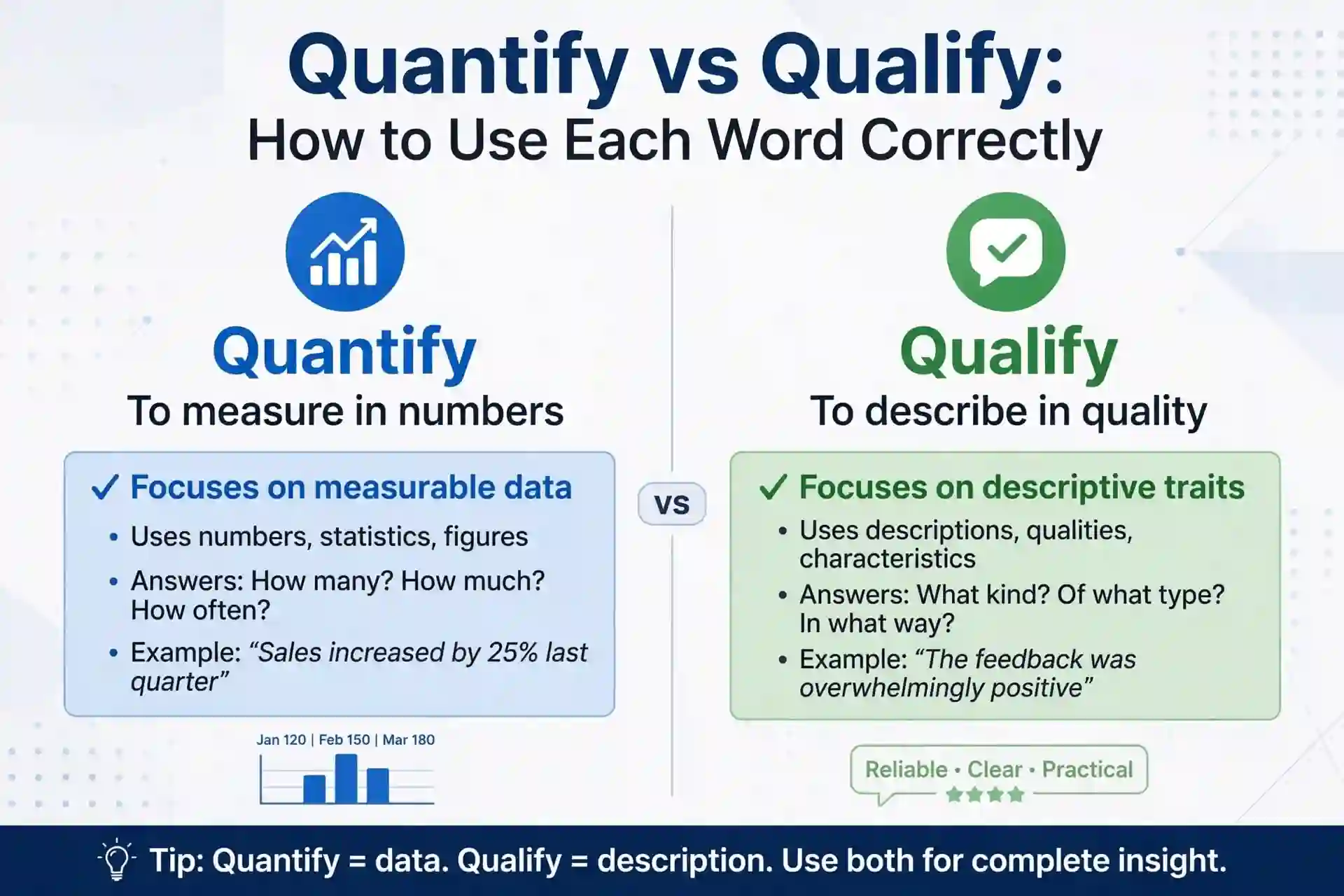
When it comes to choosing the right words, small differences in meaning can change an entire sentence. Quantify vs Qualify is a common source of confusion because both words describe ways to explain or evaluate something. However, they serve different purposes. Quantify means to measure or express something using numbers. Qualify means to describe, limit, or make a statement more specific. Both words appear in everyday conversations, academic writing, business reports, and professional discussions. Understanding their differences helps you communicate clearly and avoid grammar mistakes. This guide explains their meanings, uses, examples, and common errors in simple language.
What Does Quantify Mean?
Quantify means to measure something or express its amount using numbers. It helps people understand how much, how many, or how often something happens. The word focuses on measurable information.
People use this word when they want to turn information into numbers. It often appears in mathematics, science, business, research, and everyday discussions.
For example:
- We need to quantify the company’s monthly sales.
- The researcher tried to quantify customer satisfaction.
- It is difficult to quantify the value of friendship.
- The report quantifies the amount of waste produced each year.
In each example, quantify refers to measuring or expressing something in numerical terms.
Meaning of Quantify in Simple Words
Quantify means to put a number on something. It helps explain an amount, size, level, frequency, or value.
For example, imagine that a teacher wants to understand how well students perform in class. The teacher can quantify their performance by checking test scores, attendance records, and completed assignments.
Here are some simple examples:
- Quantify the number of visitors.
- Quantify the total cost.
- Quantify the amount of rainfall.
- Quantify the time spent on a project.
The main purpose is to make information measurable.
When Should You Use Quantify?
Use quantify when you discuss something that people can measure, count, or estimate numerically.
Common situations include:
- Business: Companies quantify profits, expenses, sales, and customer growth.
- Education: Teachers quantify student performance through test results and grades.
- Science: Researchers quantify chemical substances, temperatures, and experimental results.
- Healthcare: Professionals quantify changes in measurements such as heart rate or body temperature.
- Marketing: Teams quantify website visits, conversions, and advertising results.
What Does Qualify Mean?
Qualify means to add information that makes a statement more precise, limited, or accurate. It can also mean meeting the requirements for something or having the necessary skills to participate in an activity.
Unlike quantify, this word does not focus on numbers. It focuses on conditions, descriptions, qualifications, or limitations.
For example:
- You must qualify for the scholarship.
- The manager qualified her statement with an important detail.
- His experience qualifies him for the position.
- These results qualify the original conclusion.
The exact meaning depends on the sentence.
Meaning of Qualify in Simple Words
Qualify can mean to make something more specific or to meet certain requirements.
Consider this sentence:
“Everyone can join the competition.”
A person might qualify this statement by adding:
“Everyone can join the competition if they meet the age requirements.”
The added condition makes the original statement more precise.
Here are more examples:
- She qualifies for the university program.
- You need experience to qualify for this position.
- The teacher qualified the answer with an explanation.
- This offer qualifies only for new customers.
These examples show how qualify can describe eligibility or add important details.
When Should You Use Qualify?
Use qualify when you want to explain conditions, limitations, eligibility, or additional details.
Common situations include:
- Employment: A candidate qualifies for a job based on education and experience.
- Education: Students qualify for scholarships by meeting academic requirements.
- Sports: Athletes qualify for competitions through performance or selection.
- Writing: Authors qualify statements to avoid making overly broad claims.
- Business: Companies qualify offers by explaining their terms and conditions.
Qualify is especially useful when a statement needs an exception or additional context.
For example:
“Online shopping is convenient.”
You can qualify this statement by saying:
“Online shopping is convenient, although delivery delays can sometimes cause problems.”
The second sentence gives a more balanced explanation.
Quantify vs Qualify: Key Differences
Understanding Quantify vs Qualify becomes easier when you compare their meanings, purposes, and examples. Both words help explain information, but they answer different questions.
| Feature | Quantify | Qualify |
| Main meaning | Measure or express in numbers | Add conditions or meet requirements |
| Main purpose | Show an amount | Explain or limit meaning |
| Focus | Numbers and measurements | Details and conditions |
| Common question | How much or how many? | Under what conditions? |
| Common use | Research and statistics | Writing and eligibility |
| Example | Quantify the sales growth | Qualify the statement |
Difference in Meaning
Quantify focuses on measurement. It helps people understand the size or amount of something.
Qualify focuses on details, conditions, or eligibility. It helps people understand when something applies or whether someone meets certain requirements.
For example:
- We need to quantify the company’s expenses.
- We need to qualify the company’s financial statement.
The first sentence asks for numerical information. The second suggests adding conditions or limitations to the statement.
Difference in Purpose
The purpose of quantify is to make information measurable. It helps people compare results and understand numerical changes.
The purpose of qualify is to make information more accurate or establish eligibility. It prevents misunderstandings by adding necessary details.
For example:
A business owner may quantify monthly revenue to understand financial performance. The same owner may qualify a sales forecast by explaining that it depends on market conditions.
Difference in Grammar
Both words function as verbs. However, they often appear in different sentence patterns.
Quantify commonly takes a direct object.
Examples:
- Quantify the results.
- Quantify the risk.
- Quantify the total amount.
Qualify can also take a direct object.
Examples:
- Qualify the statement.
- Qualify the claim.
- Qualify the offer.
It can also describe eligibility.
Examples:
- She qualifies for the position.
- They qualify for financial assistance.
- He qualified as a finalist.
The surrounding words help determine the intended meaning.
Quantify vs Qualify: Examples in Everyday Sentences
Practical examples make Quantify vs Qualify easier to understand. You can find both words in conversations, school assignments, workplace communication, and formal writing.
Examples of Quantify in Sentences
Here are some sentences that show how to use quantify correctly:
- We need to quantify the number of customers who visited our store.
- The scientist tried to quantify the effects of pollution.
- Our team will quantify the project’s total expenses.
- The company wants to quantify its annual growth.
- It is difficult to quantify the emotional impact of the experience.
- The survey helps quantify customer satisfaction.
- The report quantifies the amount of energy used.
- Teachers can quantify student progress through test scores.
- The manager asked us to quantify the expected savings.
- Researchers used several methods to quantify the results.
Each sentence involves measuring, counting, or estimating something.
Examples of Qualify in Sentences
These examples show different meanings of qualify:
- She worked hard to qualify for the final competition.
- You must qualify for the program before applying.
- His experience qualifies him for the management role.
- The lawyer qualified her statement with additional information.
- These conditions qualify the original agreement.
- He qualified as a professional instructor.
- Students must meet certain requirements to qualify for admission.
- The company qualified its offer with specific conditions.
- She qualified her opinion by explaining the limitations.
- Only selected participants qualify for the award.
These sentences describe eligibility, conditions, or additional details.
Examples Using Both Words Together
You can use both words in the same sentence when you need to measure something and explain its limitations.
- The researcher quantified the results but qualified the conclusion with important limitations.
- The company quantified its sales growth and qualified its forecast based on market conditions.
- We quantified the project’s expenses and qualified the estimate by mentioning possible additional costs.
- The study quantified customer responses but qualified its findings because the sample was small.
- The manager quantified employee performance and qualified the results based on individual responsibilities.
These examples show that the words can work together without having the same meaning.
Common Mistakes When Using Quantify and Qualify
Many people confuse these words because they look similar and share the same word ending. However, their meanings are different. Learning common mistakes can help you choose the correct word.
Using Qualify When You Mean Measure
One common mistake involves using qualify when the sentence requires a numerical measurement.
Incorrect: We need to qualify the number of products sold.
Correct: We need to quantify the number of products sold.
The correct sentence explains that someone needs to count or measure the products.
Using Quantify When You Mean Add Conditions
Another mistake occurs when someone uses quantify to describe adding limitations to a statement.
Incorrect: The manager quantified his statement with an important exception.
Correct: The manager qualified his statement with an important exception.
The second sentence works because the manager adds information that limits the original statement.
Confusing Qualification With Quantification
These nouns also have different meanings.
Quantification refers to the process of measuring or expressing something numerically.
Example: The quantification of project costs helped the company prepare its budget.
Qualification refers to a condition, requirement, credential, or limitation.
Example: A university degree is one qualification for the position.
Remember that quantification relates to numbers, while qualification relates to requirements or conditions.
Assuming Qualify Always Means Meeting Requirements
Qualify does not always describe eligibility.
It can also mean adding details that make a statement more accurate.
For example:
“The service is free.”
A qualified version might be:
“The service is free for the first month, but regular charges apply afterward.”
Here, qualify describes adding a limitation rather than meeting a requirement.
How to Remember the Difference Between quantify vs qualify
A simple memory trick can help you choose the correct word. Focus on the main purpose of each word instead of trying to remember complicated grammar rules.
Associate Quantify With Quantity
The word quantify contains the word “quantity.” Both relate to amounts and measurements.
Think of questions such as:
- How much?
- How many?
- What percentage?
- How often?
- What is the total?
Associate Qualify With Qualifications
The word qualify is closely connected to qualification. A qualification can be a skill, condition, or requirement.
Think of questions such as:
- Does someone meet the requirements?
- What conditions apply?
- What details limit this statement?
- Is there an exception?
For example:
“She qualifies for the position because she has the required experience.”
The sentence focuses on eligibility.
Use a Simple Comparison
Remember these two examples:
- Quantify the number of students in the classroom.
- Qualify the statement about student performance.
The first requires counting. The second requires adding details or limitations.
This simple comparison can help you avoid confusion in everyday writing.
Quantify vs Qualify in Business, Education, and Research
Both words appear frequently in professional and academic settings. Understanding their practical uses can improve reports, presentations, and formal communication.
Quantify vs Qualify in Business
Businesses use quantify when they need measurable information. It helps managers understand financial performance, customer behavior, and operational results.
For example, a company might quantify:
- Monthly revenue.
- Customer retention rates.
- Production costs.
- Employee attendance.
- Website traffic.
- Product returns.
Qualify has a different role in business communication.
Managers use it to explain conditions, limitations, or requirements.
For example:
- A business qualifies for a government support program.
- A company qualifies its financial forecast because of economic uncertainty.
- A sales offer qualifies only for selected products.
Both words support better business decisions, but they serve different purposes.
Quantify vs Qualify in Education
Teachers and students use quantify when discussing measurable academic results.
For example, a teacher may quantify student performance by reviewing examination scores, attendance, and assignment completion.
Students also use the word in research projects.
Qualify appears when someone discusses academic requirements or limits a statement.
For example:
- Students must qualify for admission.
- A student qualifies for a scholarship after meeting the required conditions.
- A researcher qualifies a conclusion by explaining the limitations of the study.
These examples show how both words fit naturally into educational communication.
Quantify vs Qualify in Research
Researchers use quantify to measure observations and present numerical findings.
For example, a research team may quantify survey responses, population changes, or experimental results.
Quantification can make findings easier to compare. However, researchers must select suitable measurements and avoid presenting estimates as exact facts.
Qualify is equally important in research writing.
Researchers often qualify their findings by discussing:
- Small sample sizes.
- Research limitations.
- Possible sources of error.
- Conditions that affect results.
- Areas that need further investigation.
A researcher might write:
“The treatment improved test performance in this group, although the small sample limits how widely we can apply the findings.”
This statement qualifies the conclusion by explaining its limitations.
Related Words: Quantification, Qualification, and Qualifier
Learning related words can help you understand the difference more deeply. These forms appear in formal writing, workplace communication, and everyday English.
Quantification
Quantification is the process of measuring or expressing something in numerical terms.
Example:
“The quantification of customer demand helped the company plan production.”
It usually involves data, numbers, measurements, or estimates.
Qualification
Qualification has several meanings. It can refer to a skill, certificate, or requirement that makes someone suitable for a role.
It can also describe a condition or limitation added to a statement.
Examples:
- Her teaching qualification helped her secure the job.
- The agreement includes an important qualification.
The meaning depends on the context.
Qualifier
A qualifier is a word, phrase, or expression that limits or changes the meaning of another statement.
For example:
“She is very talented.”
The word “very” modifies the adjective “talented.”
In another example:
“Most people enjoy traveling.”
The word “most” limits the statement. It does not claim that everyone enjoys traveling.
Other common qualifiers include:
- Usually.
- Sometimes.
- Almost.
- Probably.
- Generally.
- Some.
- Often.
Qualifiers help writers avoid making statements that sound too broad or absolute.
Tips for Using quantify vs qualify Correctly
Good word choice improves clarity and makes your writing more professional. These practical tips can help you use both verbs correctly.
Identify Your Intended Meaning
Before choosing a word, ask yourself what you want to communicate.
If you want to measure an amount, use quantify.
If you want to add conditions, explain limitations, or describe eligibility, use qualify.
Check the Sentence Context
The words around your chosen verb can help you identify the correct meaning.
For example:
- “Quantify the costs” makes sense because costs can be measured.
- “Qualify the claim” makes sense because a claim can include limitations.
- “Qualify for admission” makes sense because admission has requirements.
Use Clear and Specific Examples
Avoid using complicated sentences when a simple explanation works.
Instead of writing:
“The organization attempted to quantify the overall extent of its operational performance.”
Review Your Writing
After writing a sentence, check whether the selected word matches your intended meaning.
Ask yourself whether the sentence discusses numbers, conditions, or eligibility. This quick review can prevent many common mistakes.
Frequently Asked Questions
What Is the Main Difference Between Quantify and Qualify?
Quantify means to measure or express something using numbers. Qualify means to add conditions or details to a statement, or to meet the requirements for something. The correct choice depends on the sentence’s meaning.
Can You Use Quantify and Qualify in the Same Sentence?
Yes. Both words can appear together when a sentence discusses measurement and limitations.
Example: “The team quantified the results but qualified its conclusion because the research sample was small.”
Does Qualify Mean to Measure Something?
No. Qualify does not generally mean to measure something numerically. It usually describes meeting requirements or adding details that limit a statement. Use quantify when you want to discuss numerical measurements.
What Is an Example of Quantify in a Sentence?
“We need to quantify the amount of money spent on advertising.”
This sentence uses quantify correctly because it describes measuring an amount of money.
What Is an Example of Qualify in a Sentence?
“She qualifies for the scholarship because she meets all the academic requirements.”
This sentence uses qualify correctly because it describes eligibility.
Final Thoughts
Understanding Quantify vs Qualify helps you choose the right word in everyday conversations, academic assignments, and professional writing. Although these words look similar, their meanings and purposes differ.
Quantify means to measure something or express it using numbers. It answers questions about amounts, totals, percentages, and measurements. Qualify means to add details or conditions to a statement. It can also describe meeting the requirements for a particular opportunity, position, or activity.
