


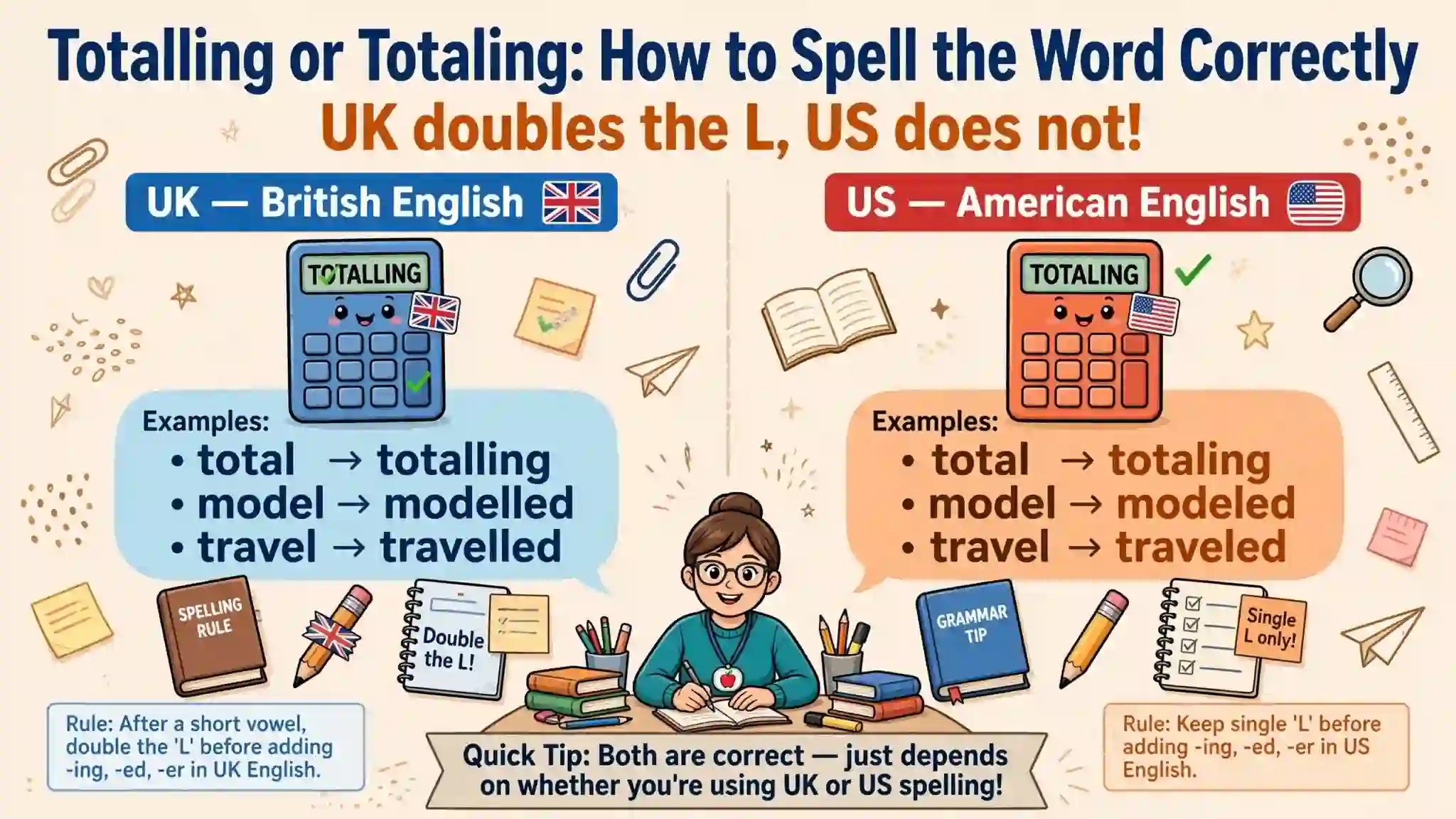
When it comes to totalling vs totaling, many people wonder which spelling is correct. Both forms have the same meaning, but their spelling depends on the type of English you use. British English usually prefers totalling, while American English uses totaling. The difference comes from a simple spelling rule involving the final letter of a word. This guide explains both spellings, their meanings, grammar rules, and common uses. You will also learn how to use each form in sentences, understand its past tense, and avoid common spelling mistakes. By the end, you will know which version suits your writing.
Totalling vs Totaling: Which Spelling Is Correct?
Both totalling vs totaling spellings are correct in English. The main difference comes from regional spelling rules. British English uses totalling, while American English uses totaling. Both words mean adding numbers or amounts to find a final sum.
The word comes from the verb total. When you add the ending -ing, the spelling changes based on the English variety.
Here is a simple comparison:
| Spelling | English variety | Example |
| Totalling | British English | The costs are totalling £500. |
| Totaling | American English | The costs are totaling $500. |
Neither spelling is wrong. Your choice depends on your audience and writing style.
British English often doubles the final consonant when adding an ending to certain verbs. American English usually keeps the final consonant single in words like total.
You can use either form in everyday writing. Keep the spelling consistent throughout your document.
What Does totalling vs totaling Mean?
The word describes the action of adding numbers, prices, or amounts to calculate a complete sum. People use it in business, shopping, accounting, mathematics, and daily conversations.
For example:
- The shopping bill is totalling £80.
- The expenses are totaling $450.
- Her savings are totalling a large amount.
- The final scores are totaling 100 points.
Both spellings communicate the same idea. The word can describe adding separate values or reaching a particular amount.
Totalling as a Verb
Totalling is the British English form of the present participle of total. It describes an action that involves calculating or adding amounts.
For example:
- I am totalling the monthly expenses.
- She is totalling the sales figures.
- They are totalling the scores.
- We are totalling the costs of the project.
In these sentences, the word describes an action that is happening now.
Totaling as a Verb
Totaling serves the same grammatical purpose in American English. It describes the process of adding values to find a complete amount.
For example:
- I am totaling the receipts.
- He is totaling the weekly sales.
- The accountant is totaling the expenses.
- We are totaling the points from each round.
The meaning does not change when you switch from one spelling to the other.
What Does Total Mean?
Total is the base word for both forms. It can work as a noun, adjective, or verb.
As a noun, it describes the final amount.
Example: “The total is $250.”
As an adjective, it means complete or whole.
Example: “The project was a total success.”
As a verb, it means to add amounts or calculate a final sum.
Example: “Please total these numbers.”
Understanding the base word makes the spelling rule easier to follow.
Why Does British English Use Totalling?
British English often doubles the final consonant when a word ends in a consonant preceded by a single vowel and receives a suffix that begins with a vowel.
The word total has two syllables. Its final syllable carries the main stress in standard pronunciation. When adding -ing, British spelling doubles the final L.
This gives us:
- Total + ing = totalling
- Total + ed = totalled
- Total + er = totaller
The same pattern appears in other British English words.
Examples include:
| Base word | British spelling |
| Travel | Travelling |
| Cancel | Cancelling |
| Label | Labelling |
| Model | Modelling |
| Signal | Signalling |
These words follow a familiar British spelling pattern.
The Double L Rule
The double L rule appears in many British English verbs. Writers often double the final L when adding endings such as -ing and -ed.
For example:
- Travel becomes travelling.
- Cancel becomes cancelling.
- Label becomes labelling.
- Total becomes totalling.
This rule helps explain why British writers prefer two Ls in the word.
However, not every verb follows the same spelling pattern. Some words have different rules based on stress, syllables, or established spelling conventions.
Why Does American English Use Totaling?
American English generally keeps one L when adding endings to certain words that end in L. This spelling convention explains why Americans write totaling instead of totalling.
The American spelling is common in newspapers, business reports, school assignments, websites, and professional documents.
Examples include:
- Total + ing = totaling
- Total + ed = totaled
- Total + er = totaler
The spelling difference also appears in other words.
| British English | American English |
| Travelling | Traveling |
| Cancelled | Canceled |
| Labelling | Labeling |
| Modelling | Modeling |
| Totalling | Totaling |
American English does not double the final L in these examples.
The Single L Rule
American spelling often keeps one L when adding a suffix to a word that ends in L.
For example:
- Travel becomes traveling.
- Cancel becomes canceling.
- Label becomes labeling.
- Total becomes totaling.
This pattern makes American spelling different from British spelling.
Writers who follow American English should use one L in these forms. This keeps their work consistent with common American spelling conventions.
Totalling vs Totaling: Examples in Everyday Sentences
Examples can help you understand how both spellings work. The following sentences show the words in different situations.
Examples of Totalling in Sentences
Use this spelling when writing in British English.
- I am totalling the expenses for this month.
- The shopping bills are totalling £200.
- She spent the afternoon totalling the sales figures.
- The repair costs are totalling more than expected.
- We are totalling the scores from every round.
- The company is totalling its yearly expenses.
- He finished totalling the receipts before lunch.
- The donations are totalling a generous amount.
- They are totalling the costs of the event.
- The final charges are totalling £750.
- She is totalling the payments from each customer.
- The team is totalling its points after the match.
- I started totalling the figures in my notebook.
- The monthly expenses are totalling less this year.
- The accountant is totalling the financial records.
Examples of Totaling in Sentences
Use this spelling when writing in American English.
- I am totaling the expenses for this month.
- The shopping bills are totaling $200.
- She spent the afternoon totaling the sales figures.
- The repair costs are totaling more than expected.
- We are totaling the scores from every round.
- The company is totaling its yearly expenses.
- He finished totaling the receipts before lunch.
- The donations are totaling a generous amount.
- They are totaling the costs of the event.
- The final charges are totaling $750.
- She is totaling the payments from each customer.
- The team is totaling its points after the match.
- I started totaling the figures in my notebook.
- The monthly expenses are totaling less this year.
- The accountant is totaling the financial records.
The sentences have the same meaning. Only the regional spelling changes.
Totalling vs Totaling: What About Past Tense and Other Forms?
The spelling difference does not stop with the present participle. It also appears in the past tense and other forms of the verb.
Learning these forms helps you avoid mistakes in longer sentences and professional writing.
Here is a useful comparison:
| Word form | British English | American English |
| Base verb | Total | Total |
| Present participle | Totalling | Totaling |
| Past tense | Totalled | Totaled |
| Past participle | Totalled | Totaled |
| Present tense | Totals | Totals |
Totalling vs Totaling in Present Continuous Tense
The present continuous tense describes an action happening now.
Examples:
- She is totalling the bills.
- She is totaling the bills.
- They are totalling the final scores.
- They are totaling the final scores.
Choose the version that matches your preferred English variety.
Totalling vs Totaling in Past Tense
The past tense describes an action that already happened.
Examples:
- I totalled the expenses yesterday.
- I totaled the expenses yesterday.
- She totalled the sales figures.
- She totaled the sales figures.
British English uses two Ls. American English uses one L.
Totals in the Simple Present Tense
The simple present tense uses totals for the third-person singular.
Examples:
- He totals the weekly expenses.
- She totals the shopping bills.
- The accountant totals the figures every Friday.
This form stays the same in British and American English.
Common Mistakes When Using Totalling vs Totaling
Many writers confuse regional spelling rules. Some use both forms in the same document. Others add unnecessary letters or choose the wrong verb form.
Understanding these mistakes can help you write more clearly.
Mixing British and American Spelling
One common mistake involves switching between the two spelling systems.
For example:
Incorrect: “The accountant is totalling the expenses. She totaled the bills yesterday.”
This sentence mixes British and American forms.
Better British English: “The accountant is totalling the expenses. She totalled the bills yesterday.”
Better American English: “The accountant is totaling the expenses. She totaled the bills yesterday.”
Choose one spelling style and follow it throughout your work.
Adding an Extra Letter
Some writers mistakenly add another L to the American spelling.
Incorrect: Totalingg
Correct: Totaling
The word needs only one G at the end of the suffix. The base word already contains one L.
Using Total Instead of Totalling
The words have related meanings, but they do not always fit the same sentence structure.
Incorrect: “I am total the expenses.”
Correct: “I am totalling the expenses.”
Correct: “I am totaling the expenses.”
The present continuous tense needs the -ing form.
Confusing the Verb With the Noun
Total can also work as a noun. This can confuse writers who do not understand the difference.
For example:
- Correct: The total is $500.
- Correct: I am totaling the expenses.
- Correct: The final total looks accurate.
Use the noun when naming the final amount. Use the verb when describing the calculation.
Which Spelling Should You Use in Professional Writing?
The best spelling depends on your audience, publication, and organization’s style guide. Both forms are accepted. Consistency matters more than choosing one as universally correct.
Here are some practical guidelines.
For British Readers
Choose totalling when writing for readers in the United Kingdom or following British English conventions.
This spelling also fits many publications that use British spelling standards.
Related forms include:
- Totalled
- Totalling
- Totals
For American Readers
Choose totaling when writing for an American audience.
Use the related American forms:
- Totaled
- Totaling
- Totals
This approach makes your writing look consistent and familiar to American readers.
For International Websites
International websites often attract readers from several countries. You can choose either spelling, but you should use it consistently.
Consider these points:
- Identify your main target audience.
- Follow your website’s existing spelling style.
- Keep the same spelling in headings and body text.
- Use regional spelling in localized content.
- Avoid switching between British and American forms.
A consistent style makes articles easier to read and maintain.
Easy Tips to Remember the Difference
You do not need to memorize a long list of spelling rules. A few simple reminders can help you choose the correct version.
- Think about your audience: Use totalling for British English and totaling for American English.
- Remember the double L: British English usually doubles the L in this word.
- Check related words: Use totalled with totalling and totaled with totaling.
- Follow one style: Avoid mixing regional spellings in the same document.
- Use a dictionary: Check a trusted British or American dictionary when you are unsure.
- Review your document: Search for both spellings before publishing.
These simple habits can prevent common spelling errors.
FAQs About Totalling vs Totaling
1. Is totalling vs totaling Correct?
Both spellings are correct. Totalling is the standard British English spelling, while totaling is the standard American English spelling. Both describe adding numbers or amounts to calculate a final sum.
2. Why Does British English Use Two Ls?
British English commonly doubles the final L in words such as total when adding certain suffixes. This produces spellings like totalling and totalled.
3. Is Totaling an American Spelling?
Yes. Totaling is the standard American English spelling. American writers generally use one L in this word when adding the -ing ending.
4. What Is the Past Tense of Totalling?
The British English past tense is totalled. The American English past tense is totaled. Both forms describe an action that happened in the past.
5. Do Totalling and Totaling Have Different Meanings?
No. Both words have exactly the same meaning. They describe adding separate numbers or amounts to calculate a final sum. The only difference is regional spelling.
6. Which Spelling Should I Use in an SEO Article?
Choose the spelling that matches your target audience. Use totalling for British readers and totaling for American readers. Keep your spelling consistent throughout the article.
Conclusion
Understanding totalling vs totaling is simple once you know the difference between British and American English. Both spellings are correct. They share the same meaning and describe the process of adding numbers or amounts to calculate a final sum.British English uses totalling with two Ls. American English uses totaling with one L.
The same pattern appears in their past-tense forms. British writers use totalled, while American writers use totaled.Your choice should depend on your readers and writing style. Use British spelling for British audiences and American spelling for American audiences. Keep your spelling consistent across articles, emails, reports, and other documents.
