


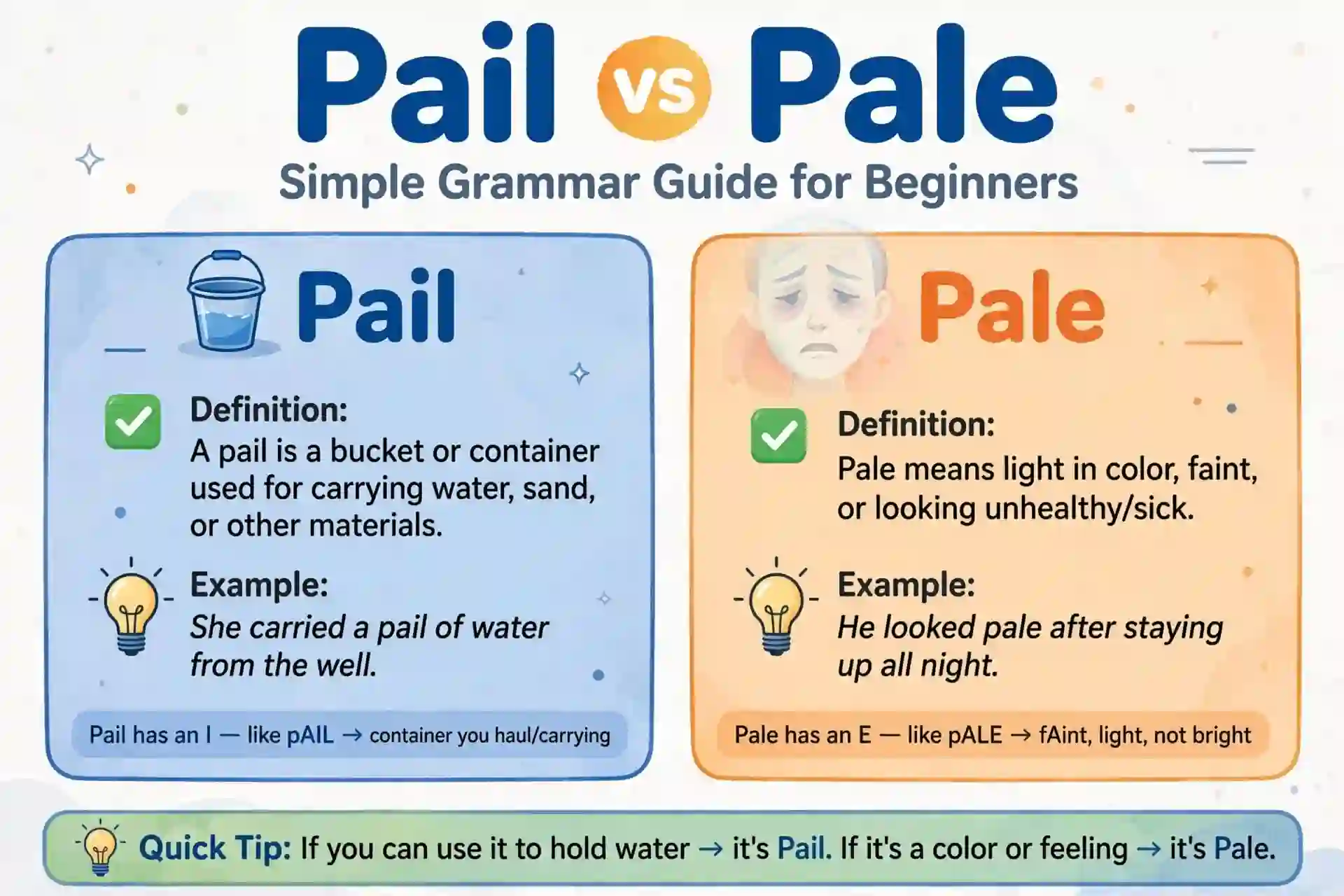
When it comes to English spelling, some words sound exactly the same but have very different meanings. Pail vs Pale is a good example. Both words share the same pronunciation, but they serve different purposes in a sentence. One refers to a container, while the other describes a light color or a person’s appearance. Mixing them up can lead to confusing sentences and spelling mistakes. This guide explains the meaning of each word, its correct usage, common examples, and simple ways to remember the difference. You will also learn how to avoid common mistakes and choose the right word with confidence.
What Is the Difference Between pail vs pale?
pail vs pale sound alike, but they have different meanings and uses. A pail is a container, while pale describes a light color or a lack of healthy color.
The main difference comes from their roles in English grammar.
- Pail: A noun that means a bucket or container.
- Pale: An adjective that describes a light color or a person’s appearance. It can also work as a verb.
Consider these examples:
- She filled the pail with fresh water.
- His face looked pale after the long journey.
In the first sentence, pail names an object. In the second sentence, pale describes someone’s appearance.
Both words sound the same in normal speech. This makes them homophones. Homophones are words that share a pronunciation but have different meanings and spellings.
The spelling tells readers which meaning you intend. Choosing the wrong word can change the meaning of your sentence.
What Does Pail Mean?
A pail is a container used to carry, hold, or store liquids and other materials. Most people use the word to describe a bucket with a handle.
The word pail often appears in everyday conversations. You may hear it when someone talks about cleaning, gardening, fishing, or household tasks.
Pail as a Noun
Pail works as a noun because it names a physical object. It usually refers to a round or deep container with an open top.
A pail may have a metal, plastic, or wooden body. Many pails also have a handle that makes them easy to carry.
Here are some common examples:
- The child carried a pail of sand to the beach.
- Dad placed the pail beside the garden hose.
- She used a small pail to collect rainwater.
- The worker filled the pail with wet cement.
- We brought a pail to collect fresh apples.
Each sentence uses pail to name a container.
Common Uses of a Pail
People use pails for many simple activities. Their shape and size make them useful for carrying different materials.
Common uses include:
- Cleaning: A pail can hold soapy water, cleaning products, or fresh water.
- Gardening: Gardeners use pails to carry soil, weeds, seeds, and water.
- Construction: Workers use pails to move paint, cement, sand, and other materials.
- Fishing: Some people use pails to carry bait or hold their catch.
- Beach activities: Children often use small pails to collect shells and build sandcastles.
- Storage: A pail can hold toys, tools, or household supplies.
The word also appears in familiar expressions. For example, a pail of water means a container filled with water.
Pail in Everyday Sentences
The best way to understand a word is to see how people use it in real situations.
Here are more examples:
- Please bring a pail from the storage room.
- The farmer filled his pail with fresh milk.
- A little water spilled from the pail.
- The children made a sandcastle with a red pail.
- She left the empty pail near the back door.
These examples show that pail always refers to a container in ordinary use.
What Does Pale Mean?
Pale describes a light color or a lack of strong color. People often use it to describe skin, faces, walls, flowers, and other objects.
The word can also describe someone who looks less colorful than usual. This may happen because of fear, illness, tiredness, or shock.
Pale as an Adjective
Pale most commonly works as an adjective. An adjective gives more information about a noun.
For example:
- She wore a pale pink dress.
- The walls were painted a pale yellow.
- His face turned pale with fear.
- The morning sky looked pale blue.
- The flowers had pale purple petals.
In each sentence, pale describes the color or appearance of something.
Pale as a Verb
Pale can also work as a verb. As a verb, it means to become lighter in color or less noticeable.
For example:
- Her face began to pale when she heard the news.
- The old photograph has started to pale over time.
- His confidence paled beside hers.
- The bright paint may pale after years in the sun.
The verb form also appears in the expression pale in comparison.
This expression means that something seems less important, impressive, or valuable when compared with something else.
For example:
- My small achievement pales in comparison to hers.
- The new phone pales beside the latest model.
Common Uses of Pale
People use pale in several situations.
- Colors: Pale pink, pale green, and pale blue describe light shades.
- Appearance: A person may look pale when tired or frightened.
- Weather: A pale morning sky may have a soft, light appearance.
- Art: Artists use pale shades to create gentle color effects.
- Comparison: Something may pale in comparison with a better or greater example.
The word does not always describe skin. It can refer to almost anything with a light or weak color.
Pail vs Pale: Examples in Everyday English
Seeing both words in similar situations makes their meanings easier to understand. Pail names a container, while pale describes color or appearance.
Look at the following sentence pairs.
| Pail | Pale |
| He carried a pail of water. | He had a pale face. |
| The pail was full of sand. | The sand had a pale color. |
| She bought a new pail. | She chose a pale blue dress. |
| The pail stood near the door. | The wall looked pale yellow. |
| I washed the pail outside. | His skin looked pale today. |
| The child dropped the pail. | The flowers were pale pink. |
| Fill the pail with water. | The sky turned pale at dawn. |
More Examples With Pail
These sentences show how the noun works in different settings.
- The little boy carried his pail to the beach.
- She poured the dirty water out of the pail.
- A metal pail stood beside the barn.
- The gardener used a pail to collect weeds.
- We need another pail for the cleaning job.
More Examples With Pale
These sentences show how the adjective and verb work.
- The pale moon appeared above the trees.
- She selected a pale shade of green.
- His face grew pale when he saw the accident.
- The curtains faded to a pale color.
- Their old records pale in comparison with the new collection.
Pay attention to the words around each spelling. A noun such as water, sand, or paint may follow pail. An adjective such as pale often appears before a color or noun.
Why Do People Confuse pail vs pale?
Many English learners confuse these words because they sound exactly alike. Their spelling differs by only one letter, so a quick typing mistake can change the intended meaning.
There are several reasons for this confusion.
They Are Homophones
Homophones create spelling problems because listeners cannot always identify the correct word by sound alone.
Pail vs pale share the same standard pronunciation. You must understand the sentence to know which spelling belongs there.
For example:
- Bring the pail outside.
- The sky looks pale.
When spoken, the two sentences contain words with the same sound. Their meanings become clear through context.
Their Spellings Look Similar
Both words contain four letters. They also share the letters P, A, and L.
The only difference is the final letter:
- Pail ends with I.
- Pale ends with E.
This small spelling difference can easily cause mistakes during fast typing or casual writing.
They Have Different Grammar Roles
Another reason for confusion is their different grammatical functions.
Pail is a countable noun. You can say one pail, two pails, or several pails.
Pale is usually an adjective. It describes something rather than naming an object. It can also act as a verb.
Understanding these grammar roles helps you choose the correct spelling.
Pail vs Pale: Common Mistakes to Avoid
Small spelling mistakes can affect the meaning of an entire sentence. Learning the common errors makes it easier to write correctly.
Here are some mistakes to watch for.
Using Pale When You Mean a Bucket
Incorrect: She filled the pale with water.
Correct: She filled the pail with water.
The sentence needs a noun that names a container. Pail is the correct choice.
Using Pail When You Mean a Light Color
Incorrect: He wore a pail yellow shirt.
Correct: He wore a pale yellow shirt.
The sentence describes the color of a shirt. Pale works as an adjective.
Confusing the Two Words in Descriptions
Incorrect: Her face turned pail after the frightening news.
Correct: Her face turned pale after the frightening news.
The sentence describes a change in someone’s appearance. Pale is the correct word.
Forgetting the Meaning During Fast Typing
Writers sometimes choose the wrong spelling because they type based on sound. This happens often in text messages, emails, and social media posts.
Always read the full sentence before sending it.
Ask yourself:
- Am I naming a container?
- Am I describing a color?
- Am I talking about someone’s appearance?
- Am I describing something becoming lighter?
These questions can help you catch spelling errors before they reach your readers.
Easy Tricks to Remember pail vs pale
Simple memory tricks can make confusing words easier to learn. You do not need to memorize long grammar rules to remember these spellings.
Try these methods.
Remember Pail With the Word Bucket
Think of a pail as another word for a bucket.
Both words refer to containers that hold things. You can remember this simple connection:
Pail = Bucket
Example: I filled the pail with water.
Whenever you think about carrying water, sand, or tools in a container, choose pail.
Remember Pale With the Word Color
Think of pale as a description of a light color.
You can connect it with common color phrases:
- Pale pink
- Pale blue
- Pale green
- Pale yellow
Example: She painted her room pale blue.
This trick works because pale often appears before the name of a color.
Use the Final Letter
You can also focus on the final letter of each word.
- Pail ends with I, like a container you might fill.
- Pale ends with E, like the word shade in a color description.
This is a simple reminder, especially for beginners who often mix up similar spellings.
Create Your Own Practice Sentences
Writing your own examples helps you remember each word.
Try these sentences:
- I carried a pail of water.
- The baby wore a pale pink blanket.
- The pail was too heavy to lift.
- The pale light filled the room.
Read each sentence aloud. Notice how the spelling changes even though the pronunciation stays the same.
Pail vs Pale: Quick Grammar Comparison
A quick comparison can help you review the main differences without reading every section again. Focus on meaning, grammar, and sentence use.
| Feature | Pail | Pale |
| Part of speech | Noun | Adjective and verb |
| Main meaning | A bucket or container | Light in color |
| Pronunciation | Same | Same |
| Spelling | Ends in I | Ends in E |
| Example | A pail of milk | Pale blue paint |
| Plural form | Pails | No regular plural as an adjective |
| Common context | Cleaning, gardening, storage | Colors, appearance, comparison |
Which Word Should You Use?
Choose pail when your sentence refers to a container.
Choose pale when your sentence describes a light shade, someone’s appearance, or something becoming lighter.
Here is a simple test:
- The farmer carried a ___ of water.
- The girl wore a ___ pink dress.
The correct answers are pail and pale.
This test helps you understand the meaning instead of guessing from pronunciation.
Frequently Asked Questions
What Is the Main Difference Between Pail and Pale?
Pail means a bucket or container used to hold or carry things. Pale describes a light color or a person’s appearance. Pail is a noun, while pale is usually an adjective. Pale can also work as a verb.
Are Pail and Pale Homophones?
Yes. Pail and pale are homophones. They have the same pronunciation but different spellings and meanings. Their context helps readers understand which word a writer intends to use.
Is Pail Another Word for Bucket?
Yes. Pail is another word for bucket. It usually describes a container with an open top and a handle. People use pails to carry water, sand, paint, and other materials.
Does Pale Only Describe Skin Color?
No. Pale can describe many things, including walls, clothes, flowers, skies, and other objects. It usually refers to a light or soft color. It can also describe someone who looks less colorful than usual.
How Can I Remember the Difference Between Pail and Pale?
Remember that pail means bucket. Pale describes a light color. Connect pail with water containers and pale with colors such as pale pink or pale blue. These simple examples make the difference easier to remember.
Can Pale Be Used as a Verb?
Yes. Pale can work as a verb when something becomes lighter or less impressive. For example, old paint may pale over time. The phrase pale in comparison means that something seems less impressive beside another thing.
Conclusion
Understanding Pail vs Pale becomes easy when you focus on the meaning of each word. Pail refers to a bucket or container. People use it for carrying water, storing materials, and completing everyday tasks. Pale describes a light color or a person’s appearance. It can also work as a verb when something becomes lighter or seems less impressive.
Remember one simple rule: use pail when you mean a container, and use pale when you describe a color or appearance. Practice with short sentences and pay attention to context. These small habits will improve your spelling and make your writing clearer. With regular practice, you can use both words correctly in schoolwork, emails, conversations, and everyday writing.
