


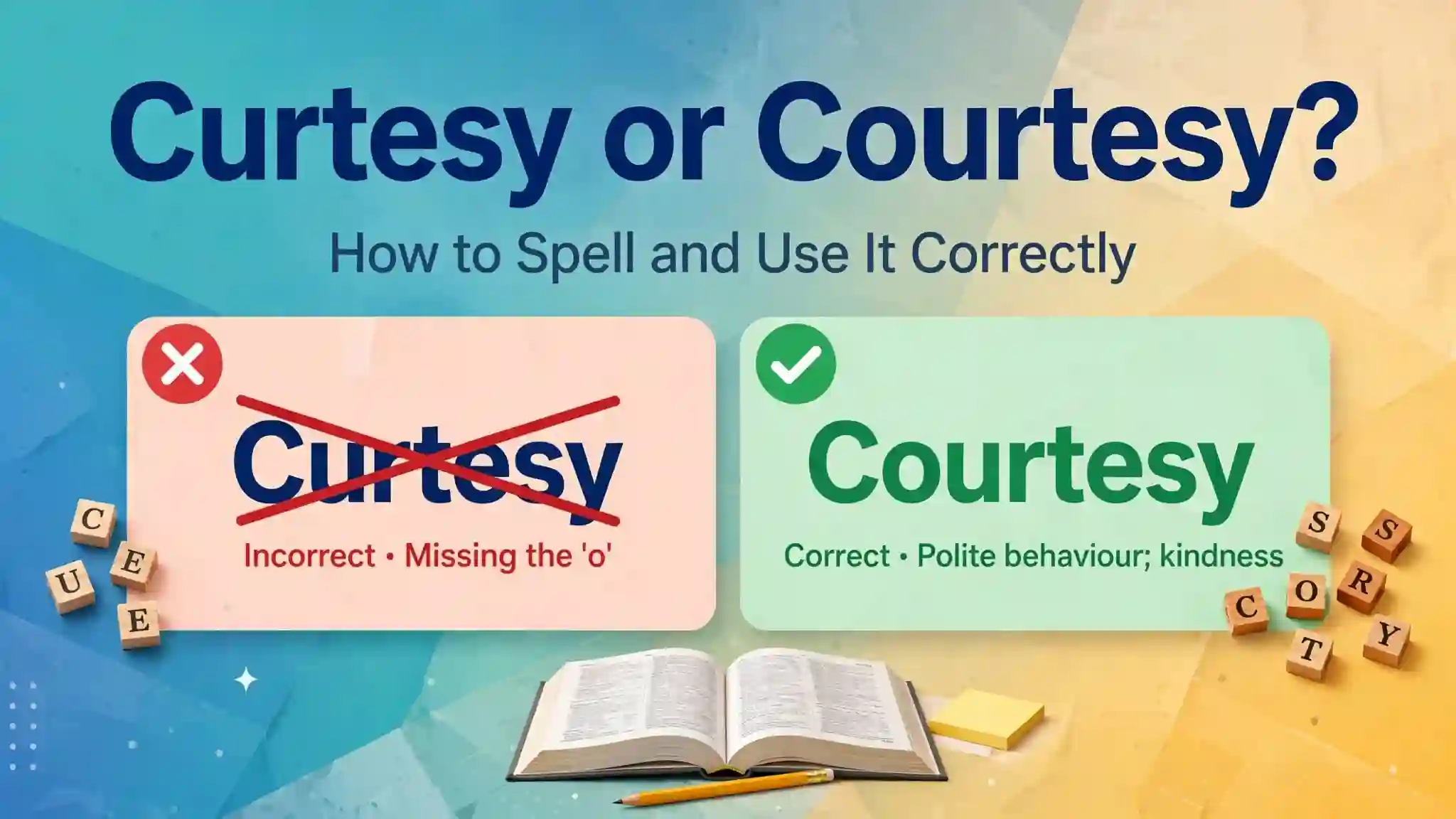
When it comes to English spelling, some words look almost identical but have very different meanings. Curtesy or courtesy is a common example that can confuse writers, students, and English learners. Both spellings exist, but they do not serve the same purpose in modern writing. Courtesy is the correct word when you mean politeness, respect, or good manners. Curtesy is a rare legal term connected to an old property right. Understanding this difference helps you avoid spelling mistakes and choose the right word. This guide explains their meanings, origins, pronunciation, differences, and practical examples. You will also learn common mistakes and simple ways to remember the correct spelling.
Curtesy or Courtesy: Which Spelling Is Correct?
Courtesy is the correct spelling for everyday situations involving politeness, kindness, and respect. Curtesy is also a valid word, but it has a specialized historical legal meaning.
Many people search for curtesy or courtesy because the two words look and sound almost identical. They differ by only one letter. This small difference can create confusion, especially when writing emails, school assignments, articles, or professional documents.
Here is the basic distinction:
- Courtesy: Polite behavior, good manners, respect, or a kind gesture.
- Curtesy: A historical legal term describing a husband’s interest in certain property inherited by his deceased wife.
If you want to describe someone who treats others politely, use courtesy.
For example:
- She treated every guest with courtesy.
- Good courtesy makes conversations more pleasant.
- Thank you for your kindness and courtesy.
What Does Courtesy Mean?
Courtesy is a noun that means polite behavior, respect, kindness, or consideration toward other people. It describes the way someone treats others in social and professional situations.
People show courtesy through their words, actions, and attitudes. Simple gestures can make others feel respected and appreciated.
For example, saying thank you, holding a door open, listening carefully, and waiting for someone to finish speaking are common acts of courtesy.
Simple Definition of Courtesy
Courtesy means showing good manners and treating people with respect. It involves thinking about other people’s feelings and behaving in a considerate way.
Here are some simple examples:
- He showed courtesy to the elderly woman.
- Please treat your coworkers with courtesy.
- A little courtesy can make someone’s day better.
- The teacher appreciated the students’ courtesy.
- She answered every question with courtesy and patience.
Different Meanings of Courtesy
Courtesy has several related meanings. Its exact meaning depends on how someone uses it.
1. Polite Behavior
Courtesy often describes good manners and respectful conduct.
Example: “His courtesy impressed everyone at the meeting.”
2. A Kind or Helpful Gesture
It can describe an action that shows consideration.
Example: “She offered me the courtesy of a quick phone call.”
3. A Favor or Privilege
Courtesy can also refer to something provided as a favor or without charge.
Example: “The hotel offers a courtesy shuttle to the airport.”
4. Permission or Acknowledgment
In certain expressions, courtesy refers to permission, recognition, or a privilege granted by someone.
Example: “The photographs are published by courtesy of the museum.”
These meanings make courtesy a useful word in everyday and professional English.
What Does Curtesy Mean?
Curtesy is a genuine English word, but it is uncommon in modern everyday conversations. It belongs mainly to historical legal language.
In traditional common law, curtesy referred to a husband’s right to receive a life interest in certain real property owned or inherited by his deceased wife.
This right generally depended on specific legal conditions. One important condition involved the couple having a child born alive who could inherit the property.
The exact rules varied by legal system and historical period.
Curtesy in Historical Law
Traditional English common law recognized certain property rights for surviving spouses. Curtesy was one of these historical rights.
Under the traditional rule, a surviving husband could receive a life estate in qualifying property belonging to his deceased wife.
A life estate generally allows someone to use or benefit from property during their lifetime without owning it outright.
For example, imagine a married woman owns qualifying land. She dies after the couple has a child who meets the inheritance requirements. Under the historical common-law rules, her surviving husband might qualify for curtesy in that land.
The husband would not automatically become the full owner of the property. His interest would generally last for his lifetime.
Is Curtesy Used Today?
Curtesy is rarely used in ordinary modern English. Many legal systems have changed their inheritance and property laws.
Modern laws often address surviving spouses’ rights through statutory inheritance rules, elective shares, or other legal arrangements.
The traditional common-law concept remains relevant when studying legal history, old property documents, or historical court cases.
Do not use curtesy when you want to describe politeness or good manners.
Curtesy or Courtesy: What Is the Main Difference?
The biggest difference between curtesy or courtesy involves their meanings and contexts. Courtesy relates to respectful behavior, while curtesy refers to a historical legal property interest.
Although the spellings look similar, they are not interchangeable.
| Feature | Courtesy | Curtesy |
| Word type | Noun | Noun |
| Main meaning | Politeness and respect | Historical property right |
| Common usage | Everyday English | Historical legal writing |
| Context | Social and professional situations | Property and inheritance law |
| Example | Show courtesy to others. | The husband claimed curtesy. |
| Modern relevance | Very common | Rare |
Difference in Everyday Usage
Courtesy appears in conversations, emails, business documents, books, and everyday writing.
For example:
- Please show courtesy to your neighbors.
- Thank you for your courtesy.
- Common courtesy makes public spaces more pleasant.
Curtesy does not fit these situations.
You would not write:
“Please show curtesy to your neighbors.”
That sentence uses the wrong word because it discusses good manners.
Difference in Legal Usage
Curtesy appears in historical legal discussions about marriage, inheritance, and property rights.
For example:
“The historical doctrine of curtesy recognized a surviving husband’s interest in certain property.”
Origin and History of curtesy or courtesy
Both words have historical connections to older forms of English and French. Their development explains why their spellings look so similar.
Historically, courtesy described the polite conduct expected in a royal or noble court. Over time, its meaning expanded beyond court life.
The word curtesy developed from the same historical word family. It became associated with a particular legal privilege under traditional English property law.
Their meanings eventually developed in different directions:
- Courtesy became a common word for politeness and respectful behavior.
- Curtesy became a specialized legal term for a historical property interest.
How to Use Courtesy Correctly in Sentences
The best way to learn a word is to see how people use it in real situations. Courtesy works in many sentences because it describes respectful behavior and helpful actions.
Here are examples from different settings.
Courtesy in Everyday Conversations
People use courtesy when discussing manners, kindness, and respect.
Examples:
- Everyone deserves courtesy and respect.
- She thanked him for his courtesy.
- Please show courtesy when speaking to others.
- His courtesy made the guests feel welcome.
- Common courtesy can prevent unnecessary arguments.
These examples show how courtesy describes positive social behavior.
Courtesy in Professional Communication
Courtesy is especially useful in workplaces and formal communication.
Examples:
- Thank you for your time and courtesy.
- Our staff always treats customers with courtesy.
- Please respond to clients with courtesy and professionalism.
- The manager appreciated her courtesy during the discussion.
- We expect courtesy from everyone in the workplace.
Professional courtesy helps build trust and maintain respectful relationships.
Courtesy in Customer Service
Customer service workers often use courtesy when helping customers and answering questions.
Examples:
- The receptionist welcomed every visitor with courtesy.
- Thank you for your patience and courtesy.
- Our team provides assistance with care and courtesy.
- The employee handled the complaint with courtesy.
- Good customer service requires patience and courtesy.
These sentences show that courtesy can improve customer experiences.
Courtesy in Formal Writing
Courtesy also appears in letters, invitations, announcements, and official communication.
Examples:
- “We appreciate the courtesy of your response.”
- “Please extend the courtesy of a reply.”
- “The event organizers provided courtesy transportation.”
- “The invitation was sent as a courtesy.”
- “We request that all visitors observe basic courtesy.”
These examples demonstrate the word’s flexibility.
Common Expressions and Phrases With Courtesy
Courtesy appears in several common English expressions. Learning these phrases helps you understand the word and use it naturally.
1. Common Courtesy
Common courtesy refers to basic manners that people should show in everyday situations.
Example: “Saying please and thank you is common courtesy.”
2. Courtesy of
The expression “courtesy of” identifies the person or organization that provided something.
Example: “The refreshments were provided courtesy of the event sponsor.”
It can also identify the source of information, photographs, or other material.
Example: “Photo courtesy of the local newspaper.”
3. Out of Courtesy
This phrase describes an action performed to show politeness or respect.
Example: “He called out of courtesy, even though he was busy.”
4. As a Courtesy
This expression describes something offered as a polite gesture or favor.
Example: “The company sent a reminder as a courtesy.”
Common Spelling Mistakes With Curtesy and Courtesy
Many spelling mistakes happen because people remember how a word sounds but forget its correct letter order.
Curtesy and courtesy are especially confusing because both have similar pronunciations.
Here are some mistakes to avoid.
1. Using Curtesy for Politeness
Incorrect: “She always treats people with curtesy.”
Correct: “She always treats people with courtesy.”
The sentence discusses respectful behavior, so courtesy is the correct spelling.
2. Writing Courtesy in Historical Legal Contexts
Incorrect: “The husband claimed a right to courtesy in the inherited land.”
Correct: “The husband claimed a right to curtesy in the inherited land.”
The legal context requires the specialized term curtesy.
3. Mixing Up the Letters
Some writers remember the sound but accidentally leave out the second “o.”
Incorrect: “Thank you for your curtesy.”
Correct: “Thank you for your courtesy.”
Check the spelling before publishing important documents or professional messages.
4. Assuming Curtesy Is Always a Typo
Curtesy is not simply a misspelling of courtesy. It has a recognized historical legal definition.
The two words share a history but have different modern uses.
Easy Ways to Remember the Correct Spelling
A simple memory trick can help you avoid confusion when writing these words.
Remember the Extra O in Courtesy
Courtesy contains the letter sequence “our.”
Think of courtesy as the word you use when showing consideration to others.
Example: “Show courtesy to everyone.”
Connect Curtesy With Courts
Curtesy is mainly associated with historical property law.
You can remember the connection by linking curtesy with courts, legal rights, and inheritance.
This is a useful way to separate the two meanings.
Check the Sentence Before Writing
Ask yourself one simple question:
Am I talking about manners or historical property law?
- If the sentence discusses kindness, respect, or politeness, use courtesy.
- If the sentence discusses the traditional legal property right, use curtesy.
This quick check works in most situations.
Practice With Short Sentences
Write a few examples to remember the distinction:
- Courtesy makes communication better.
- Good manners show courtesy.
- Curtesy was a historical legal right.
- The document discussed the old doctrine of curtesy.
Regular practice can make the difference easier to remember.
Why Courtesy Matters in Everyday Life
Courtesy is more than a spelling word. It is an important part of healthy communication and positive relationships.
People interact with family members, coworkers, classmates, customers, and strangers every day. Respectful behavior helps these interactions run smoothly.
Courtesy Builds Better Relationships
People appreciate being treated with kindness. Simple gestures can strengthen personal and professional relationships.
Listening carefully, respecting opinions, and speaking politely can help people feel valued.
Courtesy Reduces Conflict
Many disagreements become worse when people use rude or disrespectful language.
Courtesy encourages calm communication. It helps people discuss problems without attacking each other.
Courtesy Creates a Positive Workplace
Employees work better when they treat one another with respect.
Professional courtesy can include:
- Listening without interrupting.
- Respecting other people’s time.
- Using polite language.
- Giving helpful feedback.
- Acknowledging other people’s efforts.
- Communicating clearly during disagreements.
These habits support a more welcoming work environment.
Courtesy Makes Public Spaces Better
Public courtesy helps people share spaces comfortably.
Examples include keeping noise low, waiting in line, offering assistance, and respecting personal space.
Small actions can make everyday experiences more pleasant for everyone.
FAQs About Curtesy or Courtesy
1. Is it curtesy or courtesy?
Courtesy is the correct spelling when referring to politeness, good manners, or respect. Curtesy is a separate historical legal term related to a surviving husband’s property interest under traditional common law.
2. Is curtesy a real word?
Yes. Curtesy is a recognized English word. It describes a historical legal right involving a surviving husband’s interest in certain property belonging to his deceased wife.
3. What does courtesy mean in simple words?
Courtesy means being polite, kind, and respectful toward others. Saying thank you, holding a door open, and listening carefully are examples of courtesy.
4. What is the difference between curtesy and courtesy?
Courtesy means polite behavior or a kind gesture. Curtesy refers to a historical common-law property right. Their meanings are different, even though their spellings are similar.
5. How do you spell courtesy correctly?
The correct spelling is C-O-U-R-T-E-S-Y. Remember the extra “o” after “c” when writing about politeness and good manners.
6. Can I use curtesy instead of courtesy?
No, not when discussing everyday manners or respect. Use courtesy in those situations. Curtesy belongs to a specialized historical legal context.
Conclusion
Choosing between curtesy or courtesy becomes simple when you understand their meanings. Courtesy is the correct word for everyday situations involving politeness, kindness, and respect. It appears in personal conversations, professional emails, customer service, and formal writing. Curtesy is also a valid English word, but it belongs to historical legal terminology. It describes a traditional property interest that a surviving husband could receive under certain common-law conditions.
The two words look similar because they share historical roots. Their meanings, however, are different. Remember to use courtesy when discussing good manners. Reserve curtesy for discussions about historical property law and inheritance. Check the context whenever you are unsure about the spelling. A clear understanding of these words will help you write with greater accuracy and confidence. Small spelling differences can change the meaning of a sentence, so choosing the right word always matters.
