


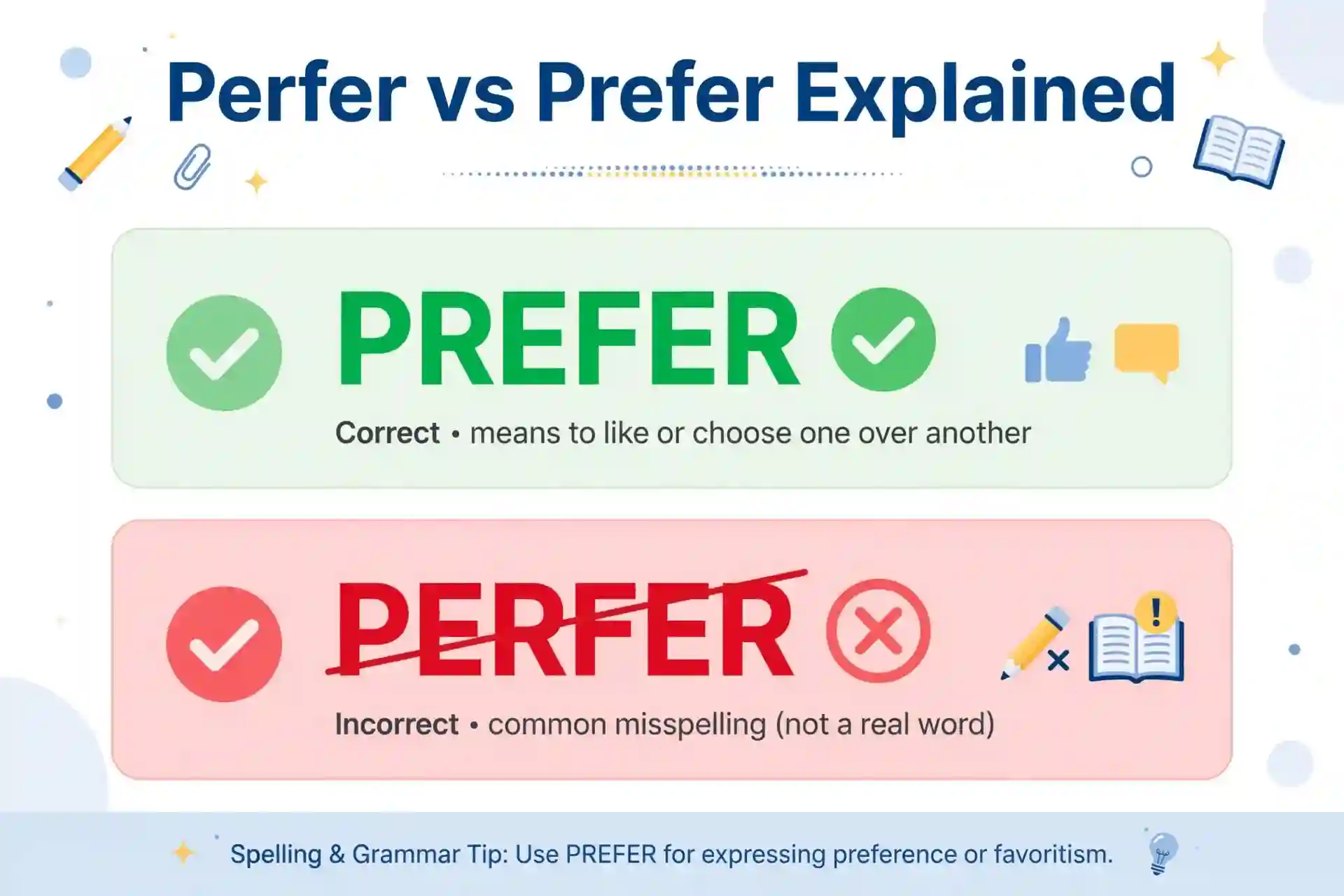
When it comes to spelling, small mistakes can change how clear and professional your writing looks. Perfer vs Prefer is a common spelling confusion for people who want to use the word correctly. Both forms may look similar, but only one is accepted in standard English. The correct spelling is prefer. People often write “perfer” because they confuse the sounds and letter order when speaking or typing quickly. This guide explains the correct spelling, meaning, pronunciation, word history, and everyday usage. You will also learn how to avoid this mistake, understand related words, and use the correct form in sentences.
Perfer vs Prefer: Which Spelling Is Correct?
The correct spelling is prefer. The word “perfer” is a common spelling mistake. It does not appear as a standard English verb. People often make this error because both forms look and sound similar.
Use “prefer” when you want to say that you like one thing more than another. It works in everyday conversations, school assignments, business emails, and formal writing.
Here are some simple examples:
- I prefer tea over coffee.
- She prefers reading books at night.
- They prefer to travel by train.
- We prefer quiet places for dinner.
- He would prefer to stay home today.
The word “prefer” follows standard English spelling rules. It contains the letters P-R-E-F-E-R. The first syllable begins with “pre,” and the second part ends with “fer.”
The incorrect form “perfer” changes the order of the letters R and E. This small change creates a spelling error.
Remember this simple rule: always write “prefer” when you mean to choose or like something more.
What Does Prefer Mean?
The verb “prefer” means to like, choose, or favor one thing more than another. It shows a personal choice or stronger liking.
You can use it when comparing food, activities, people, places, or ideas. It helps explain your choices without giving a long explanation.
For example:
- I prefer summer to winter.
- My brother prefers football to cricket.
- She prefers working alone.
- We prefer fresh fruit for breakfast.
- I prefer simple clothes over expensive outfits.
For example, someone may enjoy both coffee and tea but prefer coffee in the morning. This means coffee is their first choice at that time.
“Prefer” also appears in polite requests. People often use it to express what they want without sounding demanding.
Examples include:
- I would prefer a window seat.
- Would you prefer water or juice?
- I would prefer to discuss this tomorrow.
This makes the word useful in both casual and professional communication.
Why Do People Confuse perfer vs prefer?
Many English learners and native speakers make spelling mistakes with words that contain similar sounds like perfer vs prefer. This confusion often happens when people type quickly or rely on memory instead of checking the spelling.
There are several reasons why this particular error occurs.
Similar Letter Patterns
Both spellings contain the same letters. The only difference is the position of R and E.
This makes the mistake easy to overlook. A person may type the wrong version without noticing it.
Compare the two forms:
- Correct: P-R-E-F-E-R
- Incorrect: P-E-R-F-E-R
The first part of the correct word is “pre.” The incorrect version changes it to “per.”
Learning the correct letter order can help prevent this error.
Pronunciation Confusion
English spelling does not always match pronunciation. Some words sound different from the way people expect them to look.
The word “prefer” has two syllables. Its first syllable usually receives less stress than the second syllable.
Listening carefully and reading the word regularly can improve spelling accuracy.
Fast Typing Habits
Typing quickly can cause people to switch letters or add them in the wrong order.
This happens often when someone writes messages, social media posts, or emails without proofreading.
For example:
Incorrect: I perfer chocolate ice cream.
Correct: I prefer chocolate ice cream.
A quick spelling check can catch this mistake before you send your message.
How to Use Perfer vs Prefer Correctly in Sentences
Understanding a word becomes easier when you see it in different situations. The verb “prefer” works in several common sentence patterns.
You can use it to compare two choices, explain personal interests, or make polite requests.
Prefer Something to Something Else
Use this structure when you like one thing more than another:
Prefer + noun + to + noun
Examples:
- I prefer coffee to tea.
- She prefers books to movies.
- They prefer summer to winter.
- We prefer homemade food to fast food.
- He prefers walking to driving.
The word “to” connects the two choices. Do not automatically replace it with “than” in this structure.
Prefer Doing Something
You can use “prefer” with an activity ending in “-ing.”
Prefer + verb-ing
Examples:
- I prefer reading before bed.
- She prefers cooking at home.
- They prefer playing outside.
- He prefers studying in the morning.
- We prefer walking after dinner.
This structure describes an activity that someone enjoys or chooses more often.
Prefer to Do Something
You can also use an infinitive after “prefer.”
Prefer + to + base verb
Examples:
- I prefer to work alone.
- She prefers to study at night.
- They prefer to travel by bus.
- He prefers to exercise early.
- We prefer to eat at home.
Both the “-ing” and infinitive patterns are correct. The choice depends on the sentence and the meaning you want to express.
Would Prefer for Polite Choices
The phrase “would prefer” often appears in polite conversations.
It helps people express what they want without sounding too direct.
Examples:
- I would prefer a cup of tea.
- Would you prefer to sit here?
- She would prefer to leave early.
- We would prefer a different date.
- I would prefer to speak privately.
This structure is especially useful in restaurants, workplaces, meetings, and customer conversations.
Perfer vs Prefer vs Preferring
The word “prefer” has several forms. Each form serves a different grammatical purpose. Learning these forms helps you write complete and correct sentences.
| Word | Grammar | Example |
| Prefer | Base verb | I prefer tea. |
| Prefers | Third-person singular | She prefers tea. |
| Preferred | Past tense | He preferred tea. |
| Preferring | -ing form | She is preferring one option. |
| Preference | Noun | My preference is tea. |
Prefer
Use “prefer” with subjects such as I, you, we, and they.
Examples:
- I prefer simple designs.
- You prefer cold drinks.
- We prefer early meetings.
- They prefer online classes.
Prefers
Use “prefers” with he, she, or it in the present simple tense.
Examples:
- She prefers quiet music.
- He prefers fresh coffee.
- My sister prefers summer.
- The customer prefers a different size.
Remember to add S when the subject is a third-person singular noun or pronoun in the present simple tense.
Preferred
“Preferred” is the past tense and past participle of “prefer.”
Examples:
- I preferred the blue shirt.
- She preferred the earlier meeting.
- They preferred the old design.
- He had preferred a different option.
The spelling contains a double R before the final E and D.
Preferring
“Preferring” is the “-ing” form of the verb.
Examples:
- She is preferring the first option in this situation.
- Some customers are preferring online services.
These examples can work in specific contexts, but “prefer” is not commonly used in continuous tenses. In many situations, the simple present sounds more natural.
For example:
- More natural: She prefers the first option.
- Less natural: She is preferring the first option.
Common Mistakes to Avoid When Using Perfer vs Prefer
Correct spelling is important, but grammar also matters. Some people spell the word correctly but use it in the wrong sentence structure.
Here are common mistakes and their corrections.
Writing Perfer Instead of Prefer
This is the main spelling error.
Incorrect: I perfer fresh juice.
Correct: I prefer fresh juice.
Always check the first four letters before using the word.
Using Than Instead of To
Many writers use “than” after “prefer” because they associate comparisons with words such as “better.”
Incorrect: I prefer tea than coffee.
Correct: I prefer tea to coffee.
However, “prefer” can also appear with “rather than” in a different structure.
Example:
I prefer walking rather than driving.
Forgetting the S With He or She
The present simple tense requires an S when the subject is he, she, or it.
Incorrect: She prefer chocolate.
Correct: She prefers chocolate.
Incorrect: He prefer to stay home.
Correct: He prefers to stay home.
Confusing Prefer With Preference
These words share the same root, but they have different grammatical roles.
“Prefer” is a verb. “Preference” is a noun.
Examples:
- Correct: I prefer blue.
- Correct: My preference is blue.
- Incorrect: I preference blue.
Use the verb when describing an action or choice. Use the noun when naming a liking or favored option.
Adding Unnecessary Words
Some sentences become confusing when writers add extra words.
Incorrect: I prefer more better this option.
Correct: I prefer this option.
You can also say:
I like this option better.
Keep your sentences simple and direct.
Easy Tricks to Remember the Correct Spelling
Spelling becomes easier when you use small memory tricks. You do not need to memorize long grammar rules. A few simple habits can help you remember the correct form.
Remember the Word Pre
The correct spelling starts with “pre.”
Think of familiar words such as:
- Prepare
- Present
- Prevent
- Preview
- Prefer
These words help you remember the letter order at the beginning.
When writing the word, think of “pre” first. Then add “fer.”
Break the Word Into Parts
Divide the word into two simple parts:
PRE + FER = PREFER
This method helps you remember where the R belongs.
Repeat the spelling a few times while writing it. This creates a stronger connection between the word and its correct letter pattern.
Write Example Sentences
Practice the word in everyday sentences.
For example:
- I prefer tea.
- I prefer reading.
- I prefer blue shoes.
- I prefer quiet places.
Writing short sentences helps you remember the word in context.
Use Spell-Check Tools
Modern phones, browsers, and writing applications often include spelling suggestions.
These tools can identify many typing mistakes. They are helpful for emails, assignments, and online articles.
However, do not depend on them completely. Learn the correct spelling so you can recognize mistakes yourself.
Read English Regularly
Reading books, articles, and quality websites exposes you to correct spelling.
When you see a word many times, you become more familiar with its appearance.
Try to notice how writers use “prefer” in different sentences. This improves both spelling and grammar.
Perfer vs Prefer in American and British English
Some English words have different spellings in American and British English. Examples include “color” and “colour,” “center” and “centre,” and “organize” and “organise.”
However, the word “prefer” does not follow this spelling difference.
Both American and British English use the same spelling:
- American English: Prefer
- British English: Prefer
- Canadian English: Prefer
- Australian English: Prefer
“Perfer” is not an accepted regional spelling.
The same rule applies to the common forms of the verb:
- Prefers
- Preferred
- Preferring
- Preference
These spellings remain consistent across major English varieties.
This is useful for students, writers, teachers, and professionals. You do not need to change the spelling based on your audience’s location.
If you write for an American website or a British publication, use “prefer” in both cases.
When Should You Use Perfer vs Prefer in Everyday Writing?
The word “prefer” is useful in almost every type of communication. It helps you explain choices clearly and politely.
You can use it in personal conversations, professional emails, academic writing, and online discussions.
In Daily Conversations
People use “prefer” to discuss simple choices.
Examples:
- I prefer coffee in the morning.
- Do you prefer movies or television shows?
- I prefer staying at home on weekends.
- My parents prefer traditional food.
These sentences sound natural and are easy to understand.
In Professional Emails
“Prefer” can help you express your needs politely at work.
Examples:
- I would prefer to schedule the meeting for Monday.
- We prefer to receive the documents by email.
- I would prefer a short discussion before making a decision.
It communicates your choice without sounding rude or demanding.
In Academic Writing
Students can use “prefer” when discussing opinions, study methods, and research choices.
Examples:
- Some students prefer visual learning methods.
- Many researchers prefer reliable sources.
- I prefer studying in a quiet environment.
The word fits formal and informal writing. It is clear and easy to understand.
On Social Media
You can use “prefer” in posts, comments, captions, and messages.
Examples:
- I prefer rainy days.
- I prefer books over movies.
- Do you prefer cats or dogs?
- I prefer simple moments.
Correct spelling makes your posts easier to read and helps your writing look polished.
FAQs About Perfer vs Prefer
Is Perfer a Correct English Word?
No. “Perfer” is not a standard English word. It is a common spelling mistake. The correct spelling is “prefer.” Use it when describing something you like or choose more than another option.
How Do You Spell Prefer Correctly?
Spell it P-R-E-F-E-R. The word begins with “pre” and ends with “fer.” Remembering these two parts can help you avoid the common mistake.
What Is the Difference Between Perfer vs Prefer?
“Prefer” is the correct English verb. “Perfer” is an incorrect spelling. Both forms may look similar, but only “prefer” belongs in standard English writing.
Is Prefer Used in American and British English?
Yes. Both American and British English use “prefer.” There is no regional spelling difference for this word.
What Is the Past Tense of Prefer?
The past tense of “prefer” is “preferred.” It uses a double R before the final E and D.
Example: I preferred the blue dress.
What Is the Noun Form of Prefer?
The noun form is “preference.” It describes a person’s liking or favored choice.
Example: My preference is to study in the morning.
Final Thoughts
Understanding the difference between Perfer vs Prefer is simple once you learn the correct letter order. “Prefer” is the only accepted spelling in standard English. “Perfer” is a common typing and spelling mistake.
Use “prefer” when you want to express that you like one thing more than another. You can use it with nouns, “-ing” verbs, and infinitives. You can also use “would prefer” to make polite requests.Remember that American and British English follow the same spelling rule.
