


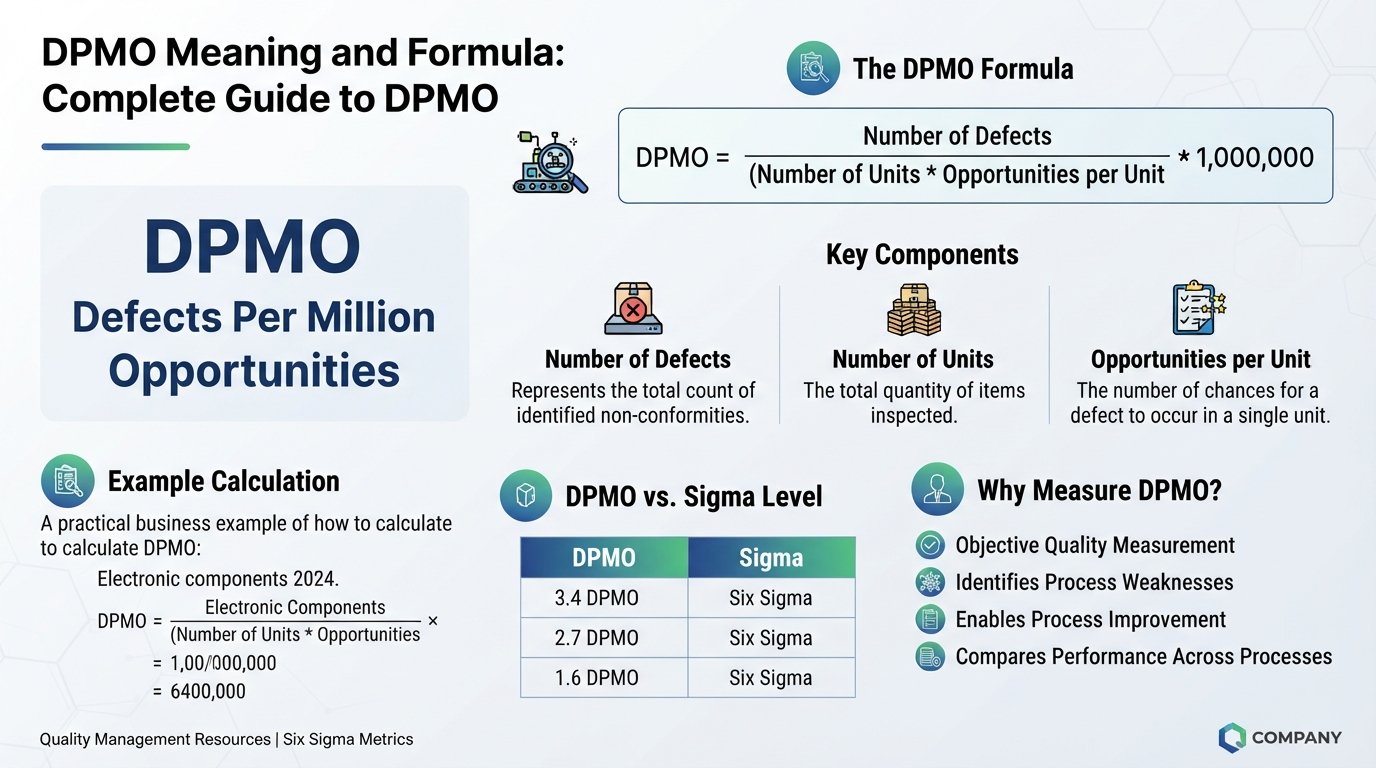
DPMO stands for Defects Per Million Opportunities. It is a quality measurement used to show how often defects may occur in a process when there are one million chances for a defect to happen. DPMO is widely used in Six Sigma, quality control, manufacturing, and process improvement.
A lower DPMO value usually means that a process has fewer defects. A higher value means that more defects are occurring compared with the number of opportunities available.
DPMO is useful because different products and processes can have different numbers of defect opportunities. By converting the result to a common base of one million opportunities, organizations can compare process quality more consistently.
This guide explains DPMO meaning, its formula, calculation, examples, importance, and connection with Six Sigma.
What Does DPMO Meaning ?
DPMO means Defects Per Million Opportunities.
It measures the number of defects that occur for every one million possible opportunities for a defect.
The word “opportunities” is important. One product can have several places where a defect may occur. For example, a product may have five different quality requirements. Each requirement represents a possible defect opportunity.
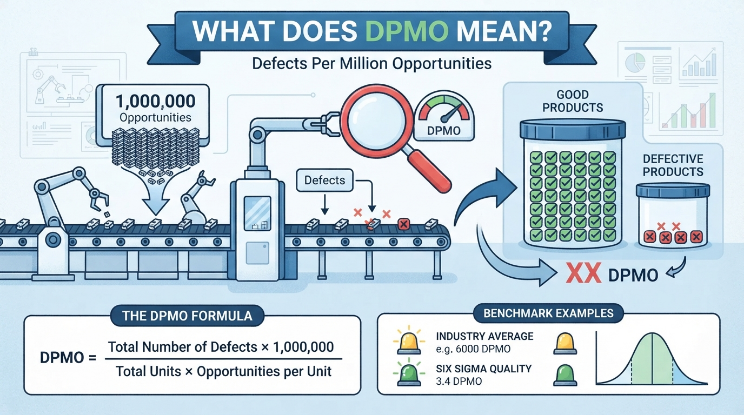
DPMO considers all of these opportunities instead of simply counting defective products.
DPMO Formula
The standard DPMO formula is:
DPMO = (Number of Defects ÷ Number of Opportunities) × 1,000,000
When calculating DPMO, you need three main values:
- Number of defects
- Number of units produced
- Number of defect opportunities per unit
The total number of opportunities is calculated as:
Units × Opportunities per Unit
So the complete formula can also be written as:
DPMO = Defects ÷ (Units × Opportunities per Unit) × 1,000,000
This formula converts the defect rate into a value based on one million opportunities.
DPMO Calculation Example
Suppose a company produces 2,000 products.
Each product has 5 possible defect opportunities.
The total number of opportunities is:
2,000 × 5 = 10,000 opportunities
Now suppose quality inspectors find 20 defects.
Using the DPMO formula:
DPMO = (20 ÷ 10,000) × 1,000,000
DPMO = 2,000
So the process has a DPMO of 2,000.
This means there are 2,000 defects for every one million opportunities, based on the observed defect rate.
Why Is DPMO Important?
DPMO helps businesses understand process quality in a standardized way.
A simple defect count does not always tell the full story. A process with 50 defects may sound worse than a process with 20 defects, but the number of products and opportunities can be very different.
DPMO accounts for these differences.
It can help organizations:
- Measure process performance
- Compare different processes
- Find quality problems
- Track improvements
- Set quality targets
- Support Six Sigma projects
- Reduce process variation
- Monitor defect rates
This makes DPMO useful for both quality teams and process improvement projects.
DPMO in Six Sigma
DPMO is strongly associated with Six Sigma quality management.
Six Sigma focuses on reducing process variation and defects. DPMO provides a way to measure how many defects occur relative to the number of opportunities.
A commonly cited Six Sigma benchmark is approximately 3.4 defects per million opportunities, based on the traditional Six Sigma convention that includes a 1.5-sigma shift.
This figure is used as a benchmark for very high process performance.
However, the actual DPMO of a process depends on the data collected and the method used to calculate opportunities and defects.
DPMO vs. Defect Rate
DPMO and defect rate both measure quality, but they are not exactly the same.
A defect rate generally describes the percentage or proportion of defective units.
DPMO considers the number of defect opportunities within those units.
For example, imagine 1,000 products are produced and each product has 4 possible defect opportunities.
That creates:
1,000 × 4 = 4,000 opportunities
If 10 defects are found, the DPMO is:
(10 ÷ 4,000) × 1,000,000 = 2,500 DPMO
The DPMO value gives more detail when each unit can have multiple possible defects.
DPMO vs. DPM
DPM stands for Defects Per Million, while DPMO stands for Defects Per Million Opportunities.
The main difference is the word opportunities.
DPM considers defects against a million units or another defined base, depending on the calculation.
DPMO considers the number of possible defect opportunities within those units.
For processes where each product can have several defect opportunities, DPMO provides a more detailed measurement.
DPMO vs. PPM
PPM means Parts Per Million. It is often used to describe the number of defective parts in a million parts.
DPMO is different because it considers multiple defect opportunities within each unit.
For example, one product may have ten different quality characteristics. A defect could occur in any of those characteristics.
DPMO counts those possible opportunities, while PPM generally focuses on defective units or parts.
| Measurement | Meaning | Main Focus |
| DPMO | Defects Per Million Opportunities | Defect opportunities |
| DPM | Defects Per Million | Defects per million units |
| PPM | Parts Per Million | Parts or units |
The appropriate measurement depends on the process and the quality metric being used.
How to Calculate Total Opportunities
Before calculating DPMO, you need to determine the total number of opportunities.
Use this formula:
Total Opportunities = Number of Units × Opportunities Per Unit
For example:
- Units produced = 5,000
- Opportunities per unit = 4
Therefore:
5,000 × 4 = 20,000 opportunities
If the process has 40 defects:
DPMO = (40 ÷ 20,000) × 1,000,000
DPMO = 2,000
The accuracy of the DPMO result depends on correctly identifying the defect opportunities.
What Is a Good DPMO?
There is no single DPMO value that is considered good for every industry or process.
The target depends on:
- Product requirements
- Customer expectations
- Industry standards
- Process complexity
- Cost of defects
- Quality goals
- Risk associated with failure
In general, a lower DPMO indicates fewer defects relative to the number of opportunities.
Organizations often set their own acceptable DPMO targets based on their processes and customer requirements.
DPMO and Process Improvement
DPMO can be used to track changes in process quality over time.
For example, a company may record:
| Period | DPMO |
| January | 8,000 |
| February | 6,500 |
| March | 4,800 |
| April | 3,200 |
This shows a reduction in the measured defect rate over the period.
Quality teams can use this information to investigate what changes helped reduce defects.
DPMO can therefore serve as a useful measurement during continuous improvement projects.
Benefits of Using DPMO
DPMO offers several benefits when used correctly.
Standardized Measurement
DPMO converts defect performance to a common base of one million opportunities.
Process Comparison
It can help compare processes with different numbers of units or defect opportunities.
Quality Tracking
Teams can monitor DPMO over time to see whether defect performance is changing.
Six Sigma Support
DPMO is commonly used in Six Sigma projects to measure process performance.
Problem Identification
A high DPMO can help identify processes that need further investigation.
Performance Goals
Organizations can use DPMO values when setting measurable quality targets.
Limitations of DPMO
DPMO is useful, but it does not explain why defects occur.
A DPMO number alone cannot tell you:
- What caused the defects
- Which defect is most serious
- Whether all defects have equal impact
- Which process step needs correction
- How much defects cost the business
The definition of a defect opportunity can also affect the final DPMO value.
For this reason, DPMO should be considered alongside other quality measurements and process information.
DPMO Example in Manufacturing
Imagine a factory produces 10,000 electronic devices.
Each device has 6 possible defect opportunities.
The total opportunities are:
10,000 × 6 = 60,000
Quality inspectors identify 30 defects.
Now calculate:
DPMO = (30 ÷ 60,000) × 1,000,000
DPMO = 500
The process therefore has a DPMO of 500 based on the collected data.
This number can then be compared with the company’s quality target or previous process results.
DPMO Example in Customer Service
DPMO is not limited to manufacturing.
Suppose a company processes 4,000 customer orders.
Each order has 3 possible error opportunities, such as:
- Incorrect customer information
- Incorrect product
- Incorrect quantity
Total opportunities:
4,000 × 3 = 12,000
If the company records 24 errors, then:
DPMO = (24 ÷ 12,000) × 1,000,000
DPMO = 2,000
This gives the company a standardized way to measure errors across the defined opportunities.
DPMO and Quality Management
DPMO can support quality management by providing a numerical view of defects.
Quality teams can use it with other methods to:
- Identify recurring problems
- Track process changes
- Monitor performance
- Compare results
- Support corrective actions
- Measure improvement
However, the number should always be interpreted within the context of the process being measured.
Frequently Asked Questions About DPMO
What does DPMO stand for?
DPMO stands for Defects Per Million Opportunities. It is a quality measurement used to express the number of defects for every one million possible defect opportunities.
What is the DPMO formula?
The formula is:
DPMO = (Number of Defects ÷ Total Opportunities) × 1,000,000
Total opportunities are usually calculated by multiplying the number of units by the number of defect opportunities per unit.
What does a lower DPMO mean?
A lower DPMO generally means fewer defects are occurring relative to the number of opportunities measured.
What does a high DPMO mean?
A high DPMO indicates that more defects are occurring relative to the defined number of opportunities.
What is 3.4 DPMO?
Approximately 3.4 DPMO is commonly associated with the traditional Six Sigma benchmark. It is based on the conventional Six Sigma calculation that uses a 1.5-sigma shift.
Is DPMO the same as PPM?
No. PPM means Parts Per Million, while DPMO means Defects Per Million Opportunities. DPMO accounts for multiple possible defect opportunities within a unit.
Is DPMO used in Six Sigma?
Yes. DPMO is commonly used in Six Sigma to measure process performance and defect levels.
How do you calculate DPMO?
First, calculate total opportunities by multiplying units by opportunities per unit. Then divide the number of defects by total opportunities and multiply the result by one million.
Can DPMO be used outside manufacturing?
Yes. DPMO can be applied to many processes where defects can be clearly defined and the number of opportunities can be identified.
Final Thoughts
DPMO means Defects Per Million Opportunities. It is an important quality measurement used to understand how many defects occur compared with the total number of possible defect opportunities.
The basic formula is simple:
DPMO = (Defects ÷ Total Opportunities) × 1,000,000
The key part of the calculation is correctly identifying the number of opportunities. Each unit may have several possible points where a defect can occur, so DPMO accounts for those opportunities rather than simply counting defective units.
DPMO is commonly used in Six Sigma and quality management to measure process performance, compare results, and track improvements. A lower DPMO generally represents fewer defects relative to the opportunities measured.
For accurate analysis, DPMO should not be viewed on its own. It works best when combined with other quality data, process analysis, and information about the type and impact of each defect.
