


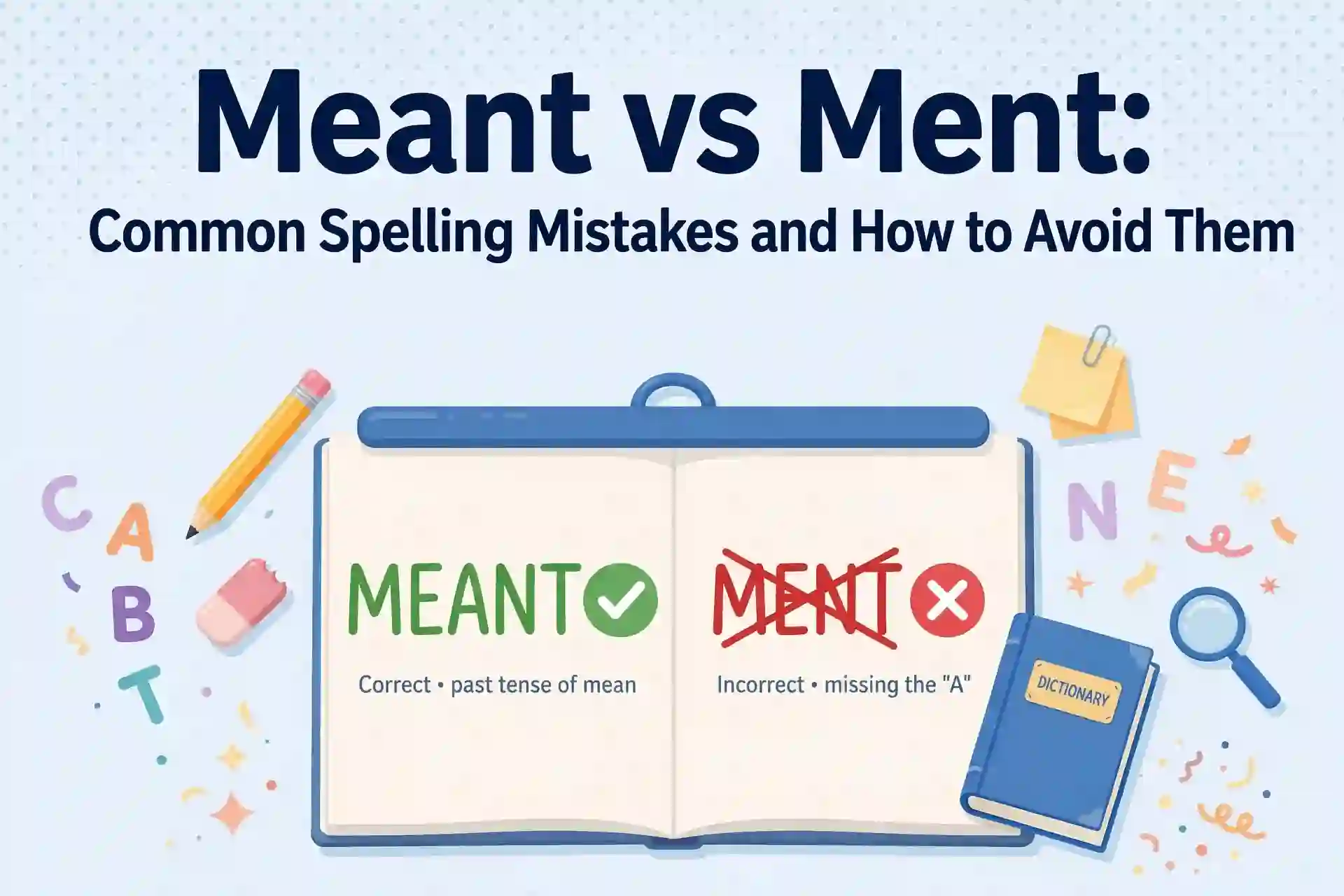
When it comes to English spelling, small differences can cause big confusion. Meant vs Ment is a common example. Both forms look similar, but they do not serve the same purpose. One is a correct English word, while the other is usually a spelling mistake. Many people confuse them when writing messages, emails, school assignments, or professional documents.
Meant vs Ment: What Is the Difference?
The main difference between these two forms is their spelling and grammatical use. One works as a past-tense verb, while the other does not work as a standard English word in the same way.
Meant is the correct past tense and past participle of the verb “mean.” It describes what someone intended, wanted to express, or had in mind.
Ment is not the standard spelling of this past-tense verb. People sometimes write it by mistake because it sounds like the ending of “meant.”
Here is a simple comparison:
| Word | Correct usage | Example |
| Meant | Past tense of mean | I meant to call you. |
| Ment | Not a standard form of mean | I ment to call you. |
The first sentence is correct. The second contains a spelling error.
What Does Meant Mean?
The word “meant” has several uses in English. It usually describes an intention, purpose, or meaning. It can also describe something that was planned or expected.
Meant is the past tense of “mean.” It can also work as a past participle with helping verbs such as “have,” “had,” and “has.”
Meant as the Past Tense of Mean
The most common use of “meant” is to describe something someone intended in the past.
For example:
- I meant to send you a message yesterday.
- She meant to help her friend.
- He meant to finish the work before dinner.
- We meant to visit our grandparents last week.
- They meant to arrive early.
Each sentence describes an intention that existed in the past.
The word does not always mean that the person completed the action. Someone may have meant to do something but failed to do it.
For example:
“I meant to clean my room, but I got busy.”
Meant as a Way to Explain Meaning
You can also use “meant” when you explain what a word, message, action, or statement represented.
Examples include:
- What did you mean by that comment?
- I meant that the plan needed more work.
- Her smile meant a lot to me.
- His words meant something different to everyone.
- The sign meant that visitors should stop.
In these examples, the word connects an action or expression to its meaning.
Meant as a Past Participle
“Meant” also works as the past participle of “mean.”
A past participle often appears with helping verbs. These include “have,” “has,” and “had.”
Consider these examples:
- I have always meant to thank you.
- She had meant to explain everything.
- We have meant to visit that place for years.
- He has meant well from the beginning.
These sentences show how the same spelling works in different verb structures.
Meant in Everyday Expressions
English speakers use “meant” in several common expressions.
Here are some examples:
- I meant no harm: I did not intend to hurt anyone.
- It was meant to be: Something happened as if it were destined to happen.
- I meant what I said: I was serious about my words.
- What I meant was: I want to explain my earlier statement.
- You know what I meant: You understand my intended message.
These expressions appear in daily conversations, books, movies, and online messages.
Is Ment a Real Word?
The answer depends on how you use it. “Ment” is not the correct past tense of “mean.” However, the same letter combination appears in many valid English words.
This difference matters because people often assume that every word ending in “ment” follows the same spelling rule.
Ment as a Spelling Mistake
When someone writes “ment” instead of “meant,” they make a spelling mistake.
For example:
Incorrect: I ment to tell you the truth.
Correct: I meant to tell you the truth.
The correct form contains the letter “a” before the final “t.”
Ment as a Word Ending
The letters “ment” form a common suffix in English.
A suffix is a group of letters added to the end of a word. It can change the word’s meaning or grammatical role.
Examples include:
- Payment
- Movement
- Agreement
- Development
- Enjoyment
- Treatment
- Improvement
- Achievement
- Excitement
- Management
These are all correct English words.
The suffix “-ment” often turns a verb into a noun. For example:
| Verb | Noun |
| Pay | Payment |
| Move | Movement |
| Agree | Agreement |
| Develop | Development |
| Enjoy | Enjoyment |
| Improve | Improvement |
In these examples, “ment” helps create a noun that describes an action, process, or result.
It does not replace the word “meant.”
Why Meant vs Ment Look Similar
Both spellings contain the same final three letters. They also have similar sounds in many accents.
This similarity makes them easy to confuse, especially for beginners and people learning English as a second language.
However, their roles differ. “Meant” is a complete verb form. The letters “-ment” usually appear as a suffix inside a larger word.
Why Do People Confuse Meant vs Ment?
Spelling confusion often happens when pronunciation, memory, and typing habits influence writing. These two forms create a common problem because they look and sound similar.
Understanding the reasons behind this mistake can help you avoid it.
Similar Pronunciation
In many English accents, “meant” sounds like “ment” might sound if it were written as a separate word.
The difference becomes difficult to notice when people speak quickly.
For example, someone may say:
“I meant to ask you something.”
A listener hears the sound but may not remember the correct spelling.
Fast Typing Habits
People often make spelling mistakes when they type quickly.
They may write “ment” without noticing that the correct word needs an “a.”
This can happen in:
- Text messages
- Social media comments
- Online chats
- Emails
- School assignments
- Work documents
A quick review can help you catch this error before sending your message.
Confusion With the Suffix Ment
Another reason for this mistake is the frequent use of “-ment” in English.
Words such as “payment” and “movement” make the ending familiar. Some writers may apply the same spelling when writing the past tense of “mean.”
Limited Grammar Knowledge
Some learners do not know that “meant” comes from the verb “mean.”
They may try to form the past tense by changing the ending in a way that seems natural.
Learning common irregular verbs can solve this problem.
The verb “mean” does not take the regular “-ed” ending. Its past form is “meant,” not “meaned” or “ment.”
Meant vs Ment: Correct Examples in Sentences
Examples make spelling rules easier to understand. The following sentences show how to use “meant” in different situations.
Read each example and notice how the word connects to intention, meaning, or purpose.
Examples With Meant
Here are some everyday sentences:
- I meant to call you last night.
- She meant every word in her apology.
- He meant to finish his homework early.
- We meant to invite you to the party.
- They meant no disrespect.
- I never meant to hurt your feelings.
- What you said meant a lot to me.
- This message meant something special.
- The teacher meant that everyone should participate.
- I meant to explain the situation earlier.
Incorrect Sentences With Ment
These examples show common spelling errors and their corrections.
| Incorrect sentence | Correct sentence |
| I ment to call you. | I meant to call you. |
| She ment no harm. | She meant no harm. |
| What he ment was clear. | What he meant was clear. |
| They ment to visit us. | They meant to visit us. |
| I never ment that. | I never meant that. |
| He ment every word. | He meant every word. |
Notice that every corrected sentence uses “meant.”
Examples in Text Messages
People often use the word in casual online conversations.
Here are some natural examples:
Example 1
Person A: Why didn’t you reply yesterday?
Person B: Sorry! I meant to reply, but I forgot.
2nd example
Person A: Did you mean that comment?
Person B: Yes, I meant every word.
Example 3
Person A: You sounded upset earlier.
Person B: I didn’t mean to sound rude. I was tired.
Meant vs Ment vs Meant to Be: Understanding the Grammar
The words”meant vs ment” belong to the same verb family. However, they appear in different grammatical situations.
Learning their relationship will help you choose the right form.
Mean: Present Tense
“Mean” is the present form of the verb. It describes what something represents or what someone intends now.
Examples:
- I mean what I say.
- What does this word mean?
- They mean well.
- These instructions mean you must wait.
Use “mean” when you talk about the present or a general fact.
Meant: Past Tense
“Meant” describes an intention or meaning in the past.
Examples:
- I meant to visit you.
- She meant to say something else.
- What did he mean yesterday?
- They meant to finish the project.
Use “meant” when the situation happened in the past.
Meant to Be: A Common Expression
“Meant to be” is a popular expression in English.
It describes something that seems destined, intended, or naturally suited to happen.
Examples:
- We were meant to meet.
- This friendship was meant to last.
- It was meant to happen this way.
- They were meant to work together.
The phrase often appears in romantic conversations and discussions about life events.
Quick Grammar Comparison
| Form | Main use | Example |
| Mean | Present tense | I mean well. |
| Means | Present tense with he, she, or it | She means no harm. |
| Meant | Past tense | I meant to help. |
| Meant | Past participle | I have meant to ask you. |
This comparison shows that “meant” has more than one grammatical use, but its spelling stays the same.
Common Mistakes to Avoid When Using Meant
Even confident writers can make spelling mistakes. A little attention to grammar and sentence structure can help you write correctly.
Here are some common errors and simple ways to fix them.
Writing Ment Instead of Meant
This is the main mistake people make.
Incorrect: I ment to send the email.
Correct: I meant to send the email.
Always include the letter “a” in the correct past-tense form.
Writing Meaned Instead of Meant
Some people assume that adding “-ed” creates the past tense of every English verb.
However, “mean” is an irregular verb.
Incorrect: I meaned to help you.
Correct: I meant to help you.
Other irregular verbs follow similar patterns. For example, “go” becomes “went,” and “write” becomes “wrote.”
Using Meant in the Present Tense
Another common error involves using the past form when talking about the present.
Incorrect: I meant that this is a good idea.
Correct: I mean that this is a good idea.
The correct choice depends on the time and meaning of your sentence.
Easy Tips to Remember the Correct Spelling
You do not need to memorize complicated grammar rules to use the correct form. A few simple techniques can help you remember it.
Connect Meant With Mean
The easiest way to remember the spelling is to connect the two forms.
- Mean = Present
- Meant = Past
For example:
“I mean to help.”
“I meant to help.”
Both sentences express an intention, but they refer to different times.
Remember the Letter A
Think of the letter “a” in “meant.”
Whenever you want to describe something you intended in the past, remember to include this letter.
A simple memory trick is:
“Meant has an A because I meant what I say.”
This phrase can help beginners recall the correct spelling.
Why Correct Spelling Matters in Everyday Writing
Correct spelling makes your message easier to understand. It also helps readers focus on your ideas instead of noticing mistakes.
The difference between two similar-looking words may seem small, but it can affect the quality of your writing.
In Professional Communication
Emails, reports, and business messages need clear language.
A spelling mistake can make a message look rushed or poorly reviewed.
For example:
Incorrect: I ment to send the report yesterday.
Correct: I meant to send the report yesterday.
The corrected sentence looks more polished and communicates the same idea clearly.
In School and Academic Writing
Students need correct spelling in essays, assignments, and examinations.
Learning irregular verbs can help reduce common grammar mistakes.
Teachers may also expect students to understand the difference between present and past verb forms.
In Social Media and Online Chats
People often use informal language online. However, correct spelling still improves communication.
A message with the wrong spelling may confuse readers or distract them from the intended meaning.
Using the correct form also helps you build stronger writing habits over time.
In Articles and Website Content
Website content needs clear spelling and grammar. Readers expect articles to explain ideas in a simple and accurate way.
A quick editing process can help writers catch mistakes before publication.
If you create online content, review common spelling pairs and irregular verbs during proofreading.
Frequently Asked Questions
Is meant vs ment the correct spelling?
“Meant” is the correct spelling when you want to use the past tense of “mean.” “Ment” is not a standard alternative. For example, “I meant to call you” is correct, while “I ment to call you” is incorrect.
What does meant mean in simple words?
“Meant” describes something a person intended, wanted to say, or had in mind. For example, “I meant to help you” means that helping you was my intention.
Is ment ever a correct word?
The letters “ment” appear in many correct English words, such as payment, movement, and agreement. However, “ment” is not the correct past-tense form of “mean.”
Why do people write ment instead of meant?
People often make this mistake because both forms look similar and can sound alike in everyday speech. Fast typing and confusion with the “-ment” suffix can also cause the error.
Is meant the past tense of mean?
Yes. “Meant” is both the past tense and past participle of “mean.” For example, “I mean well” uses the present form, while “I meant well” uses the past form.
How can I remember the difference between meant and ment?
Remember that “meant” contains the letter “a.” Use it when talking about a past intention or meaning. The spelling “ment” belongs in words with the “-ment” suffix, not as a replacement for “meant.”
Conclusion
Understanding the difference between these two spellings is simple once you learn the basic grammar rule. “Meant” is the correct past tense and past participle of “mean.” It describes something someone intended, wanted to express, or had in mind. “Ment” is not the correct spelling when you want to use the past form of this verb.
The main reason people confuse these forms is their similar appearance and pronunciation. The frequent use of the “-ment” suffix in words such as “payment” and “movement” can also cause mistakes.Once you understand the rule behind Meant vs Ment, you can avoid this common spelling error in text messages, emails, schoolwork, and professional writing. A little practice can make correct spelling feel natural.
