


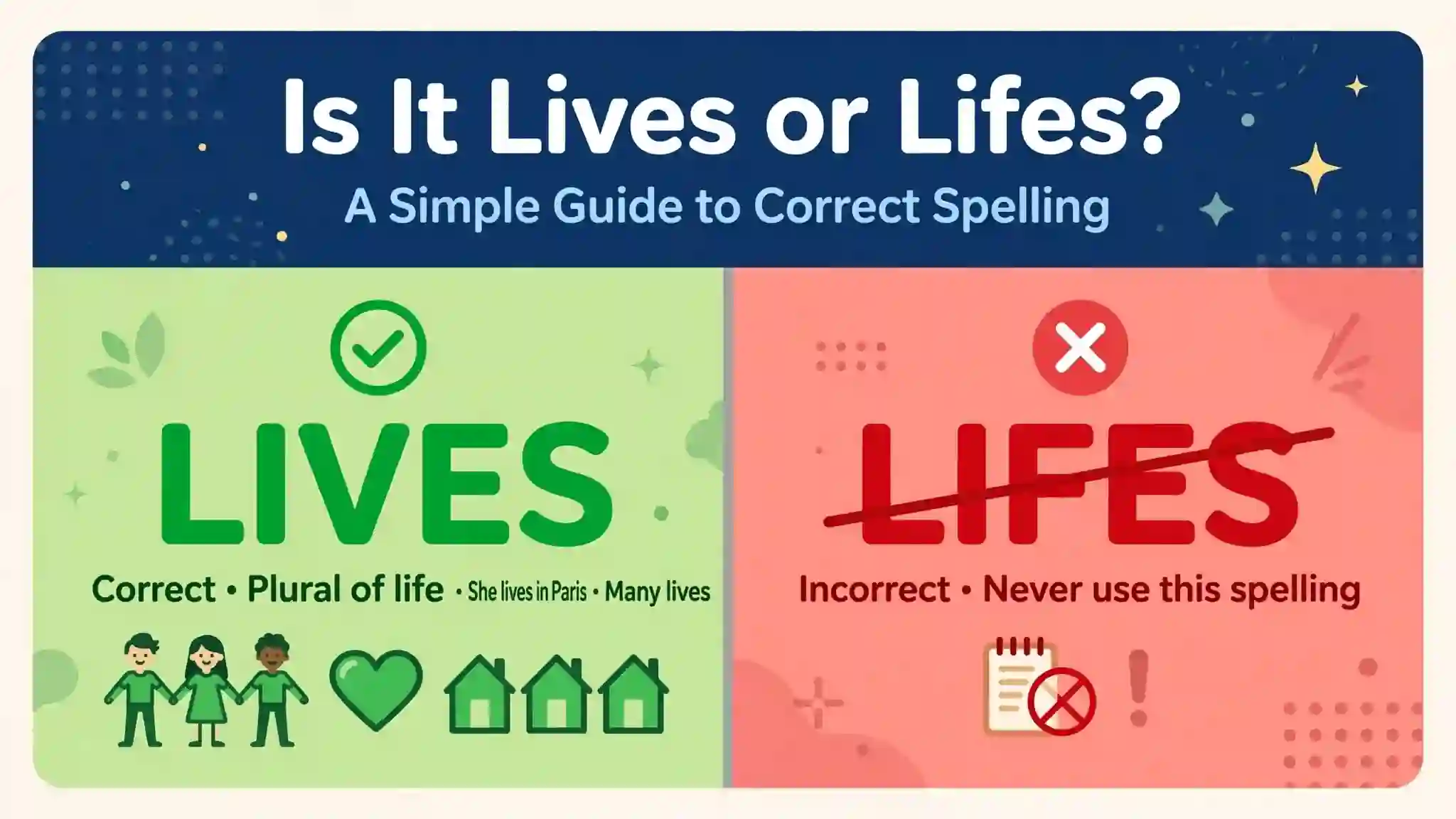
When it comes to English spelling, some words look similar but follow different grammar rules. Lives vs lifes is a common example that confuses many English learners and even native speakers. Both forms may look correct at first, but only one works as the plural of the noun “life.” The word “lives” also has another meaning as a verb, which makes the difference even more important. Knowing when to use each form can improve your writing and help you avoid common spelling mistakes. This guide explains the correct spelling, grammar rules, meanings, pronunciation, and practical examples. You will also learn how to remember the correct form in everyday writing.
Lives vs Lifes: Which Spelling Is Correct?
The spelling of a word can change when you make it plural. English has several rules for this process. Some nouns add “s,” while others need a different ending. The word “life” follows one special rule.
Lives is the correct plural form of the noun “life.” The word “lifes” is not a standard English plural. You should use “lives” when you talk about more than one person’s life, the experiences of different people, or living things.
For example:
- One life can change in a moment.
- Many lives can change in a moment.
- Every life has value.
- Millions of lives depend on clean water.
The word “lifes” does not follow the standard English spelling rule for this noun.
There is another reason people sometimes get confused. “Lives” can also work as a verb. It is the third-person singular form of “live.”
For example:
- She lives in London.
- He lives with his parents.
- My grandmother lives near the coast.
The meaning depends on how you use the word in a sentence.
Lives vs Lifes: Understanding the Grammar Rule
English spelling rules help us form plurals correctly. Most regular nouns add “s” or “es” to become plural. However, some words ending in “f” or “fe” change their endings to “ves.”
The noun “life” belongs to this group. You remove the final “fe” and add “ves” to form “lives.”
The basic spelling rule is simple:
- Life becomes lives.
- Wife becomes wives.
- Knife becomes knives.
- Wolf becomes wolves.
- Leaf becomes leaves.
These words follow a common English plural pattern. However, not every noun ending in “f” follows this rule.
For example:
- Roof becomes roofs.
- Chief becomes chiefs.
- Belief becomes beliefs.
- Chef becomes chefs.
This means you cannot change every final “f” or “fe” into “ves.” You must learn the correct plural form of each word.
The best approach is to remember common examples and check a dictionary when you are unsure.
Why Does Life Change to Lives?
The word “life” comes from Old English. Its spelling and pronunciation developed over time. English also borrowed words from different languages, which helped create several plural patterns.
The change from “life” to “lives” is part of an older English spelling pattern. The final sound changes when the word becomes plural.
The letter “f” represents a voiceless sound. In “lives,” the final consonant has a voiced sound. English spelling uses “v” to show this change.
You can see the same pattern in other familiar words:
- Wife and wives
- Knife and knives
- Life and lives
- Half and halves
These examples make the rule easier to understand. They also show why writing “lifes” is incorrect when you mean more than one life.
Is Lifes Ever Correct?
In standard English, “lifes” is not the accepted plural form of “life.” Dictionaries recognize “lives” as the correct plural.
You may still see “lifes” in informal writing, online comments, spelling exercises, or social media posts. These uses usually result from a spelling mistake.
There are rare cases where a writer may use “lifes” as part of a deliberately invented name, brand, username, or creative expression. That does not make it a standard English word.
What Does Lives Mean?
The word “lives” has two main grammatical uses. It can be a plural noun or a verb. Understanding these meanings helps you choose the right form.
As a plural noun, “lives” refers to more than one life. It can describe people, animals, experiences, or the time someone spends living.
Examples include:
- The accident changed many lives.
- Their lives became easier after moving.
- Doctors work hard to save lives.
- These animals live different lives in the wild.
As a verb, “lives” means that someone or something continues to exist or stays in a particular place.
Examples include:
- My brother lives in Canada.
- She lives a peaceful life.
- The family lives in a small village.
- He lives with his friends.
The sentence structure helps you understand the meaning. When “lives” follows a subject such as “he,” “she,” or “it,” it often works as a verb.
When it refers to several people or living experiences, it works as a plural noun.
Lives as a Plural Noun
As a noun, “lives” is the plural of “life.” It describes the existence or experiences of two or more people or living things.
For example:
- Many lives were saved during the rescue.
- Their lives changed after the wedding.
- Healthy habits can improve our lives.
- The charity helps people rebuild their lives.
You can also use this word in emotional, social, and professional contexts.
For example, a teacher may change the lives of students through education. A doctor may save lives by treating patients. A new opportunity may improve the lives of an entire family.
Lives as a Verb
The word “lives” also comes from the verb “live.” It describes what one person or thing does.
Use “lives” with singular third-person subjects such as:
- He
- She
- It
- My friend
- The child
- A bird
Examples:
- He lives near his workplace.
- She lives with her sister.
- The cat lives inside the house.
- My friend lives in a busy city.
Do not use “lives” with plural subjects such as “they” or “we.”
For example:
- They live in New York.
- We live in a small town.
- My friends live nearby.
This grammar rule helps you avoid another common writing mistake.
Why Do People Confuse Lives vs Lifes?
Many English learners assume that every noun forms its plural by adding “s.” This rule works for many common words, such as books, cars, and tables.
However, English has irregular plurals and spelling changes. These exceptions make some words difficult to remember.
The word “life” creates confusion because its plural form does not follow the most common pattern.
Here are some common reasons for this mistake.
Applying the regular plural rule: Writers may add “s” to “life” because they follow the same pattern as “book” and “books.”
Confusing spelling with pronunciation: The plural form sounds different from the singular form. Some learners do not recognize the connection between the two words.
Typing too quickly: People sometimes write “lifes” in messages or online posts without checking the spelling.
Learning English through simple rules: Beginners may learn that most nouns add “s” without studying words that change their endings.
The easiest solution is to remember the special plural form of “life.” Once you learn that “life” becomes “lives,” the spelling becomes much easier.
Lives vs Lifes: Examples in Everyday Sentences
Sentence examples show how grammar rules work in real situations. They also help you understand the difference between nouns and verbs.
The following examples use “lives” in different contexts.
Examples of Lives as a Noun
Use “lives” when you discuss several people or living experiences.
- Education can transform young lives.
- The storm put many lives at risk.
- Their lives improved after finding better jobs.
- Volunteers help save lives every year.
- Technology has changed our lives.
- The two sisters have very different lives.
- The rescue team worked hard to protect lives.
- Good decisions can improve people’s lives.
- These stories describe the lives of famous writers.
- Their lives became more peaceful after retirement.
Notice that each sentence refers to more than one life or experience.
Examples of Lives as a Verb
Use “lives” when describing where one person stays or how someone exists.
- My uncle lives in Australia.
- She lives with her family.
- He lives a simple lifestyle.
- The bird lives in a forest.
- My teacher lives near the school.
- A famous actor lives in this neighborhood.
- The child lives with his grandparents.
- She lives happily with her husband.
- He lives far away from the city.
- This animal lives in cold climates.
In these examples, “lives” describes an action or state rather than a plural noun.
Incorrect and Correct Examples
Comparing incorrect and correct sentences makes the spelling rule easier to remember.
| Incorrect sentence | Correct sentence |
| Many lifes were saved. | Many lives were saved. |
| Their lifes are different. | Their lives are different. |
| We should respect all lifes. | We should respect all lives. |
| She lifes in London. | She lives in London. |
| He lifes with his parents. | He lives with his parents. |
| These lifes matter. | These lives matter. |
Remember that “lifes” is incorrect as the standard plural of “life.” The verb “lives” also needs a singular third-person subject.
Life, Lives, and Living: Understanding the Differences
The words “life,” “lives,” and “living” look related because they share the same root. However, they have different grammatical roles.
Learning these forms can help you write clearer sentences.
| Word | Meaning | Example |
| Life | Singular noun | Life is precious. |
| Lives | Plural noun | Many lives were saved. |
| Lives | Third-person verb | She lives nearby. |
| Living | Verb form or adjective | They are living together. |
| Lived | Past tense | He lived abroad. |
Common Mistakes to Avoid When Using Lives vs Lifes
Even experienced writers sometimes make spelling and grammar mistakes. The best way to avoid them is to understand the role of each word.
Here are some mistakes to watch for.
Using lifes as a plural noun
Incorrect: Many lifes were affected by the disaster.
Correct: Many lives were affected by the disaster.
The plural of “life” is “lives,” not “lifes.”
Using lives with a plural subject
Incorrect: They lives in a large house.
Correct: They live in a large house.
Use “live” with plural subjects such as “they” and “we.”
Using live with a singular third-person subject
Incorrect: She live in Paris.
Correct: She lives in Paris.
Use “lives” with “he,” “she,” and “it” in the present simple tense.
Confusing life and lives
Incorrect: Their life are completely different.
Correct: Their lives are completely different.
The plural subject needs the plural noun “lives.”
Easy Tips to Remember the Correct Spelling of Lives vs Lifes
You do not need to memorize every English spelling rule at once. A few simple techniques can help you remember the correct form of “life.”
Remember the F-to-V rule: Many nouns ending in “f” or “fe” change to “ves” in their plural forms. Think of life and lives, wife and wives, and knife and knives.
Learn the word as a pair: Practice writing “life → lives.” Seeing both forms together helps you remember their relationship.
Read example sentences: Read sentences that use “lives” as a noun and a verb. This helps you understand both meanings.
Practice with short exercises: Write five sentences using “lives” as a noun and five using it as a verb.
Check your subject: When using “lives” as a verb, ask whether the subject is singular and third person.
Use a dictionary: If you are unsure about a plural form, check a trusted English dictionary instead of guessing.
These tips can improve your spelling and make your writing more natural.
Lives vs Lifes: Quick Practice Quiz
Practice helps you remember spelling rules. Try these questions to check your understanding.
Choose the correct word in each sentence.
- Many (lives/lifes) were saved by the rescue team.
- My sister (live/lives) in a small town.
- Their (life/lives) changed after moving abroad.
- He (live/lives) with his parents.
- Every (life/lives) deserves respect.
- The two brothers have different (life/lives).
- She (live/lives) near the university.
- Doctors work hard to protect (life/lives).
Correct answers:
- Lives
- Lives
- Lives
- Lives
- Life
- Lives
- Lives
- Lives
The first four questions test the plural noun and verb forms. The fifth question uses the singular noun. The remaining questions reinforce the correct plural and verb choices.
Review any mistakes and try the quiz again. Repeated practice will help you use these forms correctly without thinking too much about the spelling rule.
Frequently Asked Questions
Is lifes ever a correct word?
No. “Lifes” is not the standard plural form of “life” in English. The correct spelling is “lives.” You may see “lifes” in informal writing or creative names, but you should avoid it in standard sentences.
What is the plural of life?
The plural of “life” is “lives.” For example, you can say, “Many lives were saved during the emergency.” The word changes from “fe” to “ves” when it becomes plural.
Why does life become lives instead of lifes?
“Life” follows a common English spelling pattern. Some nouns ending in “f” or “fe” change that ending to “ves” in the plural form. Examples include “knife” and “knives” and “wife” and “wives.”
Is lives a noun or a verb?
” Lives” can be both a noun and a verb. As a noun, it means more than one life. As a verb, it describes where one person lives or how someone exists. The sentence determines its grammatical role.
What is the difference between lives vs lifes?
“Life” is singular, while “lives” is its plural form. You use “life” for one existence and “lives” for multiple existences. “Lives” can also function as the present-tense verb form of “live.”
How do you use lives in a sentence?
You can use “lives” as a noun or verb. For example, “Many lives were saved” uses it as a noun. “She lives in London” uses it as a verb.
Conclusion
Understanding lives vs lifes is easier when you remember one simple rule: “lives” is the correct plural form of “life.” The spelling changes because “life” follows an English pattern in which the final “fe” becomes “ves.” The word “lifes” is not a standard plural form, so avoid using it in everyday writing, schoolwork, and professional communication.
You should also remember that “lives” has two grammatical uses. It can describe several lives as a plural noun, or it can act as a verb with singular subjects such as “he,” “she,” and “it.” The surrounding sentence helps you identify its meaning.
