


When it comes to English spelling, some words create confusion even among fluent speakers. Damnit or Dammit is a common example. Both spellings appear in text messages, social media posts, online comments, and everyday writing. They express frustration, anger, disappointment, or annoyance. But which spelling should you use? Is one correct, or can you use both?
Damnit or Dammit: Which Spelling Is Correct?
Both spellings appear in everyday English, but they do not have the same status in standard writing. Understanding their differences can help you avoid spelling mistakes.
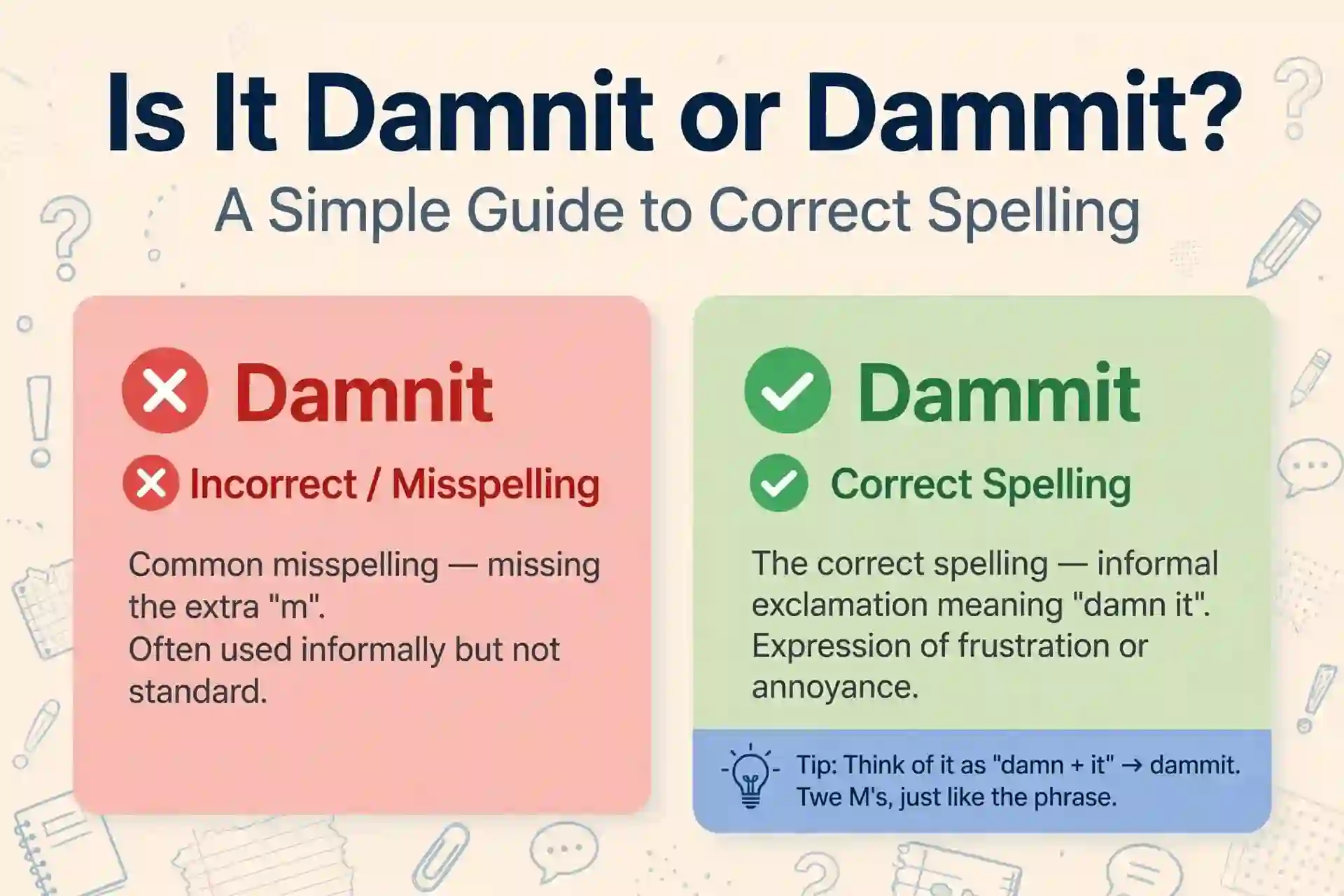
Dammit is the more widely accepted informal spelling. It represents the spoken expression used to show anger, frustration, or irritation. Many dictionaries recognize this form as an interjection.
Damnit is also common in informal writing. People often use it as an alternative spelling of the same expression. However, it is generally treated as a nonstandard variant.
Here is a simple comparison:
| Spelling | Usage | Status |
| Dammit | Informal expression of frustration | Established spelling |
| Damnit | Informal alternative spelling | Nonstandard variant |
| Damn it | Two-word expression | Standard form |
The original expression is damn it. Writers often combine these two words into one when expressing a strong emotion.
For example:
- Damn it! I forgot my keys.
- Dammit! I missed the bus again.
- Damnit! Why does this keep happening?
All three examples communicate frustration. The first uses the original two-word expression. The other two use informal spellings.
What Does Dammit Mean?
The word dammit expresses a strong feeling of frustration, anger, disappointment, or annoyance. People use it when something goes wrong or when a situation does not happen as expected.
It comes from the expression damn it. The phrase combines the word damn with the pronoun it.
In conversation, people often say this expression without thinking about its original meaning. It works as an emotional reaction rather than a complete sentence.
Consider these examples:
- Dammit! I left my wallet at home.
- Dammit, the internet stopped working again.
- I tried my best, but dammit, nothing worked.
- Oh, dammit! I forgot about the meeting.
Each sentence shows a different situation. The speaker feels annoyed because something unexpected happened.
The Meaning of Dammit in Everyday English
Dammit usually communicates an immediate emotional reaction. Its meaning can change slightly depending on the speaker’s tone and situation.
Here are some common meanings:
Frustration: Someone uses it when a task becomes difficult or something goes wrong.
Example: “Dammit! My computer just crashed.”
Anger: It can express irritation toward a person, event, or situation.
Example: “Dammit, why did you lie to me?”
Disappointment: People may use it when they feel unhappy about an unwanted result.
Example: “Dammit! I really wanted to win that game.”
Impatience: It can show that someone has lost patience with a repeated problem.
Example: “Dammit, hurry up! We are already late.”
The word does not always express serious anger. Friends may use it casually when joking about small problems.
Is Dammit a Bad Word?
Dammit comes from damn, which many people consider a mild swear word. It is not among the strongest offensive words in English, but it still counts as profanity.
Its acceptability depends on the setting.
In casual conversations, people often use it without causing much concern. However, it may sound rude in professional or formal situations.
For example:
- Casual: “Dammit! I dropped my phone.”
- Professional: “Unfortunately, I made a mistake.”
- Formal: “I regret that the plan did not work.”
Choose your words based on your audience. A casual expression may not suit a workplace email, school assignment, or official document.
What Does Damnit Mean?
Damnit has the same general meaning as dammit. People use it to express frustration, anger, annoyance, or disappointment.
The spelling appears frequently in online conversations, social media posts, and informal messages. Some people prefer it because it looks closer to the way they hear the expression.
However, damnit is not the standard spelling most dictionaries prefer. It is generally considered a variant of dammit or an informal spelling of damn it.
For example:
- Damnit! I forgot to charge my phone.
- I worked all day, and damnit, I still have more to do.
- Damnit, this game is harder than I expected.
- Oh, damnit! I missed your call.
These examples show how people use the spelling in everyday communication.
Why Do People Spell It Damnit?
English spelling does not always match pronunciation. This difference often creates alternative spellings.
People may write damnit because they hear the expression as one connected sound. They may not think about the original two-word phrase.
Several factors explain why this spelling remains popular:
- Pronunciation: The spoken expression sounds like one word.
- Typing habits: People often choose the spelling that feels natural.
- Online communication: Social media encourages informal language.
- Personal preference: Some writers simply prefer how damnit looks.
- Sound-based spelling: People sometimes write words according to how they hear them.
This does not mean every common spelling is standard. English contains many informal variations that people understand even when dictionaries do not recommend them.
Damnit or Dammit: Key Differences Explained
The difference between these spellings is mainly about standard usage, not meaning. Both forms communicate frustration, but one has stronger support as an established spelling.
Understanding this distinction helps you choose the right form for different situations.
Spelling and Dictionary Usage for Damnit or Dammit
Dammit is the more established one-word spelling. It appears in dictionaries as an informal interjection.
Damnit is also widely understood, but many readers and editors may consider it a nonstandard spelling.
The two-word form, damn it, remains the original expression.
Here is how the three forms compare:
| Form | Meaning | Best use |
| Damn it | Expression of frustration | Standard informal writing |
| Dammit | Expression of frustration | Informal one-word writing |
| Damnit | Expression of frustration | Casual online writing |
If you want to follow conventional spelling, choose damn it or dammit.
Pronunciation
The pronunciation of dammit and damnit is generally the same in everyday English.
Both spellings represent the familiar spoken expression. The difference appears in writing rather than speech.
The word usually has two syllables. Speakers pronounce it quickly, with emphasis on the first part.
The pronunciation does not change the meaning. Readers understand both spellings from context.
Meaning and Emotional Tone
Neither spelling has a stronger meaning than the other.
A person’s tone, punctuation, and situation determine how intense the expression sounds.
Compare these examples:
- “Dammit!” expresses frustration.
- “Damnit!” expresses the same frustration.
- “Damn it!” expresses the same feeling.
Adding capital letters or an exclamation mark can make the expression look more emotional.
For example, “DAMMIT!” may suggest stronger anger than “dammit.” However, this difference comes from the writing style, not the spelling itself.
When Should You Use Damnit or Dammit?
Choosing between these forms depends on your writing style and audience. Both communicate the same message, but the standard spelling is usually the safer option.
Use dammit when you want an established one-word expression. Use damn it when you want to keep the original two-word form.
Damnit may suit casual messages when you prefer that spelling, but avoid it in formal writing.
Use Dammit in Casual Conversations
Dammit works well in informal conversations with friends, family members, and people who understand your tone.
You can use it in text messages, personal notes, casual comments, and informal social media posts.
Examples:
- Dammit! I forgot to buy milk.
- I lost my favorite pen. Dammit!
- Dammit, that was supposed to be easy.
- I cannot believe I made that mistake again. Dammit!
These examples show how the word fits naturally into casual communication.
Use Damn It in Standard Writing
Damn it is a good choice when you want to preserve the original spelling.
The two-word form makes the meaning clear and avoids confusion about alternative spellings.
Examples:
- Damn it! I missed the train.
- I told myself to be careful, but damn it, I made another mistake.
- Damn it, the package has not arrived.
- Why does this happen every time? Damn it!
You can use this form in informal articles, personal writing, and dialogue.
Avoid Both Forms in Formal Writing
Neither dammit nor damn it usually belongs in formal or professional communication.
These expressions can sound emotional or inappropriate in certain settings.
Choose a neutral alternative instead.
| Informal expression | More professional alternative |
| Dammit! I made a mistake. | Unfortunately, I made a mistake. |
| Damn it! We are late. | We are running behind schedule. |
| Dammit, it did not work. | Unfortunately, it did not work. |
| Damn it! I forgot the file. | I apologize for forgetting the file. |
Professional writing should communicate the problem without unnecessary emotional language.
Examples of Damnit or Dammit in Sentences
Examples make spelling differences easier to understand. Both forms work as emotional expressions, but the context determines whether they sound natural.
Here are examples from everyday situations.
With Dammit Examples
- Dammit! I forgot my password again.
- I wanted to finish early, but dammit, I ran out of time.
- Dammit, why is my phone battery always low?
- She said, “Dammit! I knew I would forget something.”
- Dammit! The restaurant is already closed.
- I practiced all week, and dammit, I still made a mistake.
- Dammit, I spilled coffee on my shirt.
- Oh, dammit! I sent the wrong message.
Examples With Damnit
- Damnit! I left my homework at home.
- Damnit, this traffic is terrible.
- I cannot believe I lost the game. Damnit!
- Damnit! My favorite show ended.
- He whispered, “Damnit, I forgot the tickets.”
- Damnit, I thought today was Friday.
- Oh, damnit! I missed the delivery.
- Damnit! That was my last chance.
Examples With Damn It
- Damn it! I dropped my keys.
- Damn it, I forgot to call you.
- I wanted to help, but damn it, I was too late.
- Damn it! The printer stopped working.
- She sighed and said, “Damn it, not again.”
Notice that the meaning stays the same in all these examples. The spelling changes, but the emotional message remains clear.
Common Mistakes When Using Damnit or Dammit
Writers sometimes confuse these forms because they sound alike. They may also use them in situations where a different expression would work better.
Learning a few simple rules can prevent these mistakes.
Treating Damnit as the Only Correct Spelling
One common mistake is assuming damnit is the only acceptable one-word spelling.
Although people use it frequently, dammit is the more established spelling.
Remember that popularity does not always equal standard usage.
Confusing Dammit With Damn
Damn and dammit are related, but they do not always serve the same grammatical purpose.
Damn can work as a verb, adjective, or interjection.
Examples:
- Don’t damn someone without knowing the facts.
- This damn computer keeps freezing.
- Damn! I forgot my keys.
Dammit works as an informal interjection.
Example:
– Dammit! I forgot my keys.
The difference becomes clear when you look at the role each word plays in a sentence.
Writing Dammit as Two Separate Words
Some people write dammit when they mean damn it. These forms look similar, but they have different structures.
- Damn it: Two words.
- Dammit: One word.
- Damnit: One word, nonstandard variant.
The two-word form follows the original phrase. The one-word form represents its informal spelling.
Using Profanity in the Wrong Setting
Another mistake is using these expressions in formal communication.
A message to a close friend may allow casual language. A business email or school assignment may require a more respectful tone.
Consider the audience before using profanity.
Adding Unnecessary Punctuation
People sometimes add too many exclamation marks to show frustration.
For example:
“Dammit!!!! Why does this keep happening????”
This style may work in an informal chat, but it can look unprofessional or difficult to read.
One exclamation mark is usually enough.
Better Alternatives to Damnit or Dammit
Sometimes you want to express frustration without using profanity. English has many alternatives that communicate similar emotions.
The best choice depends on how strong your feelings are and who will read your message.
Mild Alternatives
These expressions work well in everyday conversations.
- Oh no!
- Oops!
- Good grief!
- Oh, bother!
- What a mess!
- Not again!
- Seriously?
Example: “Oh no! I forgot my keys.”
Stronger but Less Offensive Alternatives
These phrases communicate annoyance without using the same profanity.
- For goodness’ sake!
- What on earth?
- Come on!
- This is frustrating!
- I cannot believe it!
- You’ve got to be kidding me!
Example: “For goodness’ sake! Why is the computer so slow?”
Professional Alternatives
Use neutral expressions in workplaces, official messages, and formal documents.
- Unfortunately
- That is disappointing.
- This is frustrating.
- I made an error.
- That did not go as planned.
- I will need to try again.
Example: “Unfortunately, the file did not save correctly.”
These alternatives help you express your feelings while keeping your language suitable for the situation.
Frequently Asked Questions
Here are answers to common questions about the spelling, meaning, and usage of these expressions.
Is Damnit or Dammit the Correct Spelling?
Dammit is the more established one-word spelling. Damnit is a common informal variant. The original two-word expression is damn it. Both one-word forms communicate frustration, but dammit is generally the better choice for standard informal writing.
Is Damnit a Real Word?
Damnit appears frequently in informal English, especially in online messages and casual writing. However, it is generally treated as a nonstandard spelling variant of dammit. Readers usually understand its meaning from context.
Is Dammit Considered a Swear Word?
Yes. Dammit comes from the word damn, which many people consider mild profanity. It is less offensive than stronger swear words, but it may still sound inappropriate in formal settings, professional conversations, or around people who avoid profanity.
What Is the Difference Between Damnit or Dammit?
Damn it uses two separate words and represents the original expression. Dammit combines the phrase into one word. Both have the same meaning and express frustration, anger, or disappointment.
Can I Use Damnit in Text Messages?
Yes. You can use damnit in casual text messages. Most readers will understand what you mean. However, dammit is the more established spelling. Your choice also depends on your personal writing style and the tone you want to express.
Which Spelling Should I Use in an Article?
Use damn it or dammit in an article, depending on the sentence and tone. Avoid damnit if you want to follow conventional spelling. For formal articles, consider using neutral alternatives such as unfortunately or regrettably.
Final Thoughts
Choosing between Damnit or Dammit becomes easier when you understand their spelling and usage. Both forms express frustration, anger, and disappointment. However, dammit is the more established one-word spelling, while damnit is generally considered an informal, nonstandard variant.The original expression is damn it.
You can use this two-word form when you want to follow the traditional spelling. Dammit works well in casual writing, text messages, and informal conversations.Think about your audience before using either expression. Casual language may suit a conversation with friends, but professional writing calls for more neutral words. Expressions such as unfortunately, that is frustrating, and what a shame can communicate disappointment without profanity.
