


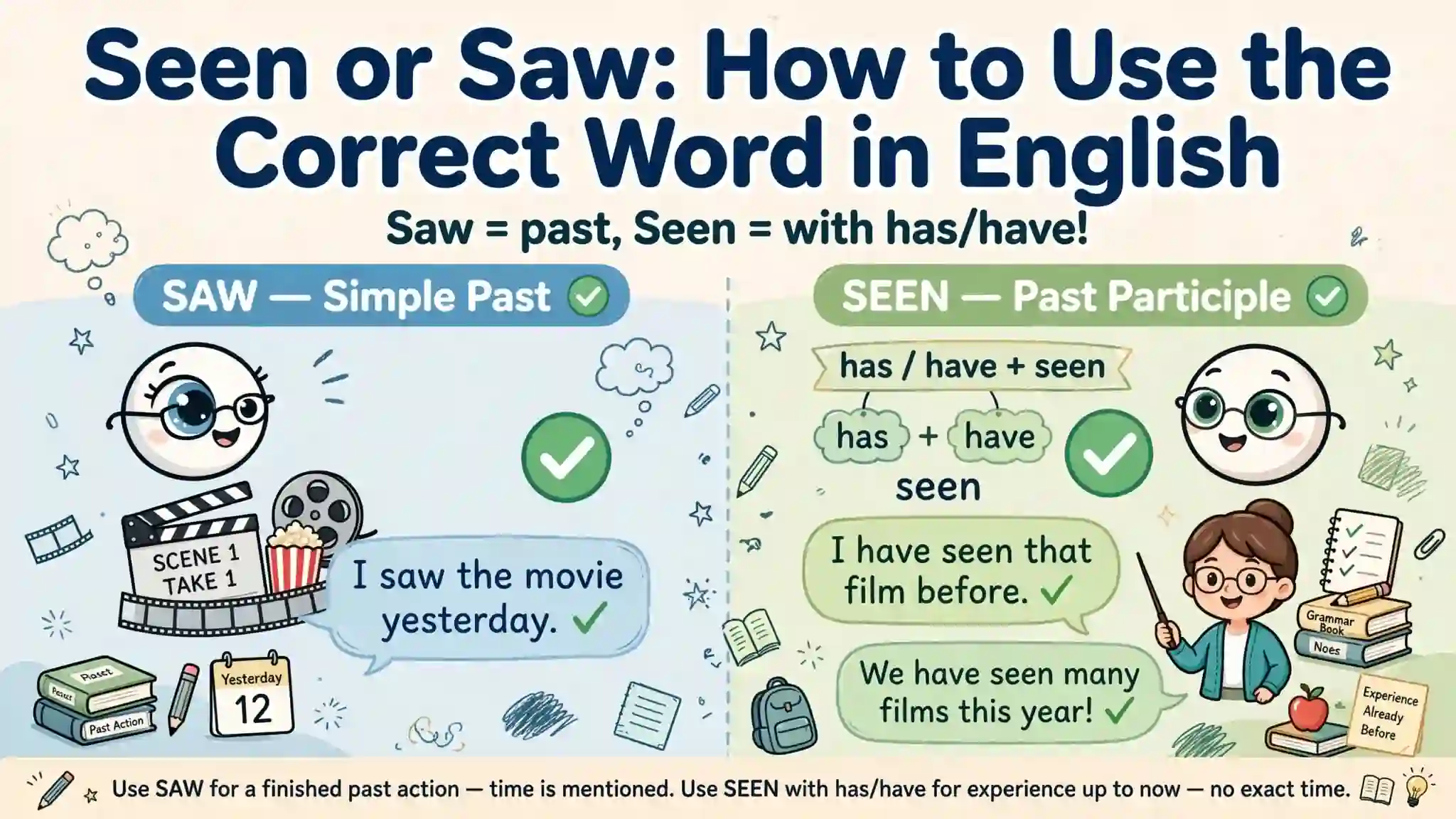
When it comes to English grammar, some words have similar meanings but follow different rules. Seen or saw is a common example that confuses English learners and even native speakers. Both words come from the verb see, which means to notice something with your eyes. However, they have different grammatical roles. Saw is the simple past tense, while seen is the past participle. Using the wrong form can make a sentence sound incorrect. This guide explains when to use each word, how they work with helping verbs, and how to avoid common grammar mistakes. You will also learn through simple examples, practical exercises, and everyday sentences.
What Is the Difference Between Seen or Saw?
The main difference between Seen or saw is their grammatical function. Both words describe the act of noticing something, but they appear in different verb structures.
- Saw is the simple past tense of see.
- Seen is the past participle of see.
The verb see is an irregular verb. It does not follow the regular pattern of adding -ed to form its past tense.
Here is the basic verb pattern:
| Verb form | Word | Example |
| Base form | See | I see a bird. |
| Simple past | Saw | I saw a bird yesterday. |
| Past participle | Seen | I have seen that bird before. |
Each form has a different purpose.
Use see for the present tense or after certain helping verbs. Saw is used when describing something that happened in the past. Use seen with helping verbs such as has, have, and had.
Examples:
- I see my friend every day.
- I saw my friend yesterday.
- I have seen my friend before.
- She had seen the movie before.
The important point is that seen usually needs a helping verb when it functions as part of a perfect tense.
When Should You Use Saw?
Saw is the simple past tense of see. Use it when you describe something you noticed or observed at an earlier time.
It works as the main verb in a simple past sentence. You do not need a helping verb before it in a standard positive statement.
Examples:
- I saw a beautiful sunset yesterday.
- She saw her teacher at the store.
- We saw a movie last weekend.
- He saw a dog running across the road.
- They saw the accident from their window.
These examples describe completed observations in the past.
1. Use Saw for Completed Past Actions
Use saw when you want to explain that someone noticed something at a particular time in the past.
The sentence may mention exactly when the event happened. It may also describe a past experience without giving a specific date.
Examples:
- I saw your message this morning.
- My parents saw the new house yesterday.
- She saw her favorite singer last night.
- We saw several birds during our walk.
- He saw an interesting documentary last week.
In each sentence, saw describes an observation that happened in the past.
2. Use Saw With Past Time Expressions
Saw often appears with expressions that identify a completed past event.
Common past time expressions include:
- Yesterday
- Last night
- Last week
- Last month
- A few minutes ago
- Two days ago
- In 2022
- When I was young
Sentence examples:
- I saw him at the shopping mall yesterday.
- She saw her cousins last weekend.
- We saw a rainbow after the rain.
- They saw the new building two months ago.
- My brother saw that movie in 2022.
These expressions make the timing clear. The simple past tense is the natural choice.
When Should You Use Seen?
Seen is the past participle of see. It usually appears with helping verbs, including has, have, and had.
Unlike saw, seen cannot normally stand alone as the main verb in a simple past statement.
Examples:
- Incorrect: I seen that movie yesterday.
- Correct: I saw that movie yesterday.
- Correct: I have seen that movie before.
The third sentence uses the present perfect tense. The helping verb have makes the structure correct.
1. Use Seen With Has
Use has seen with singular third-person subjects.
These include he, she, it, and singular nouns.
Examples:
- She has seen the new movie.
- He has seen that painting before.
- My teacher has seen my assignment.
- The manager has seen the report.
- My sister has seen the Eiffel Tower.
This structure forms the present perfect tense.
It connects a past experience or observation with the present. The exact time of the event is usually not the main focus.
2. Use Seen With Have
Use have seen with I, you, we, they, and plural subjects.
Examples:
- I have seen this movie three times.
- We have seen that beautiful garden.
- They have seen the latest announcement.
- You have seen this photograph before.
- The students have seen the science experiment.
The helping verb have supports the past participle seen.
This structure often describes life experiences, repeated observations, or events that matter in the present.
3. Use Seen With Had
Use had seen when describing an observation that happened before another past event.
This structure forms the past perfect tense.
Examples:
- I had seen the movie before my friends recommended it.
- She had seen the doctor before the symptoms improved.
- They had seen the house before making an offer.
- We had seen the warning before the accident happened.
- He had seen the message before I called him.
These sentences describe two events in the past.
The earlier event uses had seen. The later event usually uses the simple past tense.
4. Use Seen in Questions and Negative Sentences
Seen also appears in questions and negative statements with helping verbs.
Questions:
- Have you seen my keys?
- Has she seen the new teacher?
- Have they seen this place before?
- Had you seen the movie before yesterday?
Negative sentences:
- I have not seen that movie.
- She has not seen the email.
- We haven’t seen him today.
- They had not seen the warning before the incident.
The helping verb determines the tense. Seen remains the past participle.
Seen or Saw: Examples in Different Situations
Understanding grammar rules is easier when you apply them to everyday situations. Both forms appear in conversations, school assignments, professional writing, and storytelling.
The correct choice depends on the sentence structure and the time you want to express.
1. Seen or Saw in Everyday Conversations
People use these words when talking about movies, people, places, and daily experiences.
Here are some common examples:
| Saw | Seen |
| I saw your brother yesterday. | I have seen your brother before. |
| She saw the message last night. | She has seen the message. |
| We saw a beautiful sunset. | We have seen many sunsets. |
| He saw the new car yesterday. | He has seen the new car. |
| They saw the match last weekend. | They have seen that match before. |
The first column uses the simple past tense. The second uses the present perfect tense.
2. Seen or Saw in Academic Writing
Students use these words in essays, assignments, research papers, and classroom discussions.
Correct verb forms help make academic writing clear and accurate.
Examples:
- The researchers saw a change during the experiment.
- The students have seen similar examples in class.
- We had seen the results before the teacher explained them.
- She saw an interesting pattern in the data.
- The professor has seen several versions of the report.
Use saw for a completed past observation. Use seen when the sentence requires a past participle.
3. Seen or Saw in Professional Communication
Professional emails and reports often describe meetings, documents, messages, and workplace activities.
Examples:
- I saw your email this morning.
- We have seen an improvement in customer feedback.
- The manager has seen the updated proposal.
- Our team saw the issue during testing.
- The director had seen the report before the meeting.
These examples show how the two forms work in business communication.
4. Seen or Saw in Storytelling
Writers use saw to describe past observations in stories. They use seen when a helping verb creates a perfect tense.
Examples:
- I saw a strange light outside my window.
- She saw an old friend walking down the street.
- He had seen the mysterious figure before the storm started.
- They had seen the castle long before they entered it.
- We saw a beautiful village during our journey.
Correct verb forms help readers understand when events occurred.
Common Grammar Mistakes With Seen or saw
Many English learners confuse these words because they share the same base verb. Their meanings are closely related, but their grammatical roles are different.
Learning these common mistakes can help you improve your writing.
1. Using Seen Without a Helping Verb
One common mistake is using seen as a simple past verb.
Incorrect: I seen your brother yesterday.
Correct: I saw your brother yesterday.
Seen is a past participle. It normally requires a helping verb in standard perfect tense structures.
2. Using Saw After Has or Have
Has and have require the past participle when forming the present perfect tense.
Incorrect: She has saw the movie.
Correct: She has seen the movie.
Another example:
Incorrect: They have saw the new building.
Correct: They have seen the new building.
Remember that has and have work with seen, not saw.
3. Using Saw After Had
Had also requires a past participle when forming the past perfect tense.
Incorrect: He had saw the accident before calling the police.
Correct: He had seen the accident before calling the police.
Use had seen when describing an event that occurred before another past event.
4. Using Saw After Did
This mistake is especially common in questions and negative statements.
Incorrect: Did you saw my message?
Correct: Did you see my message?
The same rule applies to negative sentences.
Incorrect: I did not saw him.
Correct: I did not see him.
After did, always use the base form of the verb.
5. Using the Wrong Form With Time Expressions
Some writers choose a verb based only on a time expression without checking the full sentence.
For example:
Incorrect: I have saw that movie before.
Correct: I have seen that movie before.
Another example:
Incorrect: I seen her last week.
Correct: I saw her last week.
Use the complete sentence structure to choose the right verb form.
Easy Tips to Remember Seen or Saw
You do not need complicated grammar rules to remember these two words. A few simple techniques can help you choose the correct form.
1. Memorize the Three Verb Forms
Start with the basic pattern:
- See: Present or base form.
- Saw: Simple past tense.
- Seen: Past participle.
Repeat this pattern during your English practice.
It helps you recognize the correct form when writing or speaking.
2. Look for Helping Verbs
Check the sentence for helping verbs.
If you see has, have, or had forming a perfect tense, use seen.
Examples:
- I have seen.
- She has seen.
- They had seen.
If you describe a completed past action without a perfect tense helping verb, use saw.
Example:
– I saw the movie yesterday.
Why Is the Difference Between Seen or saw Important?
Correct verb usage improves your communication. It helps readers understand when an event happened and how it relates to other events.
A small grammar mistake can make a sentence sound unnatural.
1. It Improves Writing Accuracy
Using the correct verb form makes your sentences grammatically complete.
Compare these examples:
- Incorrect: I have saw that picture.
- Correct: I have seen that picture.
The second sentence follows the present perfect structure.
2. It Makes Communication Clearer
Correct verb forms help readers understand the timing of an observation.
Compare:
- I saw the movie yesterday.
- I have seen the movie before.
The first sentence identifies a specific past event. The second describes a previous experience without specifying exactly when it happened.
3. It Helps With Professional and Academic Writing
Correct grammar matters in emails, essays, reports, applications, and presentations.
Using saw and seen correctly makes your writing more polished. It also helps you communicate past events and experiences clearly.
4. It Builds English Language Confidence
Learning irregular verbs strengthens your understanding of English grammar.
Other verbs follow a similar pattern:
| Base form | Simple past | Past participle |
| Eat | Ate | Eaten |
| Write | Wrote | Written |
| Speak | Spoke | Spoken |
| Break | Broke | Broken |
| Take | Took | Taken |
| Give | Gave | Given |
| Drive | Drove | Driven |
Practice these verb forms along with see, saw, and seen. This will help you recognize irregular verb patterns more easily.
Frequently Asked Questions About Seen or Saw
These common questions explain how to use both words correctly. Each answer provides a simple rule and a practical example.
1. Is Seen or Saw Correct?
Both words are correct, but they serve different grammatical purposes. Saw is the simple past tense of see. Seen is the past participle. Use saw for a simple past action and seen with helping verbs such as has, have, and had.
2. Should I Say I Saw It or I Seen It?
“I saw it” is correct in standard English. You can also say “I have seen it.” The phrase “I seen it” is grammatically incorrect in standard English because seen needs a helping verb in this structure.
3. Is It Have Seen or Have Saw?
Have seen is correct. Have requires the past participle seen when forming the present perfect tense. For example, “I have seen this movie before” is correct, while “I have saw this movie before” is incorrect.
4. Is It Had Seen or Had Saw?
Had seen is correct because had forms the past perfect tense with a past participle. For example, “She had seen the building before it was renovated” follows the correct grammar rule.
5. Can I Use Seen Without a Helping Verb?
In standard English, seen normally needs a helping verb when it functions as part of a perfect tense. For example, “I have seen him” is correct. “I seen him” is not standard grammar.
Conclusion
Understanding seen or saw becomes simple when you remember their different grammatical roles. Saw is the simple past tense of see. Use it when describing an observation that happened in the past. Seen is the past participle. Use it with helping verbs such as has, have, and had to form perfect tenses.
Remember these examples: “I saw the movie yesterday” and “I have seen the movie before.” Both sentences are correct because they follow different grammar structures.
