


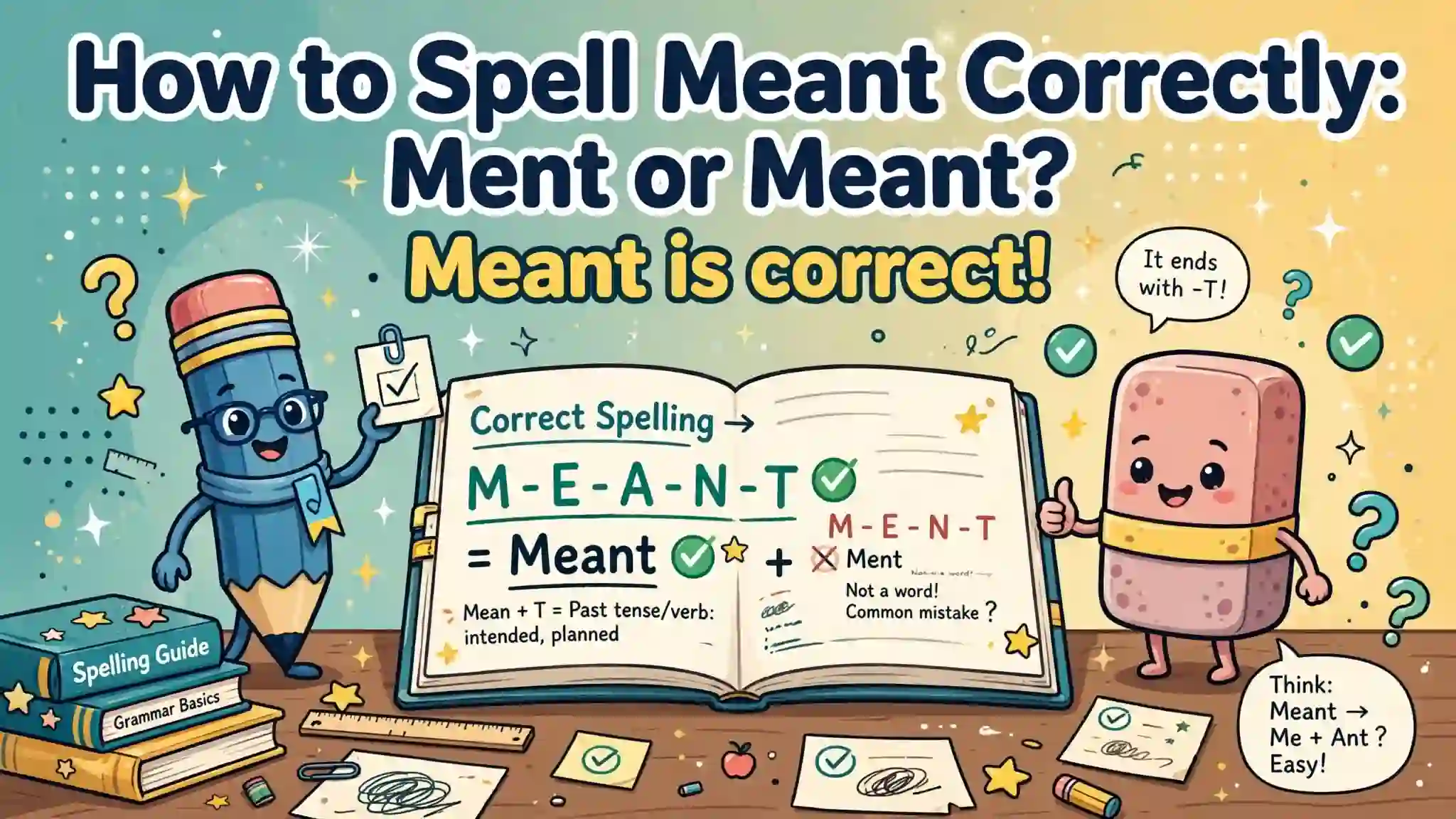
When it comes to English spelling, small mistakes can change the meaning of a sentence. Many people confuse Ment or Meant because both forms look similar. They may sound close in fast speech, but only one works as the past tense of the verb mean. The correct spelling is meant. The word ment is not a standard standalone English word with the same meaning. It does appear as a suffix in words such as payment, movement, and agreement. This guide explains the difference, shows how to use each form, and shares simple examples. You will also learn common spelling mistakes and easy ways to remember the correct form.
Ment or Meant: Which Spelling Is Correct?
The correct spelling depends on how you use the word. If you want to describe something you said, intended, or had in mind in the past, write meant. The spelling ment does not work as its replacement.
The word meant is the past tense and past participle of the verb mean. It describes an idea, purpose, message, or intention from an earlier time.
For example:
- I meant to call you yesterday.
- She meant every word in her message.
- What did you mean by that comment?
- He meant no harm.
- We meant to arrive early.
In each sentence, meant connects to the verb mean. It tells the reader that someone had a particular thought or intention.
The spelling ment is incorrect in these examples. You should not write, “I ment to call you” or “She ment every word.” These forms contain spelling errors.
A simple rule can help:
- Use mean for the present tense.
- Use meant for the past tense.
- Do not use ment as a standalone replacement.
The difference becomes easier once you understand the verb and its forms.
What Does ment or meant in English?
The word meant has several related meanings. It can describe an intention, explain a message, or show what something was supposed to do. Its exact meaning depends on the sentence.
Meant as a Past Form of Mean
The most common use of meant is as the past tense of mean. It describes what someone intended or wanted to do before the present moment.
Examples:
- I meant to send you the file.
- They meant to visit us last week.
- Sarah meant to finish her homework.
- We meant to leave before sunset.
- He meant to ask you a question.
These sentences describe past intentions. The action may or may not have happened. For example, “I meant to call you” tells someone that you planned to call. It does not confirm that you made the call.
This distinction matters in everyday communication. A person can mean to do something but fail to complete it.
Meant as Intended or Planned
The word can also explain a person’s purpose. It often appears when someone wants to clarify their actions or words.
Examples:
- I meant well.
- She meant no disrespect.
- He meant to help.
- They meant to surprise us.
- I never meant to upset you.
In these sentences, meant explains the intention behind an action. It can also help clear up a misunderstanding.
Meant as Having a Particular Meaning
You can use meant to ask what a word, sign, action, or message represented.
Examples:
- What was that message meant to say?
- The red light meant stop.
- Her smile meant a lot to me.
- This symbol meant something different in the past.
- His silence meant that he disagreed.
This use focuses on meaning rather than a person’s plan. It helps explain what something represented or communicated.
Why Is Ment or Meant a Common Spelling Mistake?
Many English learners and native speakers make spelling mistakes with words that sound similar like ment or meant. The confusion between these two forms often comes from pronunciation, typing habits, and a lack of familiarity with irregular verbs.
Similar Sounds in Everyday Speech
In normal conversation, people often speak quickly. The final sound in meant may not stand out clearly. Some listeners may focus on the sound and write a shorter form.
This can lead to errors such as:
- I ment to tell you.
- She ment what she said.
- He ment no harm.
- We ment to visit.
- They ment to help.
Each sentence needs meant instead.
Listening can help you recognize the correct word, but spelling should follow the standard written form. Do not rely only on how a word sounds.
Confusion With Other Words Ending in Ment
English has many words that end in -ment. Examples include:
- Payment
- Movement
- Agreement
- Development
- Enjoyment
- Management
- Improvement
Because these words are familiar, some writers may assume that ment can also stand alone. It cannot serve as the past tense of mean.
The ending -ment is a suffix. It helps form nouns from other words. For example, payment comes from pay, while movement comes from move.
The word meant has a different role. It is a complete verb form, not a suffix.
Typing Too Quickly words ment or meant
Fast typing can cause spelling mistakes. People may leave out a letter or choose a familiar spelling without checking the sentence.
Autocorrect can also miss some errors. A sentence may still look understandable even when it contains the wrong form.
Take a moment to check the word before sending an important email, school assignment, or professional message.
Meant vs Mean: Understanding the Difference
The words mean and meant belong to the same verb. They differ in tense. Use mean for the present and meant for the past.
| Word | Grammar | Example |
| Mean | Present tense | I mean what I say. |
| Means | Present tense, third-person singular | She means well. |
| Meant | Past tense | I meant to call you. |
| Meant | Past participle | I have meant to ask you. |
When to Use Mean
Use mean when you talk about a current meaning, intention, or idea.
Examples:
- I mean every word.
- What do you mean?
- This sign means danger.
- I mean to finish the task today.
- They mean well.
The word can also appear in questions. “What do you mean?” asks someone to explain their message or intention.
When to Use Meant
Use meant when you describe an earlier intention or meaning.
Examples:
- I meant to call you yesterday.
- What did she mean by that?
- The note meant a lot to him.
- We meant to arrive earlier.
- He meant no offense.
The word also works with helping verbs such as have, has, and had.
Examples:
- I have meant to visit you for months.
- She has meant to discuss the issue.
- They had meant to leave before noon.
How to Use ment or meant Correctly in Sentences
The best way to learn a spelling rule is to see it in real sentences. The word meant appears in casual chats, formal writing, schoolwork, and professional communication.
Meant in Everyday Conversation
People often use meant when they explain what they wanted to say or do.
Examples:
- I meant to text you earlier.
- I meant to ask about your new job.
- We meant to meet at the cafe.
- She meant to bring the book.
- He meant to send the photos.
These examples show past plans or intentions. They sound natural in everyday conversation.
Meant in Apologies
The word often appears in apologies. It helps someone explain that they did not intend to hurt another person.
Examples:
- I never meant to hurt your feelings.
- I meant no disrespect.
- I did not mean to sound rude.
- I meant well, but I chose the wrong words.
- I never meant to cause trouble.
These sentences can help explain an action. They do not automatically remove its impact, so a sincere apology should also recognize the other person’s feelings.
Meant in Questions
You can use meant to ask someone to explain a past statement or action.
Examples:
- What did you mean by that?
- Did you mean to send this message?
- What was this note meant to explain?
- Was that what you meant?
- Who was the message meant for?
These questions are useful in both casual and formal settings.
Meant in Professional Writing
The word also works in business emails, reports, and workplace discussions.
Examples:
- The instructions were meant to guide new employees.
- I meant to include the updated figures.
- The change was meant to improve the process.
- This section was meant to explain the new policy.
- The meeting was meant to review the project.
Use the word when you need to explain an earlier purpose. Keep the rest of the sentence clear and direct.
Ment or Meant: Correct and Incorrect Examples
Comparing correct and incorrect sentences makes the spelling rule easier to remember. The main point is simple: write meant when you need the past form of mean.
| Incorrect sentence | Correct sentence |
| I ment to call you. | I meant to call you. |
| She ment no harm. | She meant no harm. |
| What did he ment? | What did he mean? |
| They ment to help us. | They meant to help us. |
| I never ment that. | I never meant that. |
| He ment every word. | He meant every word. |
| We ment to visit. | We meant to visit. |
| I ment what I said. | I meant what I said. |
Notice that one example uses mean rather than meant. The phrase “What did he mean?” needs the base form because the helping verb did already marks the past tense.
Easy Tips to Remember the Correct Spelling
A few simple habits can help you remember the right form. You do not need to memorize a long grammar rule. Focus on the relationship between mean and meant.
Remember Mean and Meant Together
Learn the two forms as a pair:
- Mean = present.
- Meant = past.
Repeat a simple example: “I mean it today. I meant it yesterday.”
This pattern helps connect the spelling with the tense.
Think of the Word Meant as a Complete Verb
The word meant stands on its own as a verb form. It does not need the suffix -ment to make it complete.
When you write about a past intention, choose the full spelling. Avoid shortening it based on sound.
Read the Whole Sentence
The sentence can help you select the correct form.
Ask:
- Am I describing a past intention?
- Am I explaining what someone said earlier?
- Am I talking about what a sign or message represented?
If the answer is yes, meant may be the right choice. Check the grammar around it, too.
Use a Spelling Checker
A spelling checker can catch many typing errors. It can help when you write emails, assignments, reports, or social media posts.
Do not depend on it completely. Some tools may miss errors when a sentence contains a valid but unsuitable word. Read your sentence once before you send it.
Common Mistakes to Avoid When Writing Meant
Some errors happen because writers focus on spelling but overlook sentence structure. Learning a few grammar points can improve both accuracy and clarity.
Writing Ment Instead of Meant
This is the main error. Remember that ment is not the correct past tense of mean.
Incorrect: “I ment to help you.”
Correct: “I meant to help you.”
Using Meant After Did
The helping verb did already shows past tense. Use the base form mean after it.
Incorrect: “What did you meant?”
Correct: “What did you mean?”
Other examples:
- Did she mean that?
- What did he mean by his reply?
- Did they mean to leave early?
Confusing Meant With Mean
Use the tense that matches the sentence.
- I mean what I say.
- I meant what I said.
- She means well.
- She meant well.
The surrounding words often make the correct form clear.
Frequently Asked Questions
1. Is It Ment or Meant?
The correct spelling is meant when you use the past tense of mean. The spelling ment is not a standard standalone replacement. For example, write “I meant to call you,” not “I ment to call you.”
2. What Is the Past Tense of Mean?
The past tense of mean is meant. You can use it to describe a past intention or meaning. For example, “I meant to send the email yesterday.”
3. Is Ment a Real Word?
The letters ment appear in English as a suffix. You can see them in words such as payment, movement, and agreement. However, ment is not the standard past tense of mean.
4. How Do You Use Meant in a Sentence?
Use meant when you describe an earlier intention or meaning. For example, “She meant to help her friend.” You can also write, “His words meant a lot to me.”
5. Should I Write What Did You Mean or What Did You Meant?
Write “What did you mean?” The helping verb did already marks the past tense. The main verb must stay in its base form. Do not add -t to mean in this question.
6. Is Meant the Same as Intended?
The words have similar meanings in many sentences. Meant can describe what someone intended or planned. For example, “I meant to help” has a similar meaning to “I intended to help.”
Conclusion
The correct spelling is meant when you want to use the past tense of mean. It describes an earlier intention, purpose, or message. The spelling ment does not work as a replacement, even though it appears at the end of many English nouns.
Remember the simple difference: mean is the present form, while meant is the past form. You can use meant in everyday chats, apologies, questions, emails, and formal writing. The sentence “I meant to call you” is correct. The sentence “I ment to call you” is not.
The easiest way to avoid this mistake is to read the full sentence and check its tense. Practice a few short examples. Use a spelling checker when needed, but do not depend on it alone. Once you understand the relationship between these verb forms, Ment or Meant becomes a much easier spelling choice.
