


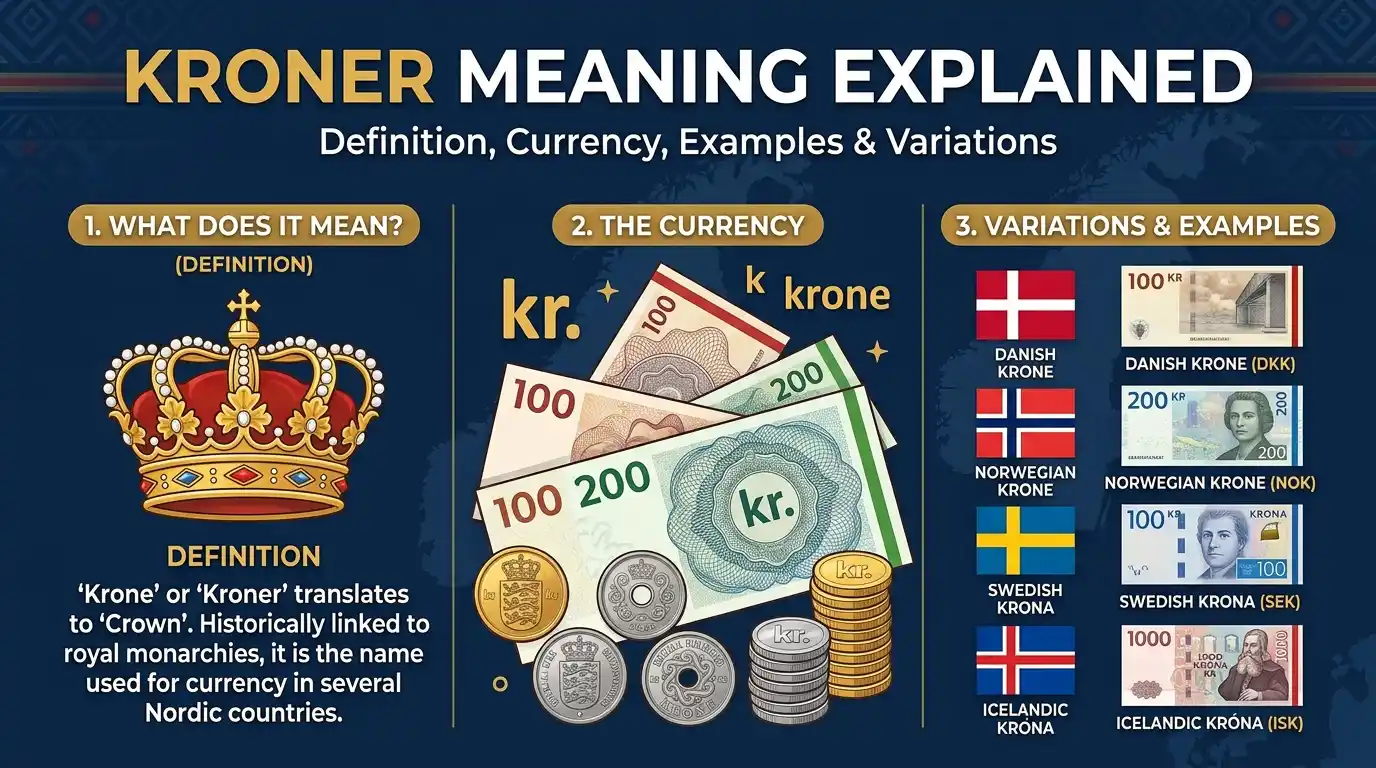
Kroner meaning explained in simple terms is “crowns,” and the word is used as the plural form of krone in several Scandinavian currencies. The name comes from the word for “crown,” which has a long connection with Scandinavian monetary history.
The word kroner may look unfamiliar if you have not come across Scandinavian currencies before. You may see it while reading about prices in Norway, Denmark, or other Nordic countries, especially when looking at travel costs, shopping prices, exchange rates, or financial information. Although the word sounds like a single currency name, its meaning is connected to more than one Scandinavian currency.
The term is especially important when discussing the currencies of Norway and Denmark. For example, Norway uses the Norwegian krone, while Denmark uses the Danish krone. Their plural forms are commonly written as kroner.
Understanding the kroner meaning is useful for travelers, students, shoppers, readers of international news, and anyone comparing prices across countries. A price such as “500 kroner” does not have exactly the same value everywhere because the Norwegian and Danish kroner are separate currencies.
Kroner Meaning
Kroner is the plural form of krone, a currency term used in several Scandinavian countries.
In simple English:
Kroner = crowns
In a money context, kroner means units of a currency called a krone.
For example:
100 kroner
means:
100 units of the local krone currency.
The exact value depends on the country. A Danish krone and a Norwegian krone are different currencies, even though their names are closely related.
Kroner Meaning in Simple English
The easiest way to understand the word is:
Krone = one crown
Kroner = more than one crown
The word is similar to how English changes a singular currency name into a plural form.
For example:
- One krone
- Ten kroner
- One hundred kroner
- One thousand kroner
So, if someone says “The ticket costs 200 kroner,” they are saying that the ticket costs 200 units of a Scandinavian currency called the krone.
Kroner vs. Krone
One of the most important things to understand is the difference between krone and kroner.
| Term | Meaning | Example |
|---|---|---|
| Krone | Singular form | One krone |
| Kroner | Plural form | 50 kroner |
| Kronen | Definite form in some Scandinavian usage | The krone |
| Kronor | Swedish plural form | Swedish kronor |
In general, krone refers to one unit, while kroner refers to multiple units.
For example:
1 krone
but:
25 kroner
This distinction is useful when reading prices or financial information.
Why Is It Called Krone?
The word krone is related to the word “crown.”
The name has historical links to monarchies and the use of crowns as symbols on coins. Several European currencies have historically used names connected with crowns.
The Scandinavian krone name reflects this broader European tradition.
The plural kroner therefore literally relates to the idea of multiple “crowns,” although in modern use it simply functions as the plural currency term.
Kroner Meaning in Norway
In Norway, the official currency is the Norwegian krone, and its plural form is kroner.
You may see prices such as:
- 50 kroner
- 100 kroner
- 500 kroner
- 1,000 kroner
The currency code for the Norwegian krone is NOK.
For example:
The hotel costs 1,500 kroner per night.
This means the price is 1,500 Norwegian kroner.
When you see “kroner” in a Norwegian context, it normally refers to Norwegian currency.
Kroner Meaning in Denmark
Denmark uses the Danish krone, whose plural form is also kroner.
Its international currency code is DKK.
For example:
The meal costs 200 kroner.
In a Danish context, this normally means 200 Danish kroner.
This is why the country or context is important. Simply seeing the word kroner does not always tell you whether the amount is Danish or Norwegian.
Kroner Meaning in Different Countries
The word is strongly associated with Scandinavian currencies, but different countries use related versions of the word.
| Country | Currency | Plural Form | Currency Code |
|---|---|---|---|
| Norway | Norwegian krone | kroner | NOK |
| Denmark | Danish krone | kroner | DKK |
| Sweden | Swedish krona | kronor | SEK |
| Iceland | Icelandic króna | krónur | ISK |
The names are related, but these are separate currencies.
This is an important point because 100 kroner in Norway is not the same currency as 100 kroner in Denmark.
Kroner Meaning in Money
When used in financial or shopping contexts, kroner simply identifies an amount of money.
For example:
The jacket costs 800 kroner.
This means the jacket has a price of 800 units of the relevant krone currency.
The word itself does not tell you the exchange value in dollars, pounds, euros, or another currency. To know that, you need to know the country and current exchange rate.
This is especially important when comparing international prices.
Kroner Meaning in Travel
Travelers may frequently encounter the word kroner when visiting Scandinavian countries.
You might see it on:
- Hotel prices
- Restaurant menus
- Train tickets
- Bus tickets
- Museum tickets
- Store receipts
- Online booking websites
- Airport services
For example:
Train ticket: 450 kroner
If you are in Norway, this would normally refer to 450 Norwegian kroner.
If you are in Denmark, it would normally refer to 450 Danish kroner.
Checking the country is the easiest way to avoid confusion.
Kroner Meaning in Shopping
Online stores serving Scandinavian customers may display product prices in kroner.
For example:
Shoes – 1,200 kroner
The price may look simple, but you need to know which country’s currency is being used before converting it into another currency.
A website serving Norway may use NOK, while a Danish website may use DKK.
This is why international shoppers should always check the currency code or country before comparing prices.
Kroner Meaning in Exchange Rates
When discussing exchange rates, kroner refers to units of a krone-based currency.
For example:
1 USD = X Norwegian kroner
or:
1 EUR = X Danish kroner
The exact conversion changes over time because exchange rates fluctuate.
This means that a fixed number of kroner does not always have the same value in another currency.
For international payments, the currency code is usually more precise than simply writing “kroner.”
Kroner Abbreviation and Symbol
The abbreviation kr is commonly associated with krone currencies.
You may see prices written like:
kr 500
or:
500 kr
However, kr alone may not always identify the exact country.
For international financial transactions, currency codes are more specific:
| Currency | Code | Common Symbol |
|---|---|---|
| Norwegian krone | NOK | kr |
| Danish krone | DKK | kr |
| Swedish krona | SEK | kr |
| Icelandic króna | ISK | kr |
This is why NOK, DKK, SEK, and ISK are useful when clarity matters.
Kroner vs. Kronor
A common source of confusion is kroner versus kronor.
Both words are related to Scandinavian currencies, but they belong to different languages and currencies.
Kroner is used for currencies such as the Danish krone and Norwegian krone.
Kronor is the Swedish plural form of krona.
For example:
Norway: 100 kroner
Sweden: 100 kronor
The words look similar because they share the same historical root, but they are not interchangeable in standard usage.
Kroner vs. Crown
The English word crown is closely related to the origin of krone.
In modern currency discussions:
crown is the English meaning behind the name.
krone is the Scandinavian currency term.
kroner is the plural form used in some Scandinavian languages.
So, when you see “kroner,” you can think of it as a currency name historically connected to the idea of crowns.
Examples of Kroner in Sentences
Here are some simple examples showing how the word is used.
- The coffee costs 50 kroner.
- The hotel charged 1,200 kroner for the room.
- I exchanged my money for Norwegian kroner.
- The ticket costs 300 kroner.
- She paid 600 kroner for the jacket.
- The restaurant bill was 850 kroner.
- The museum entrance fee is 150 kroner.
- He had 500 kroner in cash.
- The train ticket was 400 kroner.
- The price was listed in Danish kroner.
The exact currency depends on the country or context.
Kroner Meaning in Different Contexts
The word can appear in several situations.
In Travel
Kroner usually refers to local Scandinavian money used for transportation, accommodation, food, and shopping.
In Finance
It can refer to amounts of Norwegian or Danish currency when discussing markets, prices, salaries, or exchange rates.
In Shopping
It appears next to product prices on Scandinavian websites and in local stores.
In News
News reports may use kroner when discussing government spending, company earnings, wages, or economic data.
In Everyday Conversation
People may simply use kroner when talking about how much something costs.
The meaning stays connected to currency, but the exact currency depends on context.
Kroner Meaning in Salaries
You may also see kroner when salaries or wages are discussed.
For example:
She earns 500,000 kroner per year.
This means her annual salary is 500,000 units of the relevant krone currency.
A salary stated in kroner cannot be accurately compared with a salary in dollars or euros without considering the current exchange rate and the specific country.
Kroner Meaning in Prices
A price written in kroner simply indicates that the seller is using a krone-based currency.
For example:
Price: 799 kroner
The amount is 799 units of the local currency.
To understand its value in another currency, you need to know whether the price is in:
- Norwegian kroner
- Danish kroner
- Another related currency
The country usually provides the necessary clue.
Common Mistakes About Kroner
Several mistakes can make the word confusing.
Thinking Kroner Is One Single Currency
Kroner can refer to different national currencies. Norwegian kroner and Danish kroner are not the same.
Confusing Kroner With Swedish Kronor
Sweden uses kronor, not kroner, as the standard plural form.
Assuming “kr” Identifies One Country
The abbreviation kr can be used by several Scandinavian currencies, so context matters.
Treating Krone and Kroner as the Same Form
Krone is singular, while kroner is plural in Norwegian and Danish usage.
Assuming the Exchange Value Is the Same
The number 500 kroner does not automatically represent the same international value in every Scandinavian context.
Kroner Meaning vs. Other Currency Names
It can be useful to compare kroner with familiar currency terms.
| Currency Term | Country/Region | Singular | Plural |
|---|---|---|---|
| Krone | Norway/Denmark | krone | kroner |
| Krona | Sweden | krona | kronor |
| Euro | Eurozone | euro | euros |
| Dollar | Several countries | dollar | dollars |
| Pound | UK and others | pound | pounds |
This shows that kroner functions much like “dollars” or “euros” as a plural currency term, but it belongs to the krone currency family.
Is Kroner a Currency?
Kroner is a plural currency term rather than the name of one single national currency.
For example, Norway’s currency is the Norwegian krone, and multiple units are called Norwegian kroner.
Denmark’s currency is the Danish krone, and multiple units are called Danish kroner.
Therefore, when someone says “kroner,” you need the country or currency code to identify the exact currency.
Is Kroner the Same as Norwegian Krone?
Not exactly.
Krone is the singular name.
Kroner is the plural form.
So:
1 Norwegian krone
but:
100 Norwegian kroner
Both refer to the same currency, but the grammatical form changes depending on the amount.
Is Kroner the Same as Danish Krone?
Yes, in the sense that kroner is the plural form of the Danish currency name krone.
For example:
1 Danish krone
and:
100 Danish kroner
The currency itself is the Danish krone, while kroner refers to multiple units.
Kroner Meaning in Simple Examples
Consider these examples:
“The coffee costs 40 kroner.”
This means the coffee costs 40 units of the relevant local krone currency.
“I have 300 kroner.”
This means the person has 300 units of that currency.
“The hotel costs 2,000 kroner per night.”
This means the nightly price is 2,000 units of the local krone currency.
These examples show why the word is mainly used as a money term rather than a general English word.
FAQs About Kroner Meaning
What does kroner mean?
Kroner is the plural form of krone and means multiple units of a Scandinavian currency such as the Norwegian or Danish krone.
What is the meaning of kroner in English?
The word kroner is related to the English word crowns, but in modern English it is mainly used when referring to Scandinavian currency.
Is kroner the plural of krone?
Yes. In Norwegian and Danish usage, kroner is the plural of krone.
Which countries use kroner?
Norway and Denmark use currencies called the krone, with kroner as the plural form. Other Nordic countries use closely related names, such as Sweden’s krona and Iceland’s króna.
What is the difference between krone and kroner?
Krone is singular, while kroner is plural.
What does 100 kroner mean?
It means 100 units of the relevant krone currency. The exact currency depends on the country, such as Norway or Denmark.
Is kroner the same as kronor?
No. Kroner is used in Norwegian and Danish contexts, while kronor is the Swedish plural form of krona.
What is the symbol for kroner?
The symbol kr is commonly used, but the exact currency is better identified with a code such as NOK for the Norwegian krone or DKK for the Danish krone.
Is kroner a Scandinavian currency?
Kroner is a plural currency term used for Scandinavian currencies such as the Norwegian krone and Danish krone.
Why is it called kroner?
The term comes from krone, meaning “crown,” and is connected to the historical use of crown-related names in European currencies.
Final Thoughts
The kroner meaning explained in the simplest way is multiple units of a krone currency. The word is especially associated with Norway and Denmark, where the singular form is krone and the plural form is kroner.
The name has a historical connection to the word crown, which explains why similar currency names appear across several European countries. Although kroner is closely associated with Scandinavian money, it does not refer to one single currency in every situation.
When you see a price such as 500 kroner, check the country or currency code before deciding what the amount is worth. NOK indicates Norwegian kroner, while DKK indicates Danish kroner.
The easiest way to remember the term is:
Krone = one unit
Kroner = more than one unit
Once you understand this simple difference, the word becomes much easier to recognize in travel, shopping, finance, news, and everyday conversations.
