


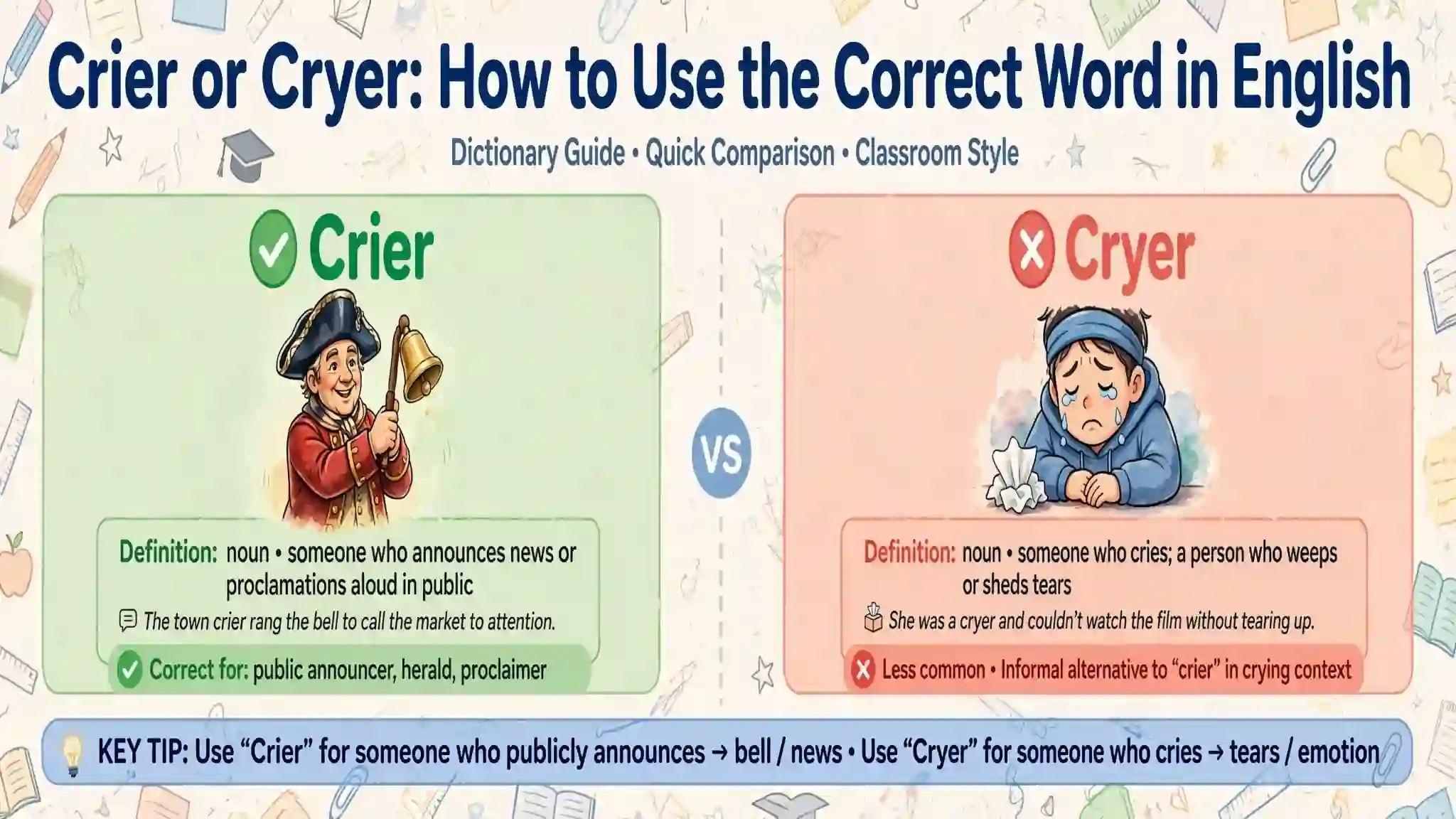
When it comes to choosing the correct spelling in English, small differences between words can cause confusion. Crier or Cryer is a common spelling question because both words look similar and sound almost identical. However, they do not have the same level of acceptance or usage. The word crier is the standard spelling in modern English, while cryer is a rare variant that most dictionaries and writing guides do not recommend. Understanding their meanings, origins, and grammatical uses can help you avoid spelling mistakes. This guide explains the difference, provides practical examples, and shows you how to choose the right word in everyday writing.
Crier or Cryer: Which Spelling Is Correct?
The spelling crier is the standard choice in modern English. It refers to someone who cries or makes an announcement, depending on the context. Cryer appears occasionally as a surname or rare spelling variant, but it is not the usual form in standard writing.
Both spellings may look reasonable because English has many words ending in -er. The confusion often comes from the verb cry, which changes its spelling when we add certain endings. Learning this spelling rule makes the correct choice easier.
Is Crier the Correct Spelling?
Yes, crier is the accepted standard spelling. English speakers use it for a person who cries or someone who makes public announcements.
For example:
- The baby became a loud crier during the night.
- The town crier announced the news in the square.
- She was a happy crier who often cried during emotional films.
- The crier attracted attention with a loud voice.
The spelling follows a common English rule. When a word ends in a consonant followed by y, we often change the y to i before adding certain endings.
The verb cry becomes cries in the third-person singular and cried in the past tense. The noun crier follows the same general spelling pattern.
Is Cryer Ever Correct?
Cryer is not the standard spelling for the ordinary noun meaning someone who cries or announces news. However, it can appear as a family name or proper name.
For example:
- Mr. Cryer attended the school meeting.
- The Cryer family moved to another town.
- I met a person named Cryer at the event.
Proper names can have unusual spellings. You should preserve a person’s official surname even when it differs from standard English spelling.
For ordinary writing, use crier. Choose Cryer only when you refer to a person, family, or name that uses that exact spelling.
Crier or Cryer: Understanding Their Meaning
Knowing the meaning of a word helps you choose its correct spelling. The word crier has two main uses in English. It can describe someone who cries easily or a person who announces information publicly.
Cryer does not normally carry a separate standard dictionary meaning in everyday English. Its appearance often relates to surnames or nonstandard spelling.
What Does Crier Mean?
A crier is a person who cries. The word can describe someone who often expresses sadness, happiness, pain, or other emotions through tears.
It can also describe an official public announcer. In the past, towns used criers to share important news with people who gathered in public places.
Examples include:
- My little brother is a frequent crier.
- The town crier shared the royal announcement.
- She is a happy crier who tears up during celebrations.
- The village crier announced the market opening.
The exact meaning depends on the sentence. The surrounding words usually make the intended meaning clear.
What Does Cryer Mean?
Cryer is generally not used as a separate common noun in standard modern English. Most readers will consider it a misspelling when someone intends to write crier.
However, English surnames do not always follow ordinary spelling rules. A person may have the surname Cryer, and that spelling remains correct when referring to that individual.
Consider these examples:
- James Cryer works at the local library.
- The Cryer family organized a community event.
- Her teacher, Mr. Cryer, helped her with English.
In these sentences, Cryer works as a proper noun. It does not describe someone who cries.
Why Do People Confuse crier or cryer?
English spelling can be difficult because similar sounds do not always follow the same spelling patterns. Crier and Cryer create confusion because they look and sound alike. Both contain the same basic consonants, and their vowel sounds may be very similar in everyday speech.
People also recognize the word cry and naturally assume that adding -er produces cryer. This seems logical, but English spelling rules often change the final letter before adding a suffix.
The Role of the Letter Y
The letter y creates several spelling changes in English. When a word ends in a consonant followed by y, we often replace the y with i before adding a suffix.
For example:
| Base word | Correct form |
| Cry | Cried |
| Try | Tried |
| Dry | Dried |
| Carry | Carried |
| Happy | Happier |
| Apply | Applied |
The word crier follows this spelling pattern.
However, not every word ending in y changes in the same way. Some suffixes keep the original letter, such as -ing.
For example:
- Cry becomes crying.
- Try becomes trying.
- Study becomes studying.
These differences explain why English learners sometimes struggle with words that have similar endings.
Pronunciation Differences
In most everyday English accents, crier or cryer would be pronounced the same way if someone used both spellings as ordinary words. Their spelling difference does not create a reliable pronunciation difference.
The word crier usually has two syllables. The first syllable carries the main stress.
You should focus on the accepted spelling rather than trying to hear a difference between the two forms. Sound alone cannot reliably help you select the correct spelling.
How to Use crier or cryer correctly in a Sentence
The word crier works as a noun. It identifies a person based on an action or role. You can use it in everyday conversations, descriptive writing, historical discussions, and formal contexts.
The two main meanings provide several useful ways to include this word in a sentence.
Crier as Someone Who Cries
Use crier when describing a person who cries frequently or easily. It can refer to a child, adult, or anyone who expresses emotions through tears.
Examples:
- My younger sister has always been a sensitive crier.
- The baby is a loud crier when he feels hungry.
- He became a happy crier after hearing the good news.
- My friend is an emotional crier during weddings.
- The little boy is a frequent crier at bedtime.
This use often appears in informal conversations. People may describe themselves as criers when they become emotional during movies, celebrations, or personal moments.
Crier as a Public Announcer
A town crier was a person who made public announcements before newspapers, radio, and modern communication systems became widespread.
Town criers often walked through streets, rang bells, and called out important information. They helped communities learn about public events, official decisions, and local news.
Examples:
- The town crier announced the arrival of the king.
- A local crier shared the latest market news.
- The crier rang a bell before making his announcement.
- Everyone gathered to hear the town crier.
- The historical festival featured a traditional town crier.
This meaning remains relevant in historical writing, cultural events, and discussions about traditional communication.
crier or cryer: Key Differences Explained
A direct comparison makes the spelling distinction easier to understand. Although both forms look similar, only one works as the standard common noun in modern English.
The following table highlights their main differences.
| Feature | Crier | Cryer |
| Standard spelling | Yes | No, for the common noun |
| Common usage | Yes | Rare |
| Meaning | Someone who cries or announces news | Usually a surname |
| Part of speech | Noun | Proper noun when used as a name |
| General writing | Recommended | Not recommended |
| Pronunciation | Usually pronounced the same | Usually pronounced the same |
When Should You Use Crier?
Choose crier when you describe someone who cries or announces information.
Use it in:
- School assignments.
- Professional writing.
- Emails and messages.
- Articles and blog posts.
- Historical descriptions.
- Everyday conversations.
For example, write, “She is a cheerful crier,” rather than “She is a cheerful cryer.”
When Should You Use Cryer?
Use Cryer when it is the actual spelling of someone’s surname or another proper name.
For example:
- Daniel Cryer is my new neighbor.
- The Cryer family owns a small business.
- I received a letter from Sarah Cryer.
Do not change someone’s surname to match a spelling rule. Proper names follow their established forms.
Common Mistakes to Avoid When Writing crier or cryer
Spelling mistakes often happen when writers rely on sound instead of standard word forms. The confusion between these two spellings is easy to avoid once you understand their grammatical roles.
Here are some common mistakes and simple ways to correct them.
Using Cryer as a Common Noun
One frequent mistake involves using cryer to describe someone who cries often.
Incorrect: My daughter is a very emotional cryer.
Correct: My daughter is a very emotional crier.
The standard spelling is crier. Remember this form when writing about emotions or crying habits.
Confusing Crier With the Verb Cry
Another mistake occurs when writers confuse the noun with the original verb.
The word cry describes an action. The word crier identifies a person who performs that action.
Compare these sentences:
- The baby will cry when he wakes up.
- The baby is a frequent crier.
Both sentences are correct, but they serve different grammatical purposes.
Changing a Person’s Surname
Never correct a person’s surname simply because it looks unusual.
Incorrect: Mr. Crier spoke at the meeting.
Correct, if his actual surname is Cryer: Mr. Cryer spoke at the meeting.
Always check the spelling of proper names before changing them in documents, emails, or articles.
Trusting Pronunciation Instead of Spelling
Some English words sound alike but have different spellings and meanings. The same issue creates confusion here.
Do not choose a spelling only because it sounds natural. Check the word’s grammatical role and use the accepted dictionary form.
Easy Tips to Remember the Correct Spelling of crier or cryer
You do not need to memorize complicated grammar rules to remember this word. A few simple techniques can help you use it correctly in everyday writing.
Remember the Cry to Crier Pattern
Think of the original verb cry. When you form the noun crier, the final y changes to i before the ending.
Remember this simple pattern:
Cry + er = Crier
This memory trick helps you recognize the standard spelling quickly.
Connect Crier With the Word Drier
The word drier follows a similar spelling pattern. It comes from dry, with the final y changing to i before adding -er.
Other examples include:
- Try becomes trier.
- Fry becomes frier.
- Dry becomes drier.
- Cry becomes crier.
These examples make the spelling pattern easier to remember.
Check the Meaning Before Writing
Ask yourself what you want to describe.
- If you mean someone who cries, write crier.
- If you mean a public announcer, write crier.
- If you mean a person with the surname Cryer, write Cryer.
This quick check can prevent many spelling errors.
Use a Reliable Dictionary
When you feel unsure about a word, consult a trusted English dictionary. Look for its definition, pronunciation, and example sentences.
A dictionary can also help you understand whether a spelling is standard, regional, historical, or limited to proper names.
Frequently Asked Questions About Crier or Cryer
These frequently asked questions cover common spelling concerns, meanings, and examples. They can help English learners and everyday writers understand the correct form.
1. Is Crier or Cryer the Correct Spelling?
Crier is the correct standard spelling when referring to someone who cries or makes public announcements. Cryer is generally used as a surname or proper name. Use crier in ordinary English writing.
2. What Is the Plural of Crier?
The plural form of crier is criers. Add the letter s to the singular noun.
Examples:
- The criers announced the news.
- Several criers gathered in the town square.
- The school had two frequent criers in the younger class.
3. Is Cryer a Real Word?
Cryer appears in English, especially as a surname. However, it is not the standard spelling of the common noun for someone who cries. The accepted everyday spelling is crier.
4. What Does Town Crier Mean?
A town crier is a person who publicly announces important information. Traditionally, town criers shared news, official messages, and community announcements by calling out in public places. Some towns still use them during festivals and historical celebrations.
5. Is Crier a Noun or a Verb?
Crier is a noun. It identifies a person who cries or makes public announcements. The related verb is cry. For example, “The baby cries” uses a verb, while “The baby is a crier” uses a noun.
6. How Do You Remember the Difference Between Crier and Cryer?
Remember that the standard noun comes from cry and follows the spelling pattern that changes y to i before adding -er. Write crier for ordinary use. Keep Cryer when it is someone’s actual surname.
Final Thoughts
Choosing between these two spellings becomes simple when you understand their meanings and uses. Crier or Cryer is not a difficult choice once you learn that crier is the standard English noun for someone who cries or makes public announcements. The spelling follows a familiar pattern in which the finally changes to i before adding an ending.
Cryer still has a place in English as a surname or proper name. You should preserve that spelling when referring to someone who uses it. However, avoid using it as the ordinary noun in articles, schoolwork, emails, and everyday writing.
