


When it comes to choosing the right words in English, small differences can change the meaning of a sentence. Continually and continuously look similar. Both describe something that happens repeatedly or over time. Many beginners use them as if they have the same meaning. However, each word has a different purpose. Understanding Continually vs Continuously can help you write clearer sentences and avoid common grammar mistakes. This guide explains the meaning of both words, their differences, correct usage, and practical examples. You will also learn how to remember which word to use in everyday conversations, school assignments, emails, and professional writing.
Continually vs Continuously Mean?
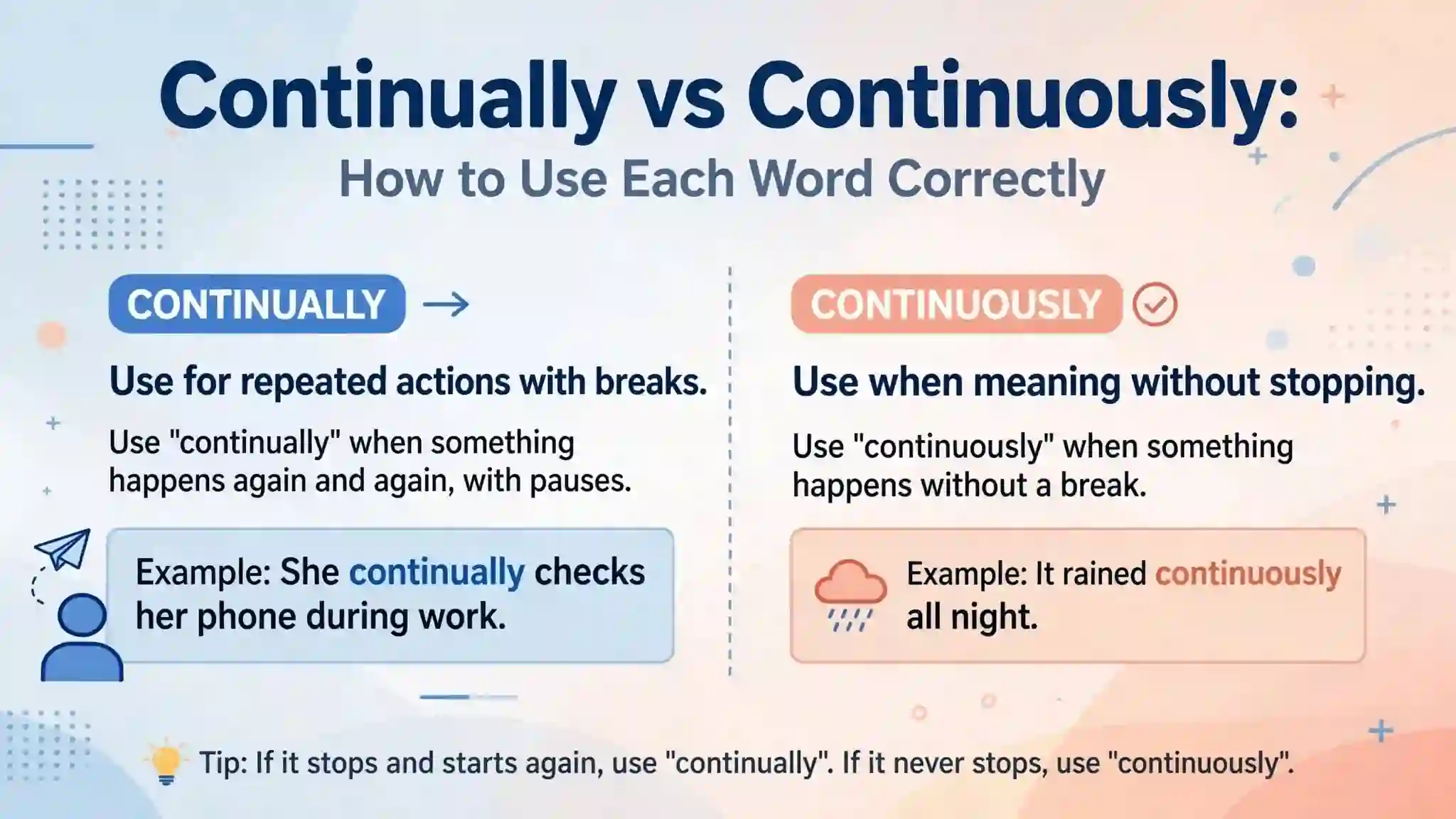
Continually describes something that happens again and again over time. It often involves breaks between actions. An activity may stop for a while and then start again. The word highlights repetition rather than an uninterrupted process.
People use this word when an event, action, or situation keeps returning. It can describe habits, repeated problems, regular changes, or frequent activities.
For example:
- She continually checks her phone during class.
- The children continually ask questions.
- Our neighbors continually play loud music.
- He continually forgets where he puts his keys.
- The company continually improves its services.
In these examples, the actions happen more than once. They do not need to continue without stopping.
Meaning of Continually in Simple Words
Continually means happening repeatedly, often with short or long breaks between events. It shows that something occurs many times over a period.
Think about someone who sends you messages throughout the day. They send one message, wait, send another, and repeat the action. You can say that the person continually messages you.
The action happens again and again. It does not happen every second.
Here are more examples:
- My little brother continually interrupts my conversations.
- She continually changes her hairstyle.
- The teacher continually reminds students about their homework.
- The dog continually barks whenever someone walks past.
- He continually searches for better opportunities.
These sentences show repeated actions. Each action can happen separately.
When Should You Use Continually?
Use continually when you want to describe repeated actions, regular interruptions, or events that happen many times.
Common situations include:
- Repeated behavior: He continually makes the same mistake.
- Frequent complaints: Customers continually complain about slow service.
- Regular changes: Technology continually changes.
- Repeated questions: The child continually asks for attention.
- Ongoing habits: She continually checks the weather before leaving home.
The word works well in casual conversations and formal writing. It helps readers understand that an action happens repeatedly over time.
What Does Continuously Mean?
Continuously describes something that happens without stopping or interruption. It focuses on an uninterrupted action, process, or condition.
When something continues continuously, it does not have meaningful breaks during the period being discussed.
For example:
- It rained continuously throughout the night.
- The machine runs continuously during production.
- The river flows continuously toward the sea.
- The baby cried continuously for an hour.
- The internet connection worked continuously throughout the meeting.
Each sentence describes an action or condition that continues without a break.
Meaning of Continuously in Simple Words
Continuously means happening without stopping. It describes an uninterrupted process that continues over a period.
Imagine a fan running for five hours without being switched off. You can say that the fan runs continuously.
The action starts and continues without a pause.
Here are some additional examples:
- The nurse monitored the patient continuously.
- Water flowed continuously from the broken pipe.
- The recording played continuously for two hours.
- The lights stayed on continuously overnight.
- The factory operates continuously throughout the year.
These examples focus on actions that do not stop during the stated period.
When Should You Use Continuously?
Use continuously when you want to show that an action or process happens without interruption.
Common situations include:
- Uninterrupted movement: The train moved continuously along the track.
- Constant sound: The alarm rang continuously.
- Ongoing processes: The system operates continuously.
- Constant flow: Water flows continuously through the pipe.
- Uninterrupted monitoring: The security team monitors the building continuously.
This word is especially useful in science, technology, business, and everyday descriptions of uninterrupted activities.
Continually vs Continuously: What Is the Main Difference?
The main difference is repetition versus uninterrupted action. Continually describes something that happens repeatedly, with possible breaks. Continuously describes something that happens without stopping.
Both words refer to actions or situations that extend over time. Their meanings depend on whether the action repeats or remains uninterrupted.
Consider these examples:
| Continually | Continuously |
| She continually calls her friend. | She talks continuously for an hour. |
| The child continually asks questions. | The baby cries continuously. |
| He continually changes his plans. | The machine runs continuously. |
| The dog continually barks at strangers. | The alarm rings continuously. |
| The company continually updates its website. | The system operates continuously. |
The first column describes repeated actions. The second column describes actions without breaks.
Repeated Actions vs Uninterrupted Actions
This is the easiest way to understand the difference.
Continually focuses on how often something happens. Continuously focuses on whether something stops.
For example, imagine a person who calls you five times in one afternoon. Each call ends before another begins. That person continually calls you.
Now imagine someone who talks on the phone for three hours without taking a break. That person talks continuously.
The difference becomes clearer when you look at the timing of each action.
Can Both Words Describe the Same Situation?
Yes. Sometimes both words can describe the same general situation. However, they create different meanings.
Consider this sentence:
– The teacher continually explains the lesson.
This suggests that the teacher repeats explanations or returns to the topic several times.
Now consider:
– The teacher explains the lesson continuously.
This suggests that the teacher explains the lesson without taking a break.
The basic activity remains the same. The meaning changes because each adverb describes a different pattern.
Continually vs Continuously: Examples in Everyday English
Examples make grammar easier to understand. Both words appear in everyday conversations, workplace communication, academic writing, and personal messages.
The following examples show how to use each word naturally.
Examples of Continually in Sentences
Use continually for repeated actions that happen over time.
- My phone continually receives notifications.
- She continually practices her English speaking skills.
- The students continually ask their teacher for help.
- He continually makes excuses for being late.
- My parents continually encourage me to work hard.
- The weather continually changes during spring.
- Our team continually looks for new ideas.
- The little boy continually runs around the house.
- She continually reminds me to drink enough water.
- The manager continually checks the team’s progress.
Each sentence describes something that happens repeatedly. The actions may stop and start again.
Examples of Continuously in Sentences
Use continuously for actions or conditions that do not stop.
- The rain fell continuously for several hours.
- The computer operated continuously throughout the test.
- The river flows continuously through the valley.
- The baby slept continuously for six hours.
- The machine produces items continuously.
- The lights remained continuously on during the event.
- The recording played continuously in the background.
- The security camera records continuously.
- The water supply runs continuously through the system.
- The engine operated continuously during the journey.
Each example describes an uninterrupted activity or condition.
Examples in Daily Conversations
You can also use both words in casual conversations.
Continually:
- “You continually leave your shoes near the door.”
- “He continually asks me the same question.”
- “My sister continually changes her mind.”
Continuously:
- “It has been raining continuously since morning.”
- “The music played continuously during the party.”
- “The baby cried continuously last night.”
These examples sound natural and show how both words work in real conversations.
Common Mistakes When Using Continually and Continuously
Many English learners confuse these words because they look similar and share related meanings. Some sentences may sound correct even when the writer chooses the wrong word.
Understanding common mistakes can help you improve your grammar and writing skills.
Using Continually for an Uninterrupted Action
A common mistake involves using continually when you mean something happens without stopping.
Incorrect or less precise:
– The machine works continually without a break.
Better:
– The machine works continuously without a break.
The second sentence clearly describes an uninterrupted process.
Using Continuously for Repeated Actions
Another mistake happens when someone uses continuously to describe separate actions.
Less precise:
– She continuously calls me throughout the day.
Better:
– She continually calls me throughout the day.
The second sentence suggests that she makes repeated calls with breaks between them.
Assuming Both Words Always Mean the Same Thing
Continually and continuously can sometimes overlap in general descriptions. However, they are not always interchangeable.
For example:
- He continually interrupts the meeting.
- He continuously interrupts the meeting.
The first sentence suggests repeated interruptions. The second can suggest that the interruptions happen almost without a pause.
The surrounding context helps readers understand the intended meaning.
Ignoring the Time Period
The time period can also affect your word choice.
Compare these sentences:
- The alarm rang continually throughout the morning.
- The alarm rang continuously for thirty minutes.
The first can describe repeated ringing. The second describes uninterrupted ringing during the stated period.
Always consider whether the action includes breaks.
Continually vs Continuously in Formal and Informal Writing
Both words work in formal and informal English. You can use them in conversations, schoolwork, reports, business emails, and professional documents.
The right choice depends on the meaning you want to communicate.
Continually in Professional Writing
Continually works well when describing repeated improvements, regular reviews, and ongoing changes.
Examples:
- Our organization continually reviews its policies.
- The department continually evaluates employee performance.
- The company continually develops new products.
- The team continually searches for ways to improve customer service.
These sentences describe repeated activities over time.
Continuously in Professional Writing
Continuously works well when describing uninterrupted services, monitoring, production, or operations.
Examples:
- Our support system operates continuously.
- The equipment runs continuously during production.
- The team monitors network activity continuously.
- The facility provides continuously available services.
These sentences highlight uninterrupted operations.
Choosing the Right Word in Emails and Reports
Think about the message you want to communicate before choosing an adverb.
If you describe a repeated activity, choose continually. If you describe something that does not stop, choose continuously.
For example, a business report might say:
“Our team continually reviews customer feedback to improve the service.”
This means the team reviews feedback repeatedly.
A technical report might say:
“The system continuously monitors incoming data.”
This means the system monitors data without interruption.
Clear word choices make professional writing easier to understand.
Easy Tricks to Remember the Difference
You do not need to memorize complicated grammar rules to understand these words. A few simple tricks can help you choose the correct one.
Remember Repetition for Continually
Connect continually with the word repeated.
If an action happens again and again, continually is usually the right choice.
Examples:
- She continually asks questions.
- He continually changes his schedule.
- The child continually interrupts his parents.
Think of separate actions that happen more than once.
Remember No Breaks for Continuously
Connect continuously with the idea of something continuing without a pause.
If an action keeps going without stopping, use continuously.
Examples:
- The water flows continuously.
- The machine operates continuously.
- The rain falls continuously.
Think of one uninterrupted action.
Ask Yourself One Simple Question
Before using either word, ask:
“Does this action stop and start again, or does it continue without stopping?”
- If it stops and starts again, use continually.
- If it does not stop, use continuously.
This simple question can help you avoid most common mistakes.
Practice With Short Sentences
Practice helps you remember the difference naturally.
Choose the correct word in each sentence:
- The phone rings continually whenever I am busy.
- The river flows continuously through the town.
- She continually forgets her notebook.
- The machine runs continuously during the test.
- He continually changes his plans.
Read each sentence and identify whether it describes repetition or an uninterrupted action.
Continually vs Continuously: Quick Comparison
A quick comparison can help you review the main grammar points.
| Feature | Continually | Continuously |
| Main meaning | Repeatedly | Without stopping |
| Focus | Repetition | Uninterrupted action |
| Breaks | Usually possible | No meaningful breaks |
| Common use | Habits and repeated events | Constant actions and processes |
| Example | He continually complains. | The alarm rings continuously. |
| Main idea | Again and again | Without a pause |
Both words are adverbs. They describe how an action happens.
Neither word is automatically better than the other. Your choice depends on the situation and the meaning you want to express.
Frequently Asked Questions
Is Continually the Same as Continuously?
No. Continually means something happens repeatedly, often with breaks between events. Continuously means something happens without stopping. Both words describe activities over time, but they focus on different patterns.
Can I Use Continually and Continuously Interchangeably?
Sometimes, but not always. Their meanings overlap in certain situations. However, continually emphasizes repetition, while continuously emphasizes an uninterrupted action. Choose the word that communicates your intended meaning.
Which Word Means Without Stopping?
Continuously means without stopping or interruption. For example, “The machine runs continuously throughout the night” means the machine does not stop during that period.
Which Word Means Again and Again?
Continually means again and again. It describes repeated actions or events. For example, “She continually checks her messages” means she checks them many times.
Is Continuously More Formal Than Continually?
Neither word is automatically more formal. Both appear in professional and casual writing. Their correct use depends on the meaning of the sentence rather than the level of formality.
What Is an Easy Way to Remember the Difference?
Remember two simple ideas: continually means repeatedly, while continuously means without stopping. Ask whether an action happens several times or continues without a break. This will help you choose the correct word.
Final Thoughts
Understanding Continually vs Continuously can make your English writing clearer and more accurate. Both words describe actions that happen over time, but they communicate different ideas.Continually refers to repeated actions or events. Something happens again and again, with possible breaks between occurrences. You can use it for habits, frequent questions, regular changes, and repeated activities.
Continuously describes an action or process that happens without stopping. It works well for constant movement, flowing water, uninterrupted sounds, and ongoing operations.The easiest way to remember the difference is to connect continually with repetition and continuously with an uninterrupted process. Pay attention to the timing of an action before choosing either word.
