


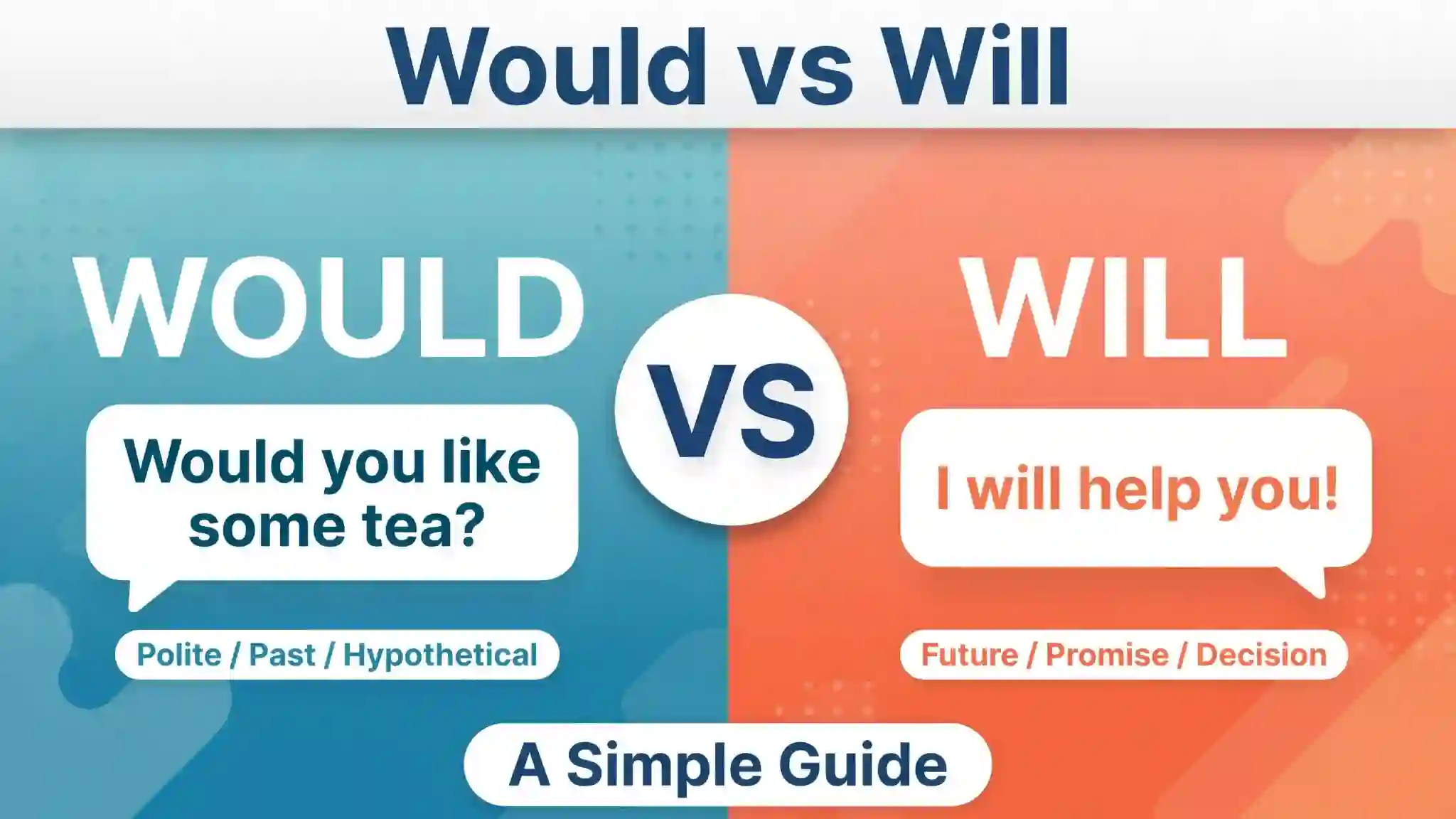
When it comes to learning English grammar, would vs will can confuse many beginners. Both words are modal verbs. They help us talk about the future, choices, requests, promises, and possible situations. They may look similar, but they do not always express the same meaning. Will often describes a future action, a decision, or a promise. Would often describes an imagined situation, a polite request, or a repeated action in the past. Knowing the difference can make your English clearer and more natural. This guide explains how to use both words, with simple rules, practical examples, and common mistakes to help you choose the correct word.
1. Would vs Will: Understanding the Basic Difference
Would and will are modal verbs. They come before the base form of a main verb. Their meanings change with context, so you need to understand the situation before choosing one.
The main difference is simple:
- Will often expresses something that a person expects, plans, decides, or promises to do in the future.
- Would often expresses something imagined, conditional, polite, or viewed from a past point of view.
Look at these examples:
| Will | Would |
| I will call you tonight. | I would call you if I had your number. |
| She will help us tomorrow. | She would help us if she could. |
| They will visit next week. | They said they would visit. |
| Will you open the door? | Would you open the door? |
The first column often refers to a real future action or a direct request. The second column can describe an imagined result, a past expectation, or a more polite request.
What Does Will Mean?
Will is a modal verb that often refers to the future. We use it to talk about actions that may happen after the present moment. It can also show promises, offers, quick decisions, and predictions.
Examples:
- I will finish my homework tonight.
- He will arrive at 6 p.m.
- We will support your decision.
- I will help you carry those bags.
- It will rain later today.
Will can also express willingness. For example, “I will listen to your problem” shows that the speaker is ready to listen.
What Does Would Mean?
Would is the past form of will in reported speech. It also has several other uses. We use it for imaginary situations, polite requests, preferences, and habits in the past.
Examples:
- I would travel more if I had enough money.
- She said she would call me.
- Would you please close the window?
- We would play outside every evening.
- I would rather stay at home.
Would does not always refer to the past. In conditional sentences, it can describe an imagined present or future situation.
2. When to Use Will in English
Will has several common uses in everyday English. It helps speakers discuss future events, make promises, offer help, and express decisions. Learning these uses makes it easier to choose the correct modal verb.
Use Will for Future Actions
Use will when you talk about an action that you expect to happen in the future. The action may be planned, expected, or simply decided at the moment of speaking.
Examples:
- I will visit my grandmother tomorrow.
- She will start her new job next Monday.
- We will meet after school.
- The train will leave in ten minutes.
- My brother will graduate next year.
These sentences describe future events. The speaker presents them as expected or intended actions.
3. When to Use Would in English
Would has many useful roles in English grammar. It can make a sentence more polite, describe an imaginary situation, or explain what someone expected in the past.
Use Would for Imaginary Situations
Use would when you talk about something that is not real or may not happen. These sentences often describe what you might do under a certain condition.
Examples:
- I would buy a bigger house if I had more money.
- She would travel around the world if she had enough time.
- They would join us if they were free.
- He would learn French if he lived in Paris.
- We would move abroad if we found good jobs.
These examples describe imagined situations. The condition explains what must happen before the action becomes possible.
Use Would for Polite Requests
Would can make requests sound softer and more respectful. It is common when speaking to strangers, customers, teachers, colleagues, or people you do not know well.
Examples:
- Would you please help me?
- Would you open the window?
- Would you mind waiting for a moment?
- Would you like some tea?
- Would you please explain this question?
Compare these two sentences:
- Will you help me?
- Would you help me?
Both are correct. The second usually sounds more polite or less direct.
Use Would for Past Habits
Would can describe repeated actions or habits from the past. It often appears in stories or memories.
Examples:
- When I was young, I would play football every evening.
- My grandfather would tell us stories at night.
- We would visit our cousins every summer.
- She would read a book before going to bed.
- They would walk to school together.
This use focuses on repeated actions. It does not usually describe a single event.
Use Would in Reported Speech
Use would when you report something that someone said about a future action from a past point of view. This often happens when you change direct speech into reported speech.
Examples:
- Direct: He said, “I will call you.”
- Reported: He said he would call me.
More examples:
- She said she would help us.
- They promised they would arrive early.
- I knew he would understand.
- My teacher told me she would check my work.
- We thought the weather would improve.
Here, would shows what someone expected or planned in the past.
4. Would vs Will in Conditional Sentences
Conditional sentences describe a condition and its possible result. Both words appear in these sentences, but they serve different purposes. The correct choice depends on whether the situation seems realistic or imaginary.
First Conditional: Will for Real Possibilities
Use the first conditional to describe a possible future situation. The condition has a realistic chance of happening.
Structure:
Examples:
- If it rains, we will stay inside.
- If you study hard, you will pass the exam.
- If she calls me, I will answer.
- If they arrive early, we will start the meeting.
- If I save enough money, I will buy a laptop.
The condition uses the present simple. The result uses will and the base form of the verb.
Second Conditional: Would for Imaginary Situations
Use the second conditional to describe an unreal, unlikely, or imagined present or future situation.
Structure:
Examples:
- If I had more money, I would buy a new car.
- If she lived nearby, we would visit her often.
- If I were you, I would accept the offer.
- If he studied harder, he would get better grades.
- If we had a bigger house, we would invite more guests.
The past simple in this structure does not necessarily refer to past time. It shows that the situation is unreal or less likely.
Compare First and Second Conditional Sentences
| First conditional | Second conditional |
| If I have time, I will help you. | If I had time, I would help you. |
| If she studies, she will pass. | If she studied, she would pass. |
| If we win, we will celebrate. | If we won, we would celebrate. |
| If he comes, I will talk to him. | If he came, I would talk to him. |
The first conditional describes a realistic possibility. The second describes a less realistic or imaginary situation.
5. Would vs Will in Questions and Negative Sentences
Both modal verbs can appear in questions and negative sentences. Their sentence structures are easy to learn. You do not need to add “do” or “does” before them.
How to Make Questions with Will
Place will before the subject to form a question.
Structure:
Examples:
- Will you come to the party?
- Will she finish the assignment?
- Will they visit us tomorrow?
- Will he call me later?
- Will we have enough time?
These questions often ask about future actions, plans, or willingness.
6. Common Mistakes When Using Would and Will
Many English learners confuse these words because both can refer to future actions. A few simple rules can help you avoid common grammar errors.
Using Will in an Imaginary Situation
A common mistake is using will in the result clause of a second conditional sentence.
Incorrect: If I had more time, I will learn Spanish.
Correct: If I had more time, I would learn Spanish.
The sentence describes an imaginary situation. Use would in the result clause.
Using Would for Every Future Action
Would does not replace will in every future sentence.
Incorrect: I would visit you tomorrow.
Correct: I will visit you tomorrow.
The first sentence can work in a special context, such as an implied condition. However, if you simply mean that you plan to visit tomorrow, will is the natural choice.
Forgetting the Base Verb
Both modal verbs take the base form of the main verb. Do not add “to” or use the past form after them.
Incorrect: She will goes to school.
Correct: She will go to school.
Incorrect: He would went home.
Correct: He would go home.
More examples:
- I will eat dinner soon.
- She would travel more.
- They will play outside.
- We would choose another option.
Confusing Would With Used To
Would and used to can both describe repeated past actions. However, they do not work in exactly the same way.
Examples:
- I used to live in London.
- When I lived in London, I would walk along the river every morning.
Used to can describe past states and repeated actions. Would usually describes repeated past actions, not past states.
For example, “I used to be shy” is natural. “I would be shy” does not normally express the same past state.
7. Easy Tips to Remember the Difference Between would vs will
You can learn these words faster by connecting them with their most common uses. Focus on the meaning of the sentence instead of memorizing long grammar rules.
Remember Will for Real Future Actions
Think of will when you talk about future plans, predictions, promises, and decisions.
Examples:
- I will call you later.
- We will finish the work tomorrow.
- She will help her friend.
- It will be a beautiful day.
Ask yourself: Am I talking about something I expect or intend to happen? If the answer is yes, will may be the right choice.
Remember Would for Imagined Situations
Think of would when you describe an unreal condition or an action that depends on something else.
Examples:
- I would travel if I had money.
- She would join us if she were free.
- He would buy that phone if it were cheaper.
Ask yourself: Am I imagining what might happen under a different condition? If the answer is yes, would may be the right choice.
Use Would to Sound More Polite
Would is useful when you want to make a request or offer politely.
Compare:
- Will you help me?
- Would you help me?
The second sentence often sounds softer. It is a good choice when you want to show respect or avoid sounding too direct.
8. Would vs Will: Quick Comparison Table
A comparison table makes the main grammar differences easier to review. Use it as a quick reference when writing sentences or speaking English.
| Feature | Will | Would |
| Main use | Future actions | Imaginary or conditional actions |
| Predictions | Future predictions | Expected outcomes from a past viewpoint or imagined results |
| Requests | Direct requests | Often more polite requests |
| Promises | Commonly used | Less common for direct promises |
| Past habits | Not used for this purpose | Repeated past actions |
| Reported speech | Direct speech | Often replaces will after a past reporting verb |
| Conditional sentences | First conditional | Second conditional |
| Negative form | Will not / won’t | Would not / wouldn’t |
| Example | I will help you. | I would help you if I could. |
The table gives you a quick overview. Remember that context matters. Would has more than one use, and it does not always describe an imaginary event.
10. Frequently Asked Questions About Would vs Will
1. What Is the Main Difference Between would vs will?
Will often refers to future actions, predictions, promises, and decisions. Would often describes imaginary situations, polite requests, past habits, and reported speech. The correct choice depends on the meaning and context of your sentence.
2. Is Would the Past Tense of Will?
Yes. Would is the past form of will in some grammar structures, especially reported speech. For example, “She says she will come” can change to “She said she would come.” However, would also has uses that do not refer to the past.
3. Can I Use Would for Future Situations?
Yes. You can use would to describe an imagined or conditional future situation. For example, “I would travel next year if I had enough money.” The sentence describes a possible action that depends on a condition.
4. Is Would More Polite Than Will?
Would often sounds more polite or less direct than will when making requests and offers. For example, “Would you help me?” sounds softer than “Will you help me?” Both are grammatically correct, but the tone differs.
5. Can Will and Would Appear in the Same Sentence?
Yes. They can appear in the same sentence when they serve different purposes. For example, “I will help you if I can” describes a possible future action. “I would help you if I could” describes a more hypothetical situation.
6. Which Word Should Beginners Learn First?
Beginners can start with will because it has a clear and common role in future statements. Learn would next for polite requests, imagined situations, and past habits. Practice both in short sentences to understand their differences.
Conclusion: Mastering Would vs Will
Understanding would vs will becomes easier when you focus on the meaning of each sentence. Will often describes future actions, predictions, promises, offers, and quick decisions. Would often describes imaginary situations, polite requests, past habits, and reported speech.
Remember these simple rules:
- Use will for actions you expect or intend to happen.
- Use would for imagined results and conditional situations.
- Choose would when you want to make a request sound more polite.
- Use would to report what someone expected or promised in the past.
- Use the base form of the verb after both modal verbs.
Do not rely on one rule for every sentence. Context plays an important role in English grammar. Read examples, write your own sentences, and practice using both words in everyday conversations. With regular practice, you will learn to choose the right word naturally and express your ideas with greater confidence.
