


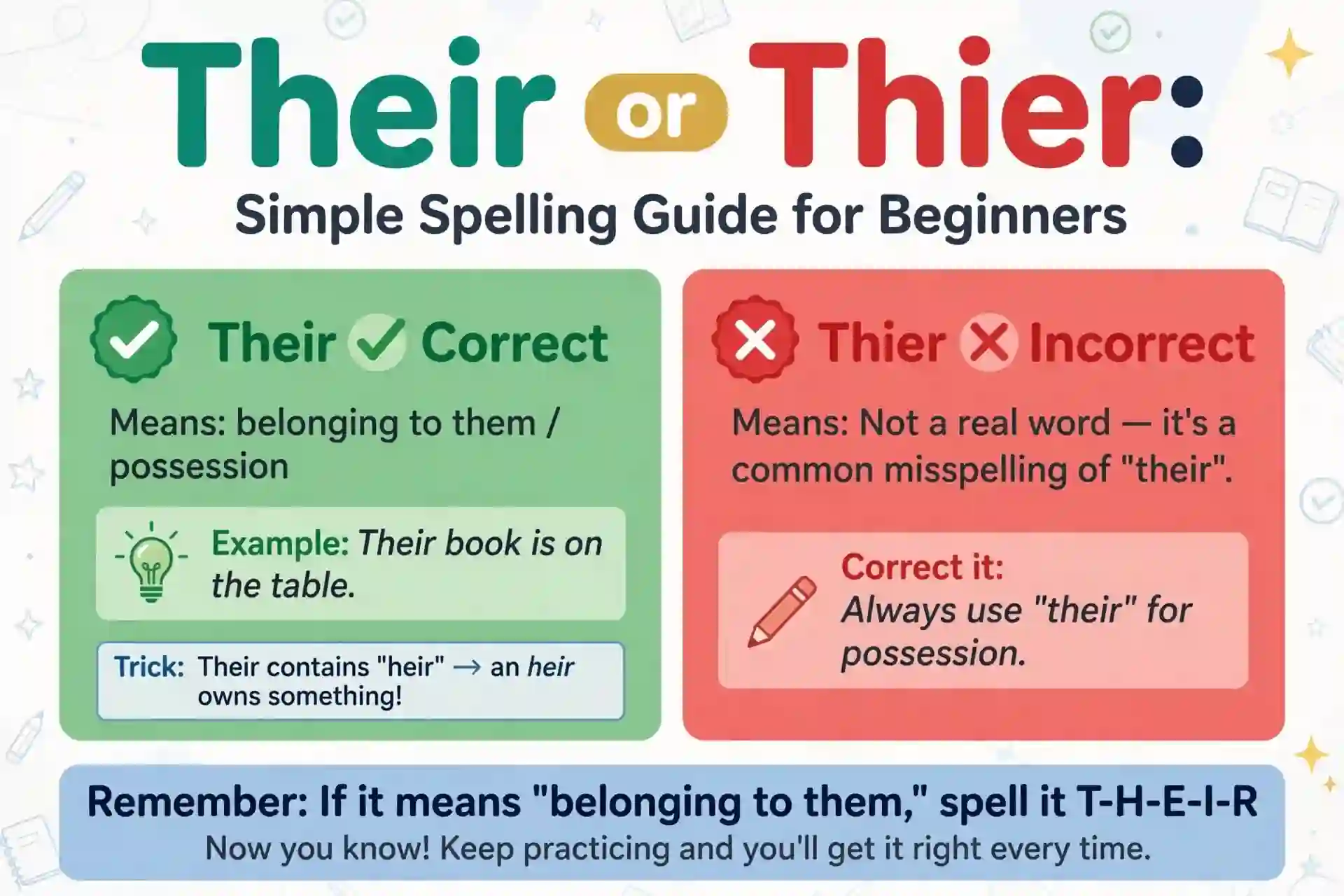
When it comes to English spelling, small mistakes can change the quality of your writing. Their vs Thier is a common spelling confusion among beginners, students, and even experienced writers. Both forms look similar, but only one is correct in standard English. The correct spelling is their. The word “thier” is a common typing mistake. It does not have an accepted meaning in standard English. Learning the correct spelling helps you write clear messages, emails, school assignments, and professional documents. This guide explains the difference, meaning, grammar rules, examples, and common mistakes. You will also learn easy ways to remember the correct form.
Their vs Thier: Which Spelling Is Correct?
Many English learners confuse these two spellings because they contain almost the same letters. A small change in letter order makes one form incorrect. The correct word is their.
“Their” is a possessive word. It shows that something belongs to a person or a group. People use it every day in spoken and written English.
“Thier” is not a standard English word. It usually appears when someone types the letters in the wrong order. You may see it in text messages, online comments, schoolwork, or social media posts.
Look at these examples:
- Correct: Their house is near the park.
- Incorrect: Thier house is near the park.
- Correct: Their children love reading.
- Incorrect: Thier children love reading.
- Correct: I like their new car.
- Incorrect: I like thier new car.
The correct spelling always places the letters in this order: T-H-E-I-R.
Remember this simple rule: write “their” when you want to show ownership. Never use “thier” as a replacement.
What Does Their Mean in English?
“Their” is a possessive determiner. It shows that something belongs to someone or something. It often refers to more than one person, but it can also refer to one person when their gender is unknown or when someone uses they/them pronouns.
The word helps writers avoid repeating names. It also makes sentences shorter and easier to understand.
For example:
- Sarah and John forgot their books.
- The students finished their homework.
- Someone left their phone on the table.
- Alex brought their lunch to work.
- The children cleaned their room.
In each sentence, “their” connects an owner with something they own or use.
Their as a Possessive Word
A possessive word shows ownership, connection, or association. “Their” works before a noun to explain who something belongs to.
Examples include:
- Their teacher is very kind.
- Their garden looks beautiful.
- Their favorite movie starts at seven.
- Their team won the match.
- Their plans changed suddenly.
You can use it with people, animals, groups, and organizations.
For example, consider this sentence:
“The company changed their website.”
Here, “their” connects the website with the company. The sentence shows who owns or controls the website.
Their for One Person
Many people believe “their” only refers to two or more people. This idea is incorrect. English speakers also use singular “their” when a person’s gender is unknown, irrelevant, or when that person uses they/them pronouns.
Examples:
- Every student must bring their notebook.
- Someone forgot their umbrella.
- The winner can collect their prize tomorrow.
- Each person should check their email.
- A customer left their wallet here.
Singular “their” is widely accepted in modern English. It helps writers avoid awkward phrases such as “his or her” when they do not know the person’s gender.
Why Is Thier Incorrect?
“Thier” is a spelling error. It does not have a recognized meaning in standard modern English dictionaries as a normal English word. Writers often produce it by reversing the letters “e” and “i.”
English contains many words with similar letter patterns. This can make spelling difficult for beginners.
Compare these forms:
| Spelling | Status | Explanation |
| Their | Correct | Shows possession |
| Thier | Incorrect | Common spelling mistake |
| There | Correct | Refers to a place or introduces a statement |
| They’re | Correct | Short form of they are |
The difference may look small, but the meaning and grammar matter.
How Does the Thier Mistake Happen?
People make this mistake for several reasons. Some writers type quickly and fail to notice the letter order. Others remember the sound but not the correct spelling.
Common causes include:
- Fast typing: People may type the wrong letter order when they rush.
- Poor spelling habits: Writers may repeat the same mistake without checking it.
- Autocorrect problems: Some keyboards may not catch every spelling error.
- Visual confusion: The two forms look almost identical.
- Limited practice: Beginners may not have seen the correct form enough times.
The best solution is regular reading and writing practice. Pay attention to the spelling whenever you use this possessive word.
Their vs Thier: Examples in Everyday Sentences
Examples make spelling rules easier to understand. They show how a word works in real situations. You can use “their” in conversations, school assignments, business emails, and online posts.
Here are several examples.
Simple Examples of Their
These sentences show the basic use of the correct spelling.
- Their house has a large garden.
- Their dog loves playing outside.
- I met their parents yesterday.
- Their school is close to my home.
- Their new car looks amazing.
- Their baby is sleeping peacefully.
- We enjoyed their wedding party.
- Their teacher gave them extra work.
- Their kitchen needs a little cleaning.
- Their friends arrived early.
Each sentence uses “their” to show a connection or relationship.
Their in School and Education
Students often use possessive words in essays, homework, and classroom discussions.
Examples:
- The students submitted their assignments.
- Their teacher explained the lesson.
- The children packed their school bags.
- The players forgot their sports equipment.
- Every student should bring their textbook.
These examples show how the word connects people with their belongings or responsibilities.
Their in Text Messages and Social Media
People use “their” in casual conversations. Correct spelling still matters in informal writing.
Examples:
- I love their new pictures.
- Their outfits look great.
- Did you see their latest post?
- Their vacation looks amazing.
- I think their idea is brilliant.
You may see the incorrect form in online comments or messages. Avoid copying that spelling.
Their vs Thier: Understanding the Difference
Many beginners confuse “their,” “there,” and “they’re.” These words sound alike in most English accents, but their meanings differ.
Learning the difference helps you avoid common grammar mistakes.
| Word | Meaning | Example |
| Their | Shows possession | Their car is new. |
| There | Refers to a place or position | Put the bag there. |
| They’re | Means they are | They’re very happy. |
When to Use Their
Use “their” when you want to show ownership or association.
Examples:
- Their children are playing.
- I like their new house.
- Their plans sound interesting.
A simple way to check is to ask, “Who owns it?” If the answer refers to a person or group, “their” may be the right choice.
When to Use There
Use “there” when you refer to a place, position, or existence.
Examples:
- Put your shoes over there.
- There is a book on the desk.
- We went there last weekend.
- There are five people outside.
You can remember “there” by connecting it with a place.
When to Use They’re
“They’re” is a contraction of “they are.” It combines two words into one shorter form.
Examples:
- They’re going to the market.
- They’re excited about the trip.
- They’re waiting for their friends.
- They’re working on a new project.
Try replacing “they’re” with “they are.” If the sentence still makes sense, the contraction is correct.
For example:
“They’re happy.”
“They are happy.”
Both sentences have the same meaning.
Easy Ways to Remember the Correct Spelling
Remembering the right letter order can prevent repeated mistakes. You do not need complicated grammar rules. A few simple techniques can help you write the word correctly every time.
Remember the Phrase They Are
Think about the phrase “they are” when you see the word “their.” Both begin with the same three letters: T-H-E.
This does not explain the full spelling, but it gives you a useful starting point.
Remember that “their” contains the letters E before I.
Use the Ownership Test
Ask yourself whether the sentence shows ownership or a connection.
For example:
- Their room is clean.
- Their parents are visiting.
- Their business is growing.
Each sentence connects something with its owner.
If you want to describe a place, use “there.” If you mean “they are,” use “they’re.”
Practice Writing the Word
Writing a word several times can help you remember its spelling.
Try this short exercise:
- Their books are on the desk.
- Their friends are coming today.
- Their house looks beautiful.
- Their team played well.
- Their plans are ready.
Read each sentence aloud. Notice how the word appears before a noun.
Read More English Content
Reading books, articles, and reliable websites helps you recognize correct spelling. Your brain becomes familiar with common word patterns.
Pay attention to possessive words when you read. Notice how writers use them in different sentences.
You can also keep a small list of words that often cause spelling problems. Review the list regularly.
Common Mistakes to Avoid When Using Their
Even after learning the correct spelling, people may confuse possessive words with other similar forms. Understanding these mistakes will improve your grammar.
Using Thier Instead of Their
This is the main spelling mistake discussed in this guide.
Incorrect: Thier children are playing outside.
Correct: Their children are playing outside.
Always check the order of the letters before submitting your writing.
Using Their Instead of There
These words have different grammatical roles.
Incorrect: Their is a park near my house.
Correct: There is a park near my house.
The second sentence uses “there” to introduce the existence of a park.
Using Their Instead of They’re
“They’re” means “they are.” “Their” shows possession.
Incorrect: Their going to school.
Correct: They’re going to school.
The contraction is correct because the sentence means “They are going to school.”
Forgetting the Possessive Meaning
Some writers use “their” without checking whether the sentence shows ownership or association.
For example:
Incorrect: Their are many books on the shelf.
Correct: There are many books on the shelf.
Read the whole sentence before choosing a word. The meaning will often tell you which spelling to use.
Frequently Asked Questions
1. Is their vs thier the Correct Spelling?
“Their” is the correct spelling. It is a possessive word that shows ownership or association. “Thier” is a common spelling error. You should always write “their” in standard English.
2. What Does Their Mean?
“Their” shows that something belongs to a person or group. For example, “Their house is beautiful” means the house belongs to them. English speakers also use it for one person when gender is unknown or when that person uses they/them pronouns.
3. Is their vs thier a Real English Word?
No. “Thier” is not an accepted standard English word with a normal dictionary meaning. People usually write it by mistake when they mix up the letters in “their.”
4. What Is the Difference Between their vs thier?
“Their” shows ownership, while “there” refers to a place or introduces the existence of something. For example, “Their car is outside” shows ownership. “The car is over there” refers to a location.
5. How Can I Remember the Spelling of Their?
Remember that the correct word has the letters E before I. Write it in short sentences and practice using it in everyday conversations. Regular reading also helps you recognize the correct spelling.
6. Can I Use their vs thier One Person?
Yes. Singular “their” is accepted in modern English. Writers use it when a person’s gender is unknown, irrelevant, or when the person uses they/them pronouns. For example, “Someone forgot their keys.”
Conclusion: Their vs Thier
The difference between these two forms is simple. Their vs Thier is a common spelling question, but only “their” is correct in standard English. It is a possessive word that shows ownership, connection, or association. “Thier” is a spelling mistake caused by placing the letters in the wrong order.
Remember the difference between “their,” “there,” and “they’re.” Use “their” for possession, “there” for a place or existence, and “they’re” when you mean “they are.” These simple rules can improve your writing and prevent common grammar errors.Practice with short sentences, read English content, and check your spelling before sharing important work. Keep the correct letter order in mind. The more you use the word correctly, the easier it becomes to remember.
