


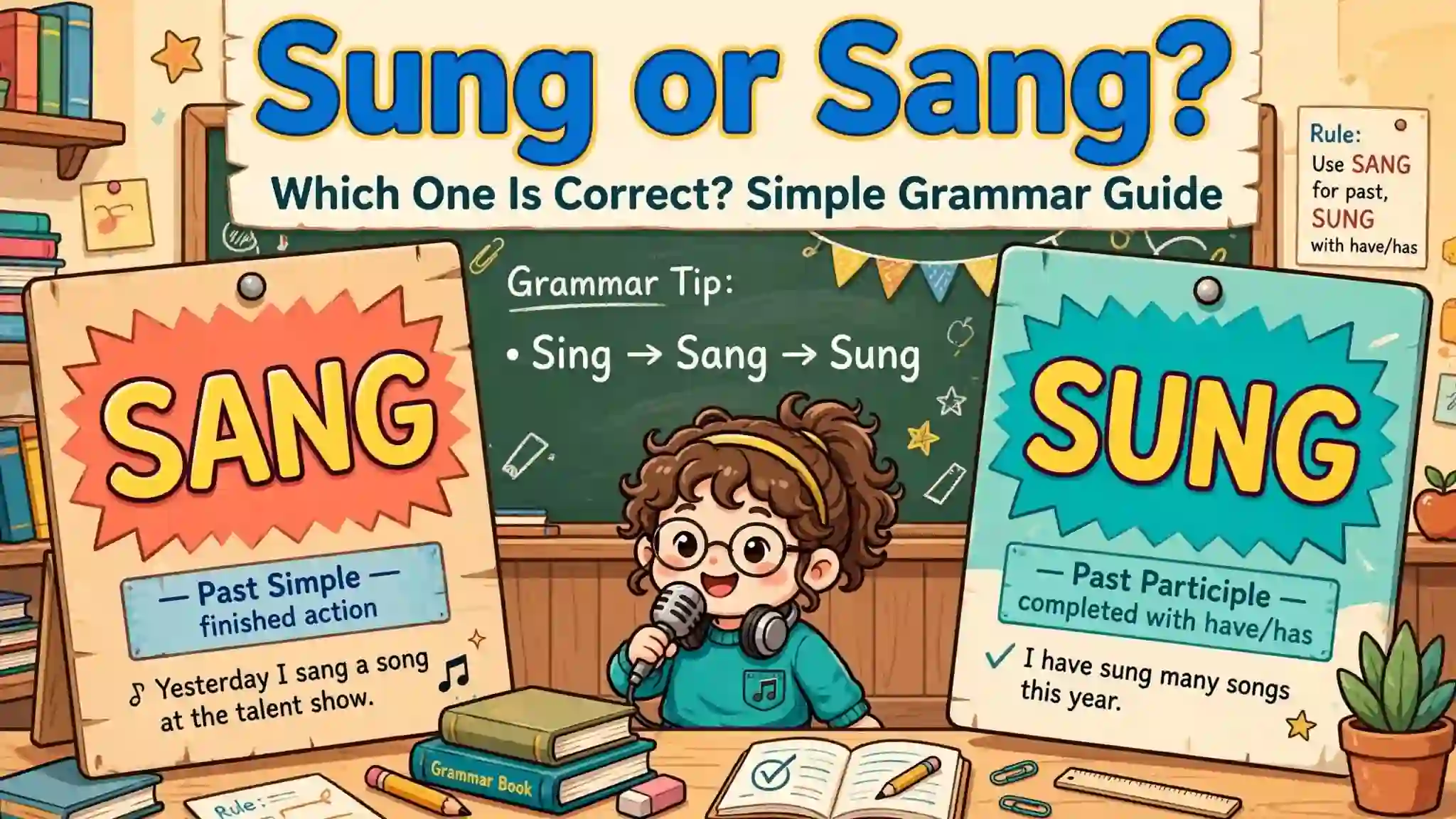
When it comes to English grammar, small differences between words can cause confusion. Sung or Sang is a common example. Both words come from the verb sing, but they serve different purposes in a sentence. Many English learners use them incorrectly because they describe actions related to singing. The good news is that the difference is simple once you understand verb forms. This guide explains when to use each word, how they work in different tenses, and how to avoid common mistakes. You will also find practical examples, sentence comparisons, and easy tips to help you use both words with confidence.
Sung or Sang: What Is the Main Difference?
Both words describe the action of producing music with your voice. However, they belong to different verb forms. Understanding their roles helps you build grammatically correct sentences.
- Sang is the simple past tense of sing.
- Sung is the past participle of sing.
Use sang when you describe an action that happened and finished in the past.
Example:
– She sang a beautiful song yesterday.
Use sung with helping verbs such as has, have, or had.
Example:
– She has sung that song many times.
The main difference comes down to sentence structure. You cannot freely replace these words. Each one follows a specific grammar pattern.
| Verb form | Word | Example |
| Base form | Sing | I sing every morning. |
| Simple past | Sang | I sang yesterday. |
| Past participle | Sung | I have sung before. |
Think of sang as the word for a completed past action. Think of sung as the form that works with auxiliary verbs to create perfect tenses and certain passive constructions.
What Does sung or sang Mean in English?
The word sang is the simple past form of the verb sing. It describes an action that happened at a specific time in the past. You do not need a helping verb to use it in a standard past-tense sentence.
Definition of Sang
Sang means that someone performed an action by producing musical sounds with their voice. It can describe singing alone, singing with others, or performing a song for an audience.
For example:
- He sang at the school concert.
- My sister sang a song at dinner.
- They sang together during the celebration.
- The children sang their favorite nursery rhyme.
- She sang beautifully at the wedding.
Each sentence describes an action that took place in the past.
The word can also appear in stories, personal experiences, and descriptions of past events. It helps readers understand that the singing happened before the present moment.
When Should You Use Sang?
Use sang when you want to describe a completed action in the simple past tense.
Here are common situations where this word fits naturally:
1. When describing yesterday’s activities
- I sang in the shower yesterday.
- He sang his favorite song last night.
- We sang at the party.
2. When talking about past performances
- The singer sang in front of thousands of people.
- My brother sang at the talent show.
- The choir sang during the ceremony.
3. When telling a story
- The little girl sang while walking home.
- The old man sang a song from his childhood.
- Birds sang outside my window that morning.
4. When describing a finished event
- Everyone sang during the birthday celebration.
- The students sang the national anthem.
- Our team sang after winning the competition.
In all these examples, sang works without a helping verb. It directly expresses the past action.
Sang in Different Sentence Types
You can use sang in positive, negative, and question sentences. The sentence structure changes depending on the type of statement.
Positive sentences:
- She sang at the event.
- They sang beautifully.
- I sang a new song.
Negative sentences:
- She did not sing at the event.
- They did not sing together.
- I did not sing yesterday.
Notice that negative sentences use did not followed by the base form sing, not sang.
Questions:
- Did you sing yesterday?
- Did she sing at the concert?
- Did they sing the school song?
This rule is important. Once you use did, you must use the base form of the main verb.
What Does Sung Mean in English?
Sung is the past participle of sing. It usually appears with helping verbs. These verbs include has, have, had, and forms of be. It can also appear in passive sentences.
Definition of Sung
Sung describes the past participle form of singing. It does not normally work alone as the main verb in a standard simple past sentence.
For example:
- I have sung this song before.
- She has sung at several weddings.
- They had sung before the guests arrived.
- The song was sung by a famous artist.
Each sentence uses sung with another verb to create a complete grammatical structure.
The past participle helps express actions that connect to another time or grammatical idea. It can show experience, completion, or an action performed by someone.
When Should You Use Sung?
Use sung when a sentence requires a past participle. It commonly appears in perfect tenses and passive voice.
1. With Has
Use has sung with singular third-person subjects, such as he, she, and it.
Examples:
- She has sung this song before.
- He has sung in many competitions.
- My mother has sung at family gatherings.
2. With Have
Use have sung with I, you, we, and they.
Examples:
- I have sung in a choir.
- You have sung this song many times.
- We have sung together since childhood.
- They have sung at several festivals.
3. With Had
Use had sung to describe an action completed before another past event.
Examples:
- She had sung before the guests arrived.
- We had sung the national anthem before the match started.
- He had sung in the choir before moving away.
4. In Passive Voice
Use sung with a suitable form of be when the sentence focuses on the song rather than the singer.
Examples:
- The song was sung by the children.
- The anthem was sung before the game.
- The melody has been sung for generations.
These patterns make sung easy to recognize. Look for the helping verb before it.
Sung or Sang: Examples in Different Tenses
Verb tense tells readers when an action happens. The three main forms of sing appear in different grammatical structures. Learning these patterns makes everyday writing easier.
Simple Present Tense
The simple present describes habits, routines, and general facts. Use sing or sings in this tense.
Examples:
- I sing every morning.
- She sings in the school choir.
- They sing together on Sundays.
- My father sings while cooking.
Do not use sang or sung to describe a regular present habit.
Simple Past Tense
The simple past describes an action that happened and finished in the past. Use sang.
Examples:
- I sang yesterday.
- She sang at the wedding.
- They sang their favorite song last weekend.
- He sang beautifully during the show.
You do not need has, have, or had in these sentences.
Present Perfect Tense
The present perfect connects a past action to the present. Use has sung or have sung.
Examples:
- I have sung this song before.
- She has sung professionally for years.
- They have sung at many events.
- We have sung together several times.
This tense often describes experience or an action with present relevance.
Past Perfect Tense
The past perfect describes an action that happened before another past action. Use had sung.
Examples:
- She had sung before the audience arrived.
- They had sung the song before the show ended.
- I had sung in a choir before joining the band.
The word had signals the past perfect structure.
Future Perfect Tense
The future perfect describes an action that will be complete before a particular future time. Use will have sung.
Examples:
- I will have sung three songs by tonight.
- She will have sung at the event by noon.
- They will have sung their final performance before the festival ends.
This tense combines will have with the past participle.
| Tense | Correct form | Example |
| Present simple | Sing | I sing daily. |
| Past simple | Sang | I sang yesterday. |
| Present perfect | Have sung | I have sung before. |
| Past perfect | Had sung | I had sung earlier. |
| Future perfect | Will have sung | I will have sung by then. |
Sung or Sang: Common Grammar Mistakes
Many people confuse these two words because they both describe past singing actions. However, using the wrong form can make a sentence grammatically incorrect.
Mistake 1: Using Sung Without a Helping Verb
Incorrect: She sung at the concert yesterday.
Correct: She sang at the concert yesterday.
Why? The sentence uses the simple past tense. It does not need a helping verb. Therefore, sang is the correct choice.
Mistake 2: Using Sang With Has
Incorrect: He has sang this song before.
Correct: He has sung this song before.
Why? The present perfect tense requires has followed by a past participle. The past participle of sing is sung.
Mistake 3: Using Sang With Have
Incorrect: They have sang together many times.
Correct: They have sung together many times.
Why? The helping verb have requires the past participle in the present perfect tense.
Mistake 4: Using Sung After Did
Incorrect: Did you sung at the party?
Correct: Did you sing at the party?
Why? The auxiliary verb did already marks the past tense. The main verb must return to its base form.
Mistake 5: Using Sang After Had
Incorrect: I had sang before the show started.
Correct: I had sung before the show started.
Why? The past perfect tense requires had followed by a past participle.
Sung vs. Sang: Easy Ways to Remember the Difference
You do not need to memorize complicated grammar rules to understand these words. A few simple techniques can help you choose the correct form.
Remember the Three Forms of Sing
Start by learning the basic verb pattern:
- Sing: Present or base form
- Sang: Simple past
- Sung: Past participle
Repeat this pattern when practicing English. It will help you recognize the correct form in different sentences.
Look for Helping Verbs
Check whether the sentence contains a helping verb.
- Has sung
- Have sung
- Had sung
- Will have sung
- Was sung
- Has been sung
These patterns usually require sung.
If the sentence describes a simple completed action without a helping verb, use sang.
Look for Time Expressions
Time expressions can help you identify the correct tense.
| Time expression | Example |
| Yesterday | She sang yesterday. |
| Last night | He sang last night. |
| Last year | We sang last year. |
| Before | I have sung this song before. |
| By the time | She had sung by the time we arrived. |
| By tomorrow | They will have sung by tomorrow. |
Remember that time expressions provide clues. The full sentence structure determines the correct verb form.
Sung or Sang in Everyday English
Both forms appear in conversations, songs, stories, school assignments, and professional writing. Knowing where each word belongs helps you communicate clearly.
In Casual Conversations
People often talk about music and singing in everyday chats.
Examples:
- I sang that song yesterday.
- Have you sung this song before?
- She sang beautifully at dinner.
- We have sung together since school.
Use the simple past for finished events. Use the past participle with the correct helping verb.
In School and Academic Writing
Students often use these words when writing stories, reports, and personal experiences.
Examples:
- The students sang the school anthem.
- The choir had sung before the principal arrived.
- The song was sung during the ceremony.
Correct verb forms make written work easier to understand. They also help students demonstrate their understanding of English tenses.
In Music and Performance Reviews
Writers use these forms to describe singers and performances.
Examples:
- The artist sang with confidence.
- The performer has sung on international stages.
- The song was sung with great emotion.
These sentences describe completed performances, professional experience, and musical presentations.
In Creative Writing
Writers can use both forms to create clear timelines in stories.
Examples:
- The young musician sang under the stars.
- She had sung the melody many times before.
- The song had been sung by generations of her family.
Each form serves a different grammatical purpose. Choosing the correct one keeps the story clear.
Frequently Asked Questions About Sung or Sang
Is Sung or Sang Correct?
Both words are correct, but they serve different grammatical purposes. Sang is the simple past tense of sing. Sung is the past participle. Use sang for a completed past action and sung with helping verbs such as has, have, and had.
Is It I Sang or I Sung?
The correct sentence is I sang when you describe a simple past action.
Example: I sang at the party yesterday.
You can also say:
- I have sung at the party before.
- I had sung that song earlier.
The correct choice depends on the tense and sentence structure.
Is It Has Sang or Has Sung?
The correct form is has sung.
Example: She has sung this song before.
The present perfect tense requires a past participle after has. Since sung is the past participle of sing, it is the correct choice.
Can I Say I Have Sang?
No. The grammatically correct form is I have sung.
Example: I have sung in front of a large audience.
The word have needs a past participle in the present perfect tense. Therefore, use sung instead of sang.
What Are the Three Forms of Sing?
The three main forms are:
- Present: Sing
- Past: Sang
- Past participle: Sung
Examples:
- I sing every day.
- I sang yesterday.
- I have sung before.
These forms help you create different English tenses.
Conclusion
Understanding Sung or Sang becomes easy when you learn the three forms of the verb sing. Both words are correct, but they do not work in the same way. Use sang when describing an action that happened in the past. For example, “She sang at the concert yesterday.” Use sung after helping verbs such as has, have, and had. For example, “She has sung at several concerts.”
Remember the basic pattern: sing, sang, sung. Pay attention to helping verbs and time expressions when building sentences. Avoid using sung alone in simple past sentences or placing sang after has and have. Practice with everyday examples, short writing exercises, and conversations. These small steps can improve your grammar over time. Once you understand the difference, you can use both forms naturally in schoolwork, messages, stories, and professional writing.
