


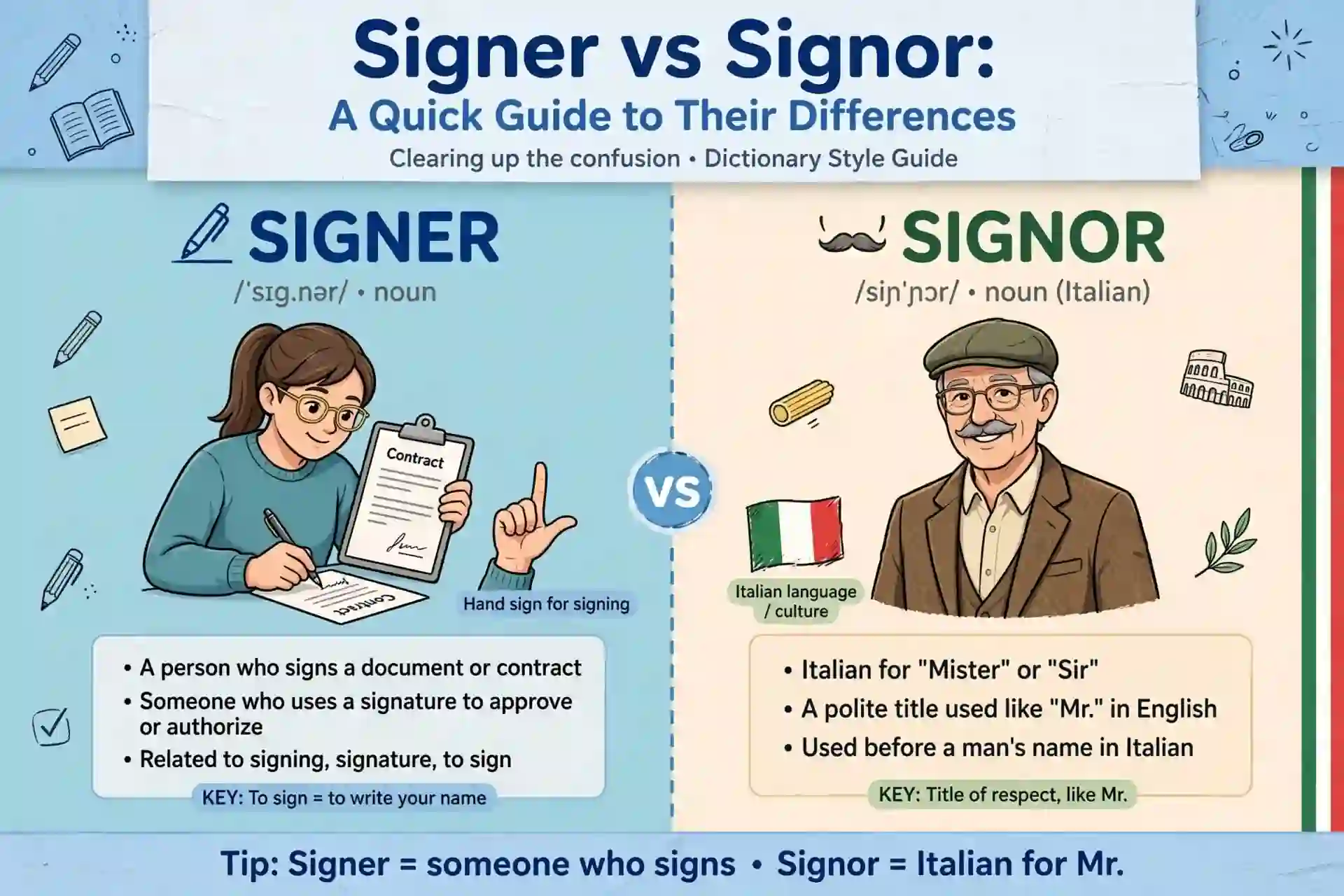
When it comes to English spelling, some words look almost identical but have completely different meanings. Signer vs Signor is a good example. Both words are correct, but they serve different purposes. A signer is a person who signs a document, agreement, or other written item. A signor is an Italian word used as a respectful title for a man, similar to “Mr.” in English. Confusing these terms can lead to spelling mistakes in formal writing, business documents, and everyday communication. This guide explains their meanings, origins, pronunciation, grammar rules, and correct usage. You will also find practical examples and simple tips to help you choose the right word.
Signer vs Signor: What Is the Difference?
The main difference between these words is their meaning and purpose. One refers to a person who signs something, while the other serves as a respectful Italian title for a man.
Here is the simplest way to understand them:
- Signer: A person who signs a document, contract, letter, or agreement.
- Signor: An Italian title used to address or refer to a man. It is similar to “Mr.” in English.
For example:
- The signer agreed to the terms of the contract.
- Signor Rossi arrived at the meeting.
The first sentence describes someone’s action or role. The second uses a respectful title before a man’s surname.
Although the words share similar spelling, you cannot use them interchangeably. Their meanings, origins, and grammatical functions are different.
What Does Signer Mean?
A signer is someone who writes their name on a document to show agreement, approval, confirmation, or identification. The word commonly appears in legal, financial, professional, and everyday situations.
A signer may approve a business contract, sign a permission form, confirm a delivery, or agree to official terms. The person does not always need to sign with a traditional handwritten signature. Electronic signatures can also identify a signer.
Definition of Signer
The word signer is a noun. It comes from the verb sign, which means to write or place a signature on something.
A signer can be:
- A person who signs a legal contract.
- Someone who approves a business agreement.
- A person who signs a school permission slip.
- An individual who signs an official application.
- Someone who confirms a document with an electronic signature.
The term describes the person’s role in the signing process.
For example, imagine that two people enter into a rental agreement. Both people sign the document. Each person becomes a signer of that agreement.
The word can also describe people who sign petitions, letters, public statements, or other written materials.
Examples of Signer in Sentences
These examples show how to use the word naturally in different situations.
- The signer must read the agreement before adding a signature.
- Every signer received a copy of the contract.
- The bank asked the signer to provide identification.
- The final signer approved the business proposal.
- Each signer must complete the required fields.
- The signer forgot to date the document.
- We need one more signer for the application.
- The authorized signer approved the payment.
- The document requires the signer’s full name.
- The signer confirmed the information was correct.
Notice that the word refers to a person who performs the act of signing. It does not function as a title or honorific.
Common Types of Signers
Different situations involve different types of signers. Understanding these roles can help you recognize the word in professional and legal writing.
1. Contract Signer
A contract signer is someone who signs an agreement. This person may accept the terms of a business deal, employment arrangement, or service contract.
2. Authorized Signer
An authorized signer has permission to sign documents on behalf of another person or organization. For example, a company may allow a manager to sign certain business agreements.
3. Electronic Signer
An electronic signer adds a digital signature to a document. This may involve typing a name, drawing a signature, or using an electronic signing service.
4. Petition Signer
A petition signer adds their name to a request or public statement. Their signature shows support for a particular cause or proposal.
5. Witness Signer
A witness may sign a document to confirm that a particular event occurred or that someone signed in their presence. The witness has a different role from the person who signs the main agreement.
What Does Signor Mean?
Signor is an Italian title used as a polite form of address for a man. It is similar to “Mr.” or “Mister” in English. You may see it in Italian conversations, letters, literature, films, and formal introductions.
The title usually appears before a man’s surname. It shows respect and politeness rather than describing an action.
Definition of Signor
The word signor comes from the Italian language. It is a masculine courtesy title that people use when addressing or referring to an adult man.
For example:
- Signor Bianchi is waiting outside.
- Good morning, Signor Romano.
- I spoke with Signor Conti yesterday.
In these sentences, the word acts as a title. It does not describe someone signing a document.
You may also encounter the spelling Signore. This is another Italian form related to the same title. In Italian, signore is the standard full form, while signor often appears before a surname or certain names.
Examples of Signor in Sentences
Here are some examples that demonstrate the correct use of this Italian title.
- Signor Rossi welcomed the visitors.
- We met Signor Bianchi at the restaurant.
- Signor Moretti lives in Rome.
- The letter was addressed to Signor Ferrari.
- Signor Conti introduced his colleagues.
- Everyone greeted Signor Romano politely.
- Signor Ricci attended the formal dinner.
- I received an invitation from Signor Lombardi.
- Signor Bruno spoke with the manager.
- The guide introduced Signor De Luca to the group.
These examples show how the title appears before a man’s name.
Signor in Italian Culture
Italian titles often reflect politeness, respect, and social etiquette. People may use them in formal conversations, business settings, and written communication.
The title signor is particularly useful when addressing a man by his surname. It works much like the English title “Mr.”
For example:
- Signor Verdi = Mr. Verdi
- Signor Romano = Mr. Romano
- Signor Ferrari = Mr. Ferrari
You may also encounter Signora, which refers to a woman. It is similar to “Mrs.” or “Ms.” depending on the context.
The word Signore can also mean “sir” or “gentleman” in Italian. Its exact use depends on the sentence.
Signer vs Signor: Meaning, Spelling, and Pronunciation
Spelling and pronunciation help explain why these words cause confusion. They share several letters, but their endings and meanings differ.
The easiest way to remember them is to connect each word with its purpose. One relates to signing documents, while the other relates to an Italian form of address.
Spelling Differences
The words have only one main letter difference near the end.
| Word | Spelling | Meaning |
| Signer | S-I-G-N-E-R | A person who signs something |
| Signor | S-I-G-N-O-R | An Italian title for a man |
The letter combination -er in signer connects the word to the person performing an action. English uses this pattern in words such as writer, teacher, and worker.
The ending -or in signor belongs to the Italian title. It does not describe a person who performs the action of signing.
Pronunciation Differences
Both words begin with the same sound, but their final syllables differ.
- Signer: Usually pronounced SY-ner.
- Signor: Usually pronounced seen-YOR in English approximations of the Italian title.
The pronunciation of signor can vary slightly depending on the speaker’s language and accent. Italian pronunciation follows its own sound rules.
Remember that spelling alone does not determine meaning. You should consider the context before choosing either word.
Quick Comparison Table
| Feature | Signer | Signor |
| Language | English | Italian |
| Word type | Noun | Courtesy title |
| Meaning | A person who signs | A respectful title for a man |
| Main use | Documents and agreements | Formal address |
| Example | The signer approved the form. | Signor Rossi arrived. |
| Related word | Sign | Signore |
This comparison makes the distinction easier to remember. The two words belong to different language contexts and perform different grammatical jobs.
Signer vs Signor: When Should You Use Each Word?
Choosing the correct word depends on your intended meaning. If you describe someone signing a document, use signer. If you address an Italian man respectfully, use signor.
The following situations show how each word works in everyday and formal writing.
Use Signer in Legal and Business Documents
The word signer frequently appears in legal and business communication. It identifies the person who places a signature on an agreement or official form.
Examples:
- The signer must approve all contract changes.
- Each signer should keep a copy of the agreement.
- The company requires an authorized signer.
- The signer confirmed the payment details.
In these situations, using signor would change the meaning and create an error.
Use Signor When Addressing an Italian Man
Choose signor when you use an Italian courtesy title before a man’s surname.
Examples:
- Signor Rossi is the new director.
- Please welcome Signor Moretti.
- I sent the invitation to Signor Bianchi.
- Signor Ferrari will attend the event.
This title adds politeness and respect. It does not indicate that someone has signed anything.
Use Signer in Everyday Conversations
You do not need to work in a legal office to use the word signer. It can describe anyone who signs a document or written statement.
For example:
- My father was the first signer on the form.
- The last signer left the office.
- We need another signer for the school application.
- The signer forgot to write the date.
These sentences use the word in simple, everyday contexts.
Use Signor in Formal Introductions
You may encounter signor in Italian literature, travel conversations, formal introductions, and business settings involving Italian names.
For example:
- Signor Antonio welcomed us to his home.
- The hotel manager introduced Signor Rossi.
- I would like to speak with Signor Bianchi.
When writing in Italian, follow the language’s standard title and capitalization conventions.
Common Mistakes When Using signer vs signor
These words are easy to confuse because they look similar. However, choosing the wrong one can change the meaning of a sentence. Learning the common mistakes will help you write more accurately.
Mistake 1: Using Signor Instead of Signer
This mistake happens when someone wants to describe a person who signs a document but chooses the Italian title.
Incorrect: The signor must approve the agreement.
Correct: The signer must approve the agreement.
The sentence refers to a person’s responsibility in a signing process. Therefore, signer is the correct word.
Mistake 2: Using Signer as a Title
Some writers may use signer before a man’s surname because it looks similar to signor.
Incorrect: Signer Rossi will attend the meeting.
Correct: Signor Rossi will attend the meeting.
The second sentence uses the Italian title correctly.
Related Words: Sign, Signature, Signatory, Signore, and Signora
Learning related words can help you understand the difference between a person who signs a document and someone who receives a respectful title.
Quick Vocabulary Comparison
| Word | Meaning | Example |
| Sign | To write your name | Please sign here. |
| Signature | A written name or mark | Your signature is missing. |
| Signer | A person who signs | The signer approved the form. |
| Signatory | A party that signs an agreement | The signatory accepted the terms. |
| Signor | Italian title for a man | Signor Rossi is here. |
| Signore | Italian form of address | The signore greeted us. |
| Signora | Italian title for a woman | Signora Bianchi arrived. |
These related terms have different grammatical roles. Learning them helps you avoid confusing a signing action with a courtesy title.
How to Remember the Difference Between signer vs signor
A simple memory trick can help you choose the correct spelling without checking a dictionary every time. Connect each word with its main meaning.
Remember Signer With the Word Sign
The word signer contains the word sign. A signer is a person who signs something.
Think of this example:
- Sign = The action.
- Signer = The person who performs the action.
You can use the same pattern with other English words:
- Teach → Teacher
- Write → Writer
- Work → Worker
- Sign → Signer
This pattern makes the meaning easier to remember.
Remember Signor as an Italian Title
Think of signor as a title that appears before an Italian man’s surname.
For example:
- Signor Rossi
- Signor Bianchi
- Signor Ferrari
You can connect it with Signora, the Italian title for a woman.
Frequently Asked Questions
These frequently asked questions cover the spelling, meaning, pronunciation, and correct use of both terms. They offer quick answers for readers who want to remember the main rules.
1. What Is the Main Difference Between signer vs signor?
A signer is a person who signs a document, agreement, or written statement. Signor is an Italian courtesy title for a man. One describes a person’s role, while the other shows respect when addressing someone.
2. Is Signer a Correct English Word?
Yes. Signer is a standard English noun. It describes someone who signs a document or other written material. For example, “The signer approved the contract” uses the word correctly.
3. Is Signor an English or Italian Word?
Signor is an Italian title that English speakers also use in certain contexts. It is similar to “Mr.” and usually appears before an Italian man’s surname. For example, “Signor Rossi” means “Mr. Rossi.”
4. Does Signor Mean Someone Who Signs a Document?
No. Signor does not mean a person who signs a document. It is a respectful Italian title for a man. Use signer when describing someone who signs a contract, form, or agreement.
5. What Is the Female Version of Signor?
The feminine Italian courtesy title is Signora. It is similar to “Mrs.” or “Ms.” in English. For example, “Signora Rossi” is a respectful way to address or refer to a woman.
6. Is Signatory the Same as Signer?
The words have similar meanings, but they are not always used in exactly the same way. A signer is anyone who signs something. A signatory often refers to a person or organization that formally signs an agreement, treaty, or official document.
Final Thoughts
Understanding Signer vs Signor becomes easy when you focus on their meanings and uses. Both words are correct, but they belong to different language contexts and serve different purposes.Use signer when referring to a person who signs a document, contract, application, or agreement.
The word comes from the English verb sign and often appears in legal, financial, and business writing.Choose signor when addressing or referring to an Italian man. It works like the English title “Mr.” and usually appears before a surname. You may also come across related Italian words such as signore and signora.
