


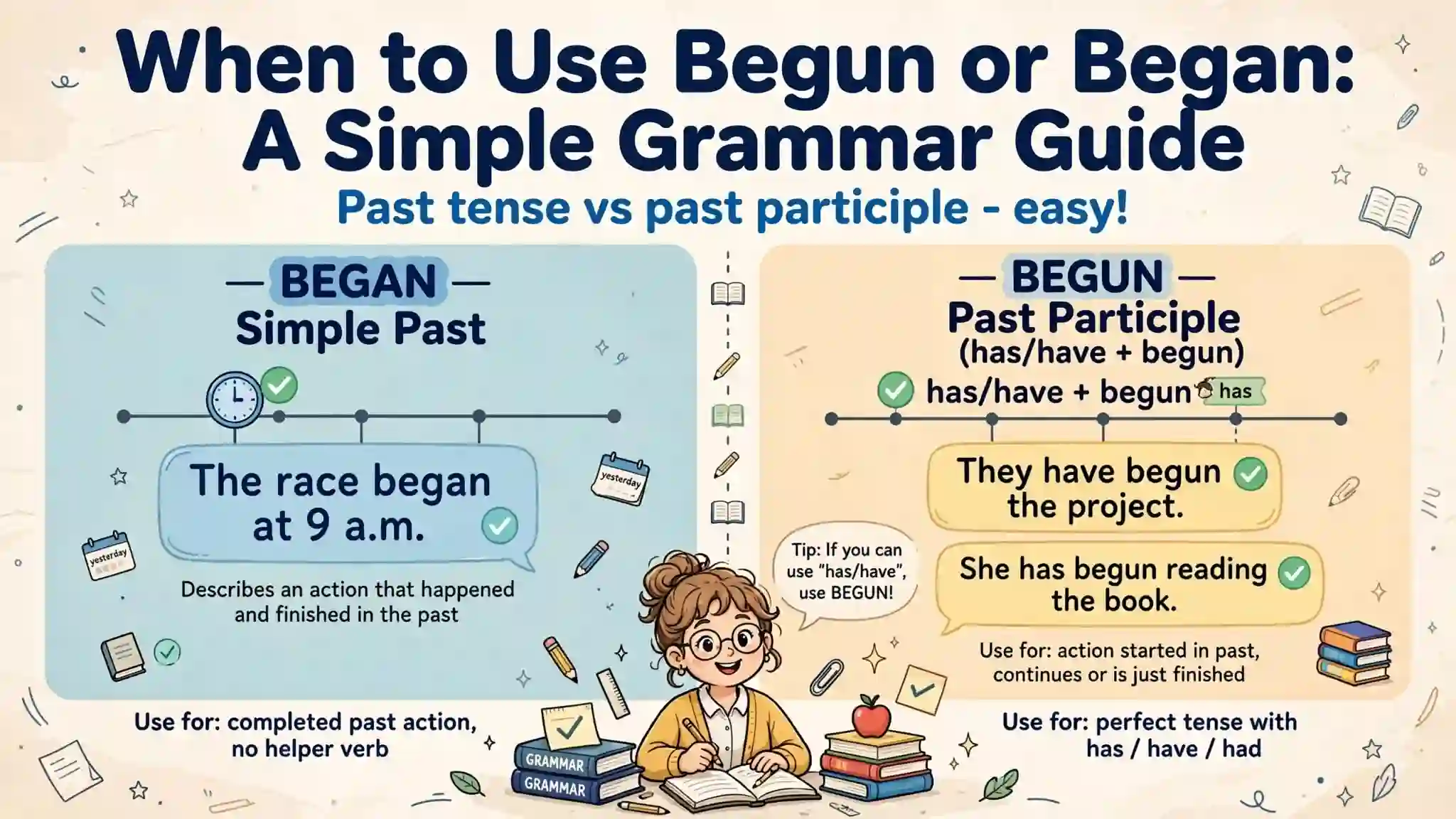
When it comes to English grammar, some words look similar but serve different purposes in a sentence. Begun or began is a common example. Both words come from the verb begin, which means to start something. However, they do not work in the same way. One is the simple past tense, while the other is the past participle. Choosing the correct form can make your writing clearer and more natural.
What Is the Difference Between Begun or Began?
The main difference between begun and began is their grammatical role. Both describe an action that started in the past, but they appear in different sentence structures.
- Began is the simple past tense of begin.
- Begun is the past participle of begin.
The verb begin is an irregular verb. This means it does not form its past tense by adding -ed.
Here is the basic verb pattern:
| Verb form | Word | Example |
| Base form | Begin | I begin work at nine. |
| Simple past | Began | I began work yesterday. |
| Past participle | Begun | I have begun my work. |
These three forms describe different stages of an action.
Use begin for the present or base form. When describing a completed action in the past. Use begun with a helping verb, such as has, have, or had.
Examples:
- The movie began at seven.
- The movie has begun.
- The students began their lesson.
- The students have begun their lesson.
Both forms can describe something that started earlier. The difference lies in the tense and sentence structure.
When Should You Use Began?
Began is the simple past tense of begin. Use it when you describe an action that started and happened at a specific time in the past.
It does not need a helping verb to make the sentence grammatically correct. It works as the main verb in a simple past sentence.
For example:
- She began learning English last year.
- We began our journey early in the morning.
- The concert began at eight o’clock.
- He began his new job on Monday.
In each example, the action started in the past. The sentence presents that starting point as a past event.
1. Use Began for Completed Past Actions
Use began when an action started and you describe it as a past event. The sentence may include a specific time or simply refer to an earlier moment.
Examples:
- I began reading the book last night.
- They began building their house in March.
- My brother began studying medicine two years ago.
- The teacher began the lesson after lunch.
- She began writing her report yesterday.
These sentences focus on an action that started in the past. You do not need has, have, or had before began.
2. Use Began With Past Time Expressions
Began often appears with words and phrases that identify a past time.
Common examples include:
- Yesterday
- Last night
- Last week
- Last month
- Two years ago
- In 2020
- When I was young
When Should You Use Begun?
Begun is the past participle of begin. It usually appears with a helping verb. Common helping verbs include has, have, and had.
You cannot normally use begun alone as the main verb in a standard past-tense statement.
For example:
- Incorrect: She begun her homework yesterday.
- Correct: She began her homework yesterday.
- Correct: She has begun her homework.
The helping verb makes the final sentence grammatically complete.
1. Use Begun With Has
Use has begun with singular third-person subjects, such as he, she, it, or a singular noun.
This structure forms the present perfect tense.
Examples:
- She has begun a new chapter in her life.
- He has begun learning French.
- The school has begun its summer program.
- The company has begun hiring new employees.
- My daughter has begun taking piano lessons.
These sentences connect a past starting point with the present. The action may still continue, or its beginning may have a present result.
2. Use Begun With Have
Use have begun with I, you, we, they, and plural subjects.
This structure also forms the present perfect tense.
Examples:
- I have begun working on my assignment.
- We have begun preparing for the event.
- They have begun their training sessions.
- You have begun making real progress.
- The students have begun reading their textbooks.
The helping verb have supports the past participle begun.
Begun or Began: Examples in Different Situations
Understanding grammar rules is useful, but everyday examples make the difference easier to remember. Both forms can describe the start of an activity, event, process, or experience.
The correct choice depends on the tense and the other words in the sentence.
1. Begun or Began in Everyday Conversations
People use begin in conversations about work, school, hobbies, and daily activities.
Here are some natural examples:
| Began | Begun |
| I began cooking dinner. | I have begun cooking dinner. |
| She began her studies yesterday. | She has begun her studies. |
| We began cleaning the house. | We have begun cleaning the house. |
| He began exercising last month. | He has begun exercising. |
| They began their journey early. | They have begun their journey. |
The first column describes a past event. The second column uses the present perfect tense.
2. Begun or Began in Academic Writing
Students often use these words in essays, assignments, research papers, and reports.
Choose the form that matches the sentence structure.
Examples:
- The research began in January.
- The researchers have begun collecting data.
- The experiment had begun before the equipment failed.
- The university began offering online courses last year.
- The students have begun preparing for their final exams.
Academic writing requires consistent verb tense. Avoid switching between past and present perfect without a clear reason.
3. Begun or Began at Work
Professional communication also requires accurate verb forms.
You might use these words in emails, reports, presentations, and workplace updates.
Examples:
- The new project began on Monday.
- Our team has begun reviewing the proposal.
- The company had begun hiring before the announcement.
- The manager began the meeting with a short introduction.
- We have begun working on the new marketing plan.
Use began when reporting a past starting point. Use begun when the sentence includes a helping verb that requires a past participle.
4. Begun or Began in Storytelling
Writers use began to describe events that happened in the past. They use begun when the sentence includes a perfect tense construction.
Examples:
- The story began on a quiet winter morning.
- A strange sound began coming from the basement.
- By midnight, the storm had begun.
- Her journey had begun long before she reached the city.
- The adventure began when they discovered an old map.
The correct choice helps readers follow the order of events.
Common Grammar Mistakes With Begun or Began
Many English learners confuse these forms because they share the same meaning. However, their grammatical functions differ.
Learning the common mistakes can help you avoid errors in everyday writing.
1. Using Begun Without a Helping Verb
One of the most common mistakes is using begun as a simple past verb.
Incorrect: She begun her presentation yesterday.
Correct: She began her presentation yesterday.
Begun is a past participle. It normally needs a helping verb, such as has, have, or had.
2. Using Began After Has or Have
Has and have form the present perfect tense with a past participle.
Incorrect: He has began his training.
Correct: He has begun his training.
The same rule applies to plural subjects.
Incorrect: They have began the project.
Correct: They have begun the project.
3. Using Began After Had
Had also requires the past participle when forming the past perfect tense.
Incorrect: We had began the discussion before lunch.
Correct: We had begun the discussion before lunch.
Remember that all three helping verbs, has, have, and had, take begun in these perfect tense structures.
Easy Tips to Remember Begun or Began
You do not need to memorize complicated grammar explanations to choose the correct form. A few simple tricks can help you remember the difference.
1. Remember the Three Verb Forms
Learn the complete verb pattern:
- Begin: Present or base form.
- Began: Simple past tense.
- Begun: Past participle.
Repeat this pattern when practicing English. It will help you recognize the correct form in different sentences.
2. Look for Helping Verbs
Check whether the sentence contains has, have, or had.
If one of these helping verbs forms a perfect tense, use begun.
Examples:
- I have begun.
- She has begun.
- They had begun.
If you are describing a simple past action without a helping verb, use began.
Example:
– I began yesterday.
3. Look for Past Time Expressions
Words such as yesterday, last year, and two days ago often indicate the simple past tense.
Examples:
- We began the project yesterday.
- She began working here last year.
- He began learning Spanish two months ago.
However, time expressions alone do not decide the verb form in every sentence. Always check the complete sentence structure.
4. Practice With Simple Sentences
Create your own examples using both forms.
Try completing these sentences:
- She _____ her new job last Monday.
- They have _____ their preparations.
- The game _____ at six o’clock.
- I had _____ studying before dinner.
- We _____ the journey yesterday.
Answers:
- Began
- Begun
- Began
- Begun
- Began
Practice regularly. You will start recognizing the correct form naturally.
Why Is the Difference Between Begun or Began Important?
Correct verb forms improve communication. They help readers understand when an action started and how it relates to other events.
A small grammar mistake can make an otherwise clear sentence sound awkward.
1. It Improves Writing Accuracy
Using the correct form makes your sentences grammatically complete.
For example:
- Incorrect: The company has began a new project.
- Correct: The company has begun a new project.
The second sentence follows the present perfect structure.
2. It Makes Communication Clearer
Correct tense usage helps readers understand the timing of events.
Compare these sentences:
- The class began at nine.
- The class has begun.
The first sentence identifies a past starting point. The second tells readers that the class has started by now.
3. It Helps With Professional and Academic Writing
Grammar matters in emails, applications, essays, reports, and presentations.
Using began and begun correctly makes your writing more polished. It also helps prevent confusion when describing completed actions and ongoing situations.
4. It Builds English Language Confidence
Learning irregular verbs improves your understanding of English sentence structures.
Once you understand this pattern, you can apply the same learning approach to other irregular verbs, such as:
- Drink, drank, drunk
- Sing, sang, sung
- Ring, rang, rung
- Swim, swam, swum
- Sink, sank, sunk
These verbs follow a similar three-form pattern. Practicing them can strengthen your grammar skills.
Frequently Asked Questions About Begun or Began
These frequently asked questions explain the most common points of confusion. They offer quick answers for learners who want to use both verb forms correctly.
1. Is Begun or Began Correct?
Both words are correct, but they serve different grammatical purposes. Began is the simple past tense of begin. Begun is the past participle. Use began for a simple past action and begun with helping verbs such as has, have, and had.
2. Is It Has Begun or Has Began?
The correct phrase is has begun. The helping verb has requires the past participle. For example, “The meeting has begun” is correct. “The meeting has began” is grammatically incorrect.
3. Can I Use Begun Without Has, Have, or Had?
Begun normally needs a helping verb in standard English sentences. You should not use it alone as a simple past verb. Use began when describing an action that started in the past without a perfect tense helping verb.
4. Is It Had Begun or Had Began?
Had begun is correct. Had forms the past perfect tense and must be followed by the past participle. For example, “The movie had begun before we arrived” is grammatically correct.
5. Is It Did Begin or Did Began?
Did begin is correct. When you use did in a question or negative sentence, the main verb returns to its base form. For example, “Did the class begin?” is correct, while “Did the class began?” is incorrect.
Conclusion
Understanding begun or began becomes much easier when you learn the three forms of the verb begin. Began is the simple past tense. Use it when describing an action that started in the past. Begun is the past participle. It normally appears with helping verbs such as has, have, and had.Pay attention to helping verbs, time expressions, and the overall sentence meaning. Avoid using begun alone in simple past statements. Also, remember to use the base form begin after did.
