


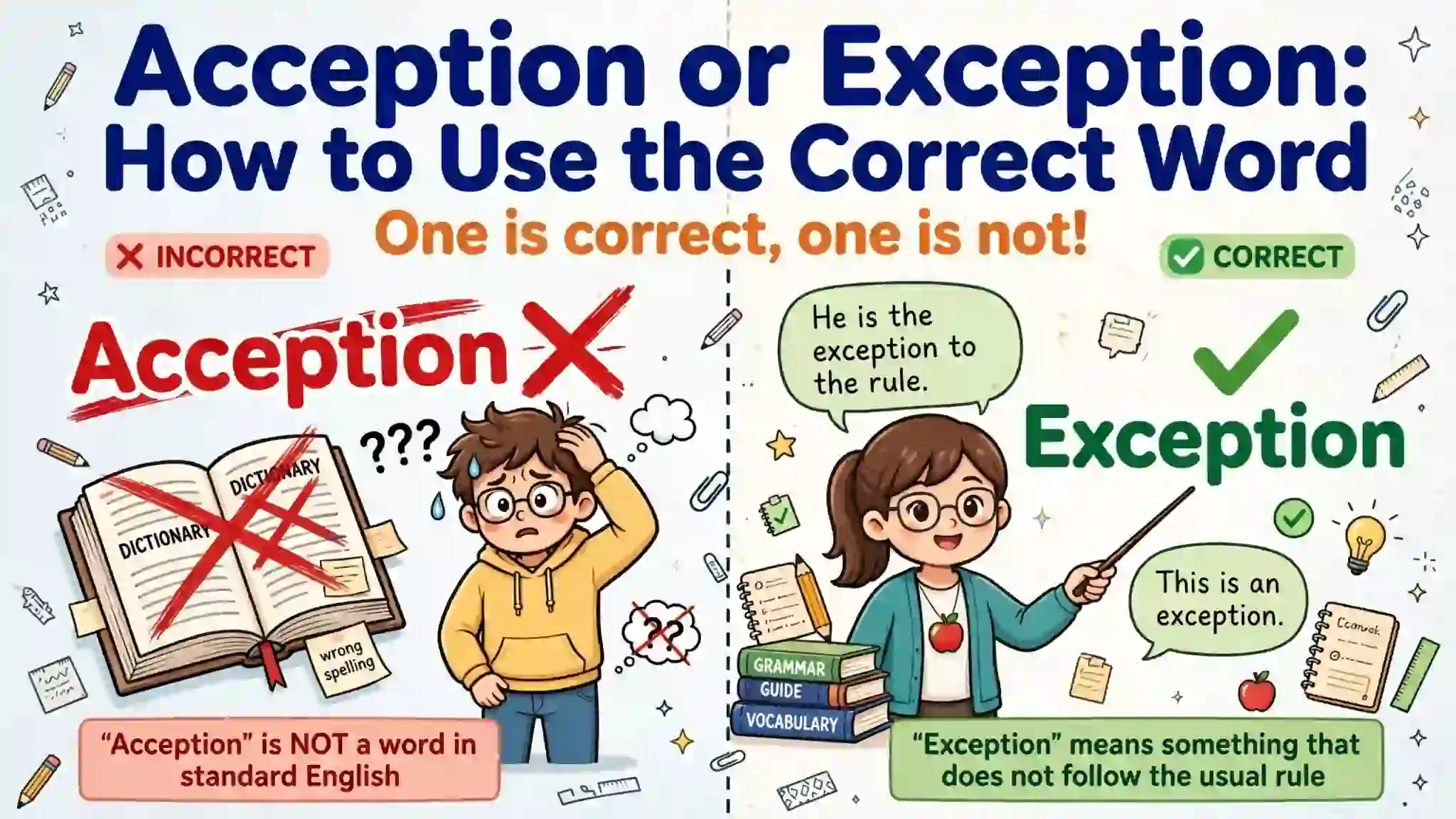
When it comes to English spelling, small differences can change the meaning of a word. Acception vs Exception is a common point of confusion because both forms look similar. They also sound close in some accents. However, they do not serve the same purpose. Exception is the standard word used when something does not follow a general rule. Acception is a rare, mostly obsolete word that may appear in older texts or specialized references. Most writers should use exception in everyday English.
Acception vs Exception: What Is the Difference?
The main difference in acception vs exception is how often people use these words and what they mean. One is common in modern English, while the other is rare and usually appears in historical contexts.
Exception is a common noun. It describes a person or thing that does not follow a rule, pattern, or general statement. For example, “Every student passed the test except Ali” means Ali did not pass. You can also say, “Ali is the exception.”
Acception is a rare term. Older sources have used it to refer to the act of accepting or receiving something. It is not the normal modern spelling for acceptance. You will rarely need it in everyday writing.
The key points are:
- Exception: Something that does not follow a rule.
- Acception: A rare or obsolete term linked to accepting or receiving.
- Acceptance: The standard modern noun for the act of accepting something.
What Does Exception Mean?
The word exception describes something that does not fit a general rule. It can refer to a person, object, event, or situation that differs from what usually happens.
An exception can appear in many areas of life. A school may allow one student to submit work late. A company may make a special rule for an urgent case. A teacher may give extra time to a student who needs support.
Meaning and Common Uses of Exception
The noun exception has several common uses:
- A case outside a rule: “All staff must attend, with the exception of new employees.”
- A person who differs from a group: “Most children enjoy the game, but Sara is an exception.”
- A special allowance: “The manager made an exception and approved the request.”
- An objection: “He took exception to the unfair comment.”
The word often appears with phrases such as with the exception of, make an exception, and take exception to.
Examples of Exception in Sentences
Here are examples from everyday situations:
- Everyone joined the trip, with one exception.
- The store is open every day, except Sunday.
- Our teacher made an exception for students who were ill.
- This rule applies to all users without exception.
- I take exception to that claim because it is not true.
- Every room was clean, with the exception of the kitchen.
- The new policy has no exceptions.
- She is an exception to the usual pattern.
These sentences show how the word works in different contexts. It can describe a person, a situation, or an action that differs from a rule.
What Does Acception Mean?
Acception is a real English word, but it is now obsolete or very rare. Older English sources used it for the act of accepting or receiving something. It could also refer to the received meaning of a word.
wehd.com+1
Modern writers do not normally use this term. The words acceptance and acceptation cover the meanings that older texts sometimes expressed with it.
For example, an old text might use acception to discuss the meaning given to a word. A modern writer would usually choose meaning, sense, or acceptation.
Historical Meaning of acception vs exception
The word has roots in Latin and appeared in older forms of English. Historical dictionaries record it in the sense of receiving or accepting. Some older uses also relate to the meaning or interpretation of a word.
This history explains why the spelling may look familiar. It does not mean that the word is a good choice for modern everyday writing.
What Should You Use acception vs exception in Modern Writing?
In most cases, no. Readers may think it is a spelling mistake because they expect acceptance or exception.
Choose the word that matches your meaning:
- Use acceptance for approval or the act of receiving something.
- Use acceptation for the recognized meaning of a word, especially in formal or specialized writing.
- Use exception for something that does not follow a rule.
- Avoid acception unless you are quoting an old source or discussing historical language.
For example:
- Incorrect for modern usage: “Thank you for your acception of my offer.”
- Correct: “Thank you for your acceptance of my offer.”
- Correct: “Every offer was approved, with one exception.”
Acception vs Exception: Which Spelling Is Correct?
The right spelling depends on the meaning you want to express. In ordinary modern English, exception is correct when you mean something excluded from a rule. If you mean approval or willingness to receive something, use acceptance.
The phrase Acception or Exception often appears in spelling questions because the two forms look almost identical. The first letters create a different word, and the meanings are not interchangeable.
| Word | Meaning | Modern usage |
| Acception | An old term linked to accepting or a received meaning | Obsolete or very rare |
| Exception | Something excluded from a rule or general case | Common |
| Acceptance | Approval or the act of receiving something | Common |
| Acceptation | The meaning in which a word is understood | Formal or less common |
A simple test can help. Ask yourself whether you mean something left out or something received.
- If you mean something left out, write exception.
- If you mean approval or receiving, write acceptance.
- If you are discussing an old word or text, acception may be relevant.
Acception vs Exception: Examples in Everyday English
Examples make the difference easier to understand. The following sentences show how to use the common modern words in school, work, daily life, and formal writing.
Examples Using Exception
Use exception when a person or thing does not follow a general rule.
- Everyone must wear a uniform, with the exception of the principal.
- The office closes at five, without exception.
- My brother is the only exception in our family.
- The teacher made an exception for a student who missed the exam due to illness.
- All products are on sale except the new collection.
- The policy allows no exception for late payments.
- She took exception to the rude message.
- This case is an exception to the usual process.
Examples Using Acceptance
Use acceptance when you mean approval, agreement, or receiving something.
- Her acceptance of the job offer made the team happy.
- The school sent an acceptance letter.
- Acceptance of the rules is required before you join.
- He found acceptance in his new community.
- The company confirmed its acceptance of the proposal.
- She showed acceptance of the final decision.
Examples of Acception in Historical Context
You are unlikely to need acception in modern conversation. Still, it helps to understand how older writers used it.
- An old text may use acception to mean the act of receiving something.
- A historical dictionary may record acception as an earlier term for a word’s received meaning.
- A scholar may explain the word’s old use when studying a passage from centuries ago.
Why Do People Confuse in acception vs exception?
The confusion comes from their similar spelling and sound. Both words contain the letters “ception.” Only the first letter changes. That small difference can make a writer choose the wrong form.
Similar Spelling
The two words look almost the same on the page. A person may type one while thinking of the other. Spellcheck may not catch the error because both forms exist in historical dictionaries.
Remember that a word can exist without being suitable for modern use. A dictionary may list an old term, but that does not make it common or appropriate in daily writing.
Similar Pronunciation
In many English accents, the words sound very similar. This can make the difference harder to notice during a conversation. A listener may understand the intended meaning from the rest of the sentence.
Writing requires more care. The spelling must match the meaning. If you are unsure, pause and ask whether the sentence refers to exclusion or acceptance.
Confusion With Acceptance
A second source of confusion is the word acceptance. It looks and sounds closer to acception than exception does. Writers may blend the two forms and create a spelling that does not fit modern usage.
Keep these meanings separate:
- Accept is a verb. It means to receive, agree to, or approve something.
- Acceptance is a noun. It means the act or state of accepting.
- Except usually means excluding or not including.
- Exception is a noun. It means a case that does not follow a general rule.
Common Mistakes to Avoid
Many spelling errors happen because writers focus on how a word looks rather than what it means. These simple checks can help you avoid mistakes.
Using Acception Instead of Acceptance
This is a common error when a writer wants to describe approval or receiving something.
Incorrect: “We are waiting for your acception of the invitation.”
Correct: “We are waiting for your acceptance of the invitation.”
The modern noun is acceptance. Use it when someone agrees to an offer, receives an invitation, or approves a decision.
Using Exception When You Mean Acceptance
The reverse mistake can also happen. A writer may use exception when the sentence needs acceptance.
Incorrect: “Her exception of the award made her family proud.”
Correct: “Her acceptance of the award made her family proud.”
The first sentence does not express the intended meaning. The second sentence clearly shows that she received the award.
Assuming Every Listed Word Is Common
A dictionary may include rare, regional, or obsolete words. That does not mean readers use them today. Acception is a good example of a word with a recorded history but little place in current everyday English.
For clear writing, choose words that your audience will recognize. Use historical terms only when the subject calls for them.
Easy Ways to Remember the Correct Word
A simple memory trick can make the spelling easier to recall. Focus on the meaning rather than trying to memorize the two forms alone.
Connect Exception With Exclude
The word exception begins with “ex,” just like exclude. Both relate to leaving something out.
Think of this example:
“Everyone is invited except Ben.”
Ben is left out of the invitation. He is the exception.
This connection works well in school assignments, emails, and everyday messages.
Connect Acceptance With Accept
The word acceptance comes from accept. If someone accepts an offer, their action is called acceptance.
For example:
- I accept your invitation.
- Thank you for your acceptance.
The verb and noun share the same basic idea. This makes the spelling easier to remember.
Check the Meaning Before You Type
Ask yourself one quick question: Does the sentence describe something left out, or something received?
- Left out = exception.
- Received or approved = acceptance.
- Old historical usage = acception may appear in the source.
This quick check can prevent many spelling errors. It also helps you choose a word that fits the sentence.
How to Use Exception in Formal and Professional Writing
The word exception appears in many professional settings. People use it to describe special cases, policy limits, rules, and differences from normal practice.
In Business and Workplace Writing
A company may have rules for staff, customers, or suppliers. Some situations may need special treatment.
Examples:
- Employees must follow the policy without exception.
- The manager approved an exception to the deadline.
- All orders qualify for free delivery, with the exception of remote locations.
- The contract lists several exceptions to the standard terms.
These sentences use the word clearly. They also show why correct spelling matters in business documents.
Related Words: Accept, Except, Acceptance, and Exception
These words share similar letters, but each has a different role. Learning their meanings will help you write clear sentences and avoid spelling errors.
| Word | Part of speech | Meaning |
| Accept | Verb | To receive or agree to something |
| Except | Preposition or conjunction | Excluding or not including |
| Acceptance | Noun | The act of accepting or approving |
| Exception | Noun | A case that does not follow a rule |
| Acception | Noun | An obsolete term linked to acceptance or meaning |
Frequently Asked Questions
1. Is It acception vs exception?
In modern English, exception is the correct word when you mean something that does not follow a rule. Acception is an obsolete or very rare word. You will usually need acceptance if you mean approval or receiving something.
2. Is Acception a Real Word?
Yes. Historical dictionaries record acception as a noun. It once referred to receiving something or the received meaning of a word. It is not common in modern English, so avoid it in everyday writing.
3. What Is the Plural of Exception?
The plural form is exceptions. For example: “The school made two exceptions to its attendance policy.”
4. Can I Use Acception Instead of Acceptance?
No. In modern writing, use acceptance when you mean approval or the act of receiving something. Acception is outdated and may confuse readers.
5. What Is the Difference Between Except and Exception?
Except usually means excluding something. Exception is a noun that describes the person, thing, or case that does not follow a rule.
Conclusion
Choosing the right word makes your writing clear and correct. The key difference in acception vs exception is their meaning and modern use. Exception is the standard word for a person, thing, or situation that does not follow a general rule. You can use it in schoolwork, business emails, reports, and daily conversations.
Acception is a real word with a place in older English. It once referred to receiving something or the accepted meaning of a word. Today, it is obsolete or very rare. Most writers should use acceptance for approval or receiving something.
Remember these simple rules: use exception for something excluded, acceptance for receiving or approval, and except when you mean “not including.” Keep acception for historical discussions or direct quotations from older texts.
