


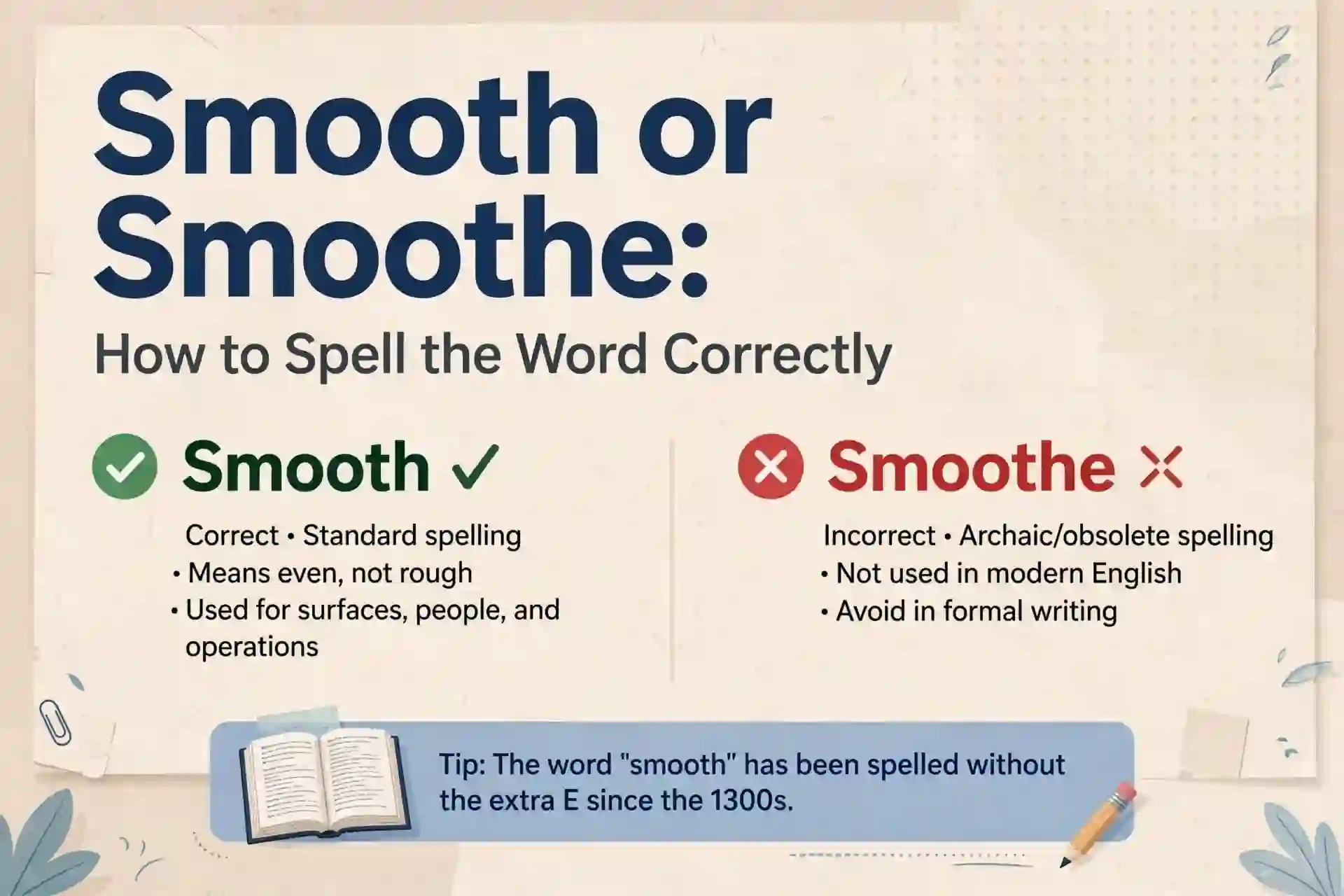
When it comes to English spelling, some words create confusion because they look similar but follow different spelling rules. smooth vs smoothe is a common example. Many people wonder whether the word needs an extra “e” at the end or whether the shorter spelling is correct. The answer is simple: smooth is the correct standard spelling, while smoothe is generally considered a misspelling. This guide explains the difference, meaning, pronunciation, grammar, and correct usage of the word. You will also learn how to use smooth in everyday conversations, professional writing, and different sentence structures.
smooth vs smoothe: Which Spelling Is Correct?
English spelling can sometimes confuse writers, especially when a word seems to need an extra letter. Understanding the standard spelling helps you avoid mistakes in everyday communication and formal writing.
The correct spelling is smooth. It works as an adjective and a verb. The spelling smoothe is not accepted in standard modern English as the regular form of the word.
For example:
- Correct: The table has a smooth surface.
- Incorrect: The table has a smoothe surface.
- Correct: Please smooth the edges of the paper.
- Incorrect: Please smoothe the edges of the paper.
The word smooth does not need an additional final “e.” You should use it when describing something even, soft, polished, gentle, or free from problems.
Some people add an “e” because other English words follow similar spelling patterns. Words such as breathe, bathe, and clothe end in “e.” However, smooth follows a different spelling pattern.
What Does Smooth Mean?
The word smooth has several meanings depending on the situation. It can describe a physical surface, a pleasant experience, a calm personality, or an action that removes roughness.
Smooth is a versatile English word. People use it in conversations, emails, books, advertisements, and professional documents. Its meaning changes slightly according to the context.
Smooth as an Adjective
An adjective describes a person, place, thing, or experience. As an adjective, smooth describes something without roughness, bumps, or uneven areas.
Examples include:
- The baby’s skin feels smooth.
- She applied a smooth layer of cream.
- The road has a smooth surface.
- His voice sounds calm and smooth.
- The chocolate has a smooth texture.
Smooth as a Verb
Smooth can also function as a verb. It means to make something even, flat, neat, or less rough.
Examples:
- Smooth the dough before baking it.
- She used her hands to smooth her dress.
- He tried to smooth the wrinkles from the fabric.
- Please smooth the paper before placing it on the desk.
Smooth as an Informal Expression
People also use smooth in casual conversations. It can describe someone who behaves confidently, speaks charmingly, or handles an awkward situation skillfully.
For example:
- That was a smooth response.
- He has a smooth way of talking.
- You made a smooth move.
In informal language, smooth can suggest confidence, charm, or good social skills.
Why Is Smoothe Incorrect?
The spelling smoothe appears in some informal writing, but it is not the standard spelling used in modern English. The extra “e” does not belong at the end of this word.
English contains many spelling patterns. Some words end with a silent “e,” while others do not. Writers sometimes apply one pattern to words that follow another rule.
The Confusion Behind the Extra E
Several English words end in a silent “e.” This pattern may cause people to assume that smooth should follow the same structure.
Consider these examples:
| Word | Correct spelling |
| Breathe | Breathe |
| Bathe | Bathe |
| Clothe | Clothe |
| Smooth | Smooth |
| Sooth | Sooth |
The word smooth already has its established spelling. It does not need an extra letter to become grammatically correct.
Another reason for the confusion is the pronunciation. The final “th” sound may make the written form seem unusual to learners. However, pronunciation does not change the standard spelling.
Does Smoothe Ever Appear in English?
You may encounter smoothe in older texts, informal posts, usernames, brand names, or creative writing. A writer might also use it intentionally for a fictional name or stylistic effect.
That does not make it the standard spelling.
In school assignments, business documents, professional emails, and published articles, choose smooth. It is the recognized form that readers expect.
Smooth vs Smoothe: Meaning and Spelling Differences
Comparing the two forms makes the spelling rule easier to remember. One is the standard English word, while the other is a nonstandard variation that you should generally avoid.
The main difference is the final letter. Smooth ends with “th,” while the incorrect form adds an unnecessary “e.”
| Feature | Smooth | Smoothe |
| Spelling | Correct | Nonstandard |
| Dictionary usage | Standard English word | Not the standard spelling |
| Part of speech | Adjective and verb | Not a standard form |
| Meaning | Even, soft, gentle, or to make even | Intended to mean smooth |
| Formal writing | Recommended | Avoid |
| Everyday communication | Correct choice | Generally incorrect |
Examples of Smooth in Sentences
Here are practical examples that show how to use the correct spelling.
- The wooden floor feels smooth after polishing.
- She likes smooth peanut butter.
- The driver enjoyed a smooth ride on the highway.
- His presentation was clear and smooth.
- Use a brush to smooth the paint.
- The river has a smooth surface today.
- They planned a smooth transition between departments.
- Her skin became smooth after using the moisturizer.
- The singer has a deep, smooth voice.
- He gave a smooth answer during the interview.
Examples of Incorrect Smoothe Usage
These examples show common mistakes and their corrections.
- Incorrect: The wall has a smoothe finish.
- Correct: The wall has a smooth finish.
- Incorrect: She wants to smoothe her hair.
- Correct: She wants to smooth her hair.
- Incorrect: We had a smoothe trip.
- Correct: We had a smooth trip.
- Incorrect: Please smoothe the surface.
- Correct: Please smooth the surface.
The correction is simple in every example. Remove the unnecessary final “e.”
How to Use Smooth Correctly in Different Situations
Knowing the spelling is only the first step. You should also understand how smooth works in different contexts. Its meaning can change depending on the subject and sentence structure.
The word appears in everyday speech, creative writing, business communication, and descriptions of physical objects.
Using Smooth to Describe Physical Objects
Use smooth when something feels even or has no noticeable rough areas.
Examples:
- The marble countertop has a smooth finish.
- This stone feels smooth in my hand.
- The glass has a smooth surface.
- Her new shoes have smooth leather.
This usage is common in product descriptions, home improvement guides, and everyday conversations.
Using Smooth to Describe Experiences
Smooth can describe an event or activity that happens without interruptions, delays, or complications.
Examples:
- We had a smooth flight.
- The meeting went smoothly.
- The project had a smooth beginning.
- The delivery process was smooth.
Using Smooth in Professional Communication
In professional writing, smooth often describes processes, teamwork, communication, or business operations.
Examples:
- We hope for a smooth transition.
- The team completed a smooth project handover.
- Clear instructions help ensure a smooth process.
- The manager supported a smooth workflow.
These examples show how the word can communicate efficiency and organization.
Using Smooth in Casual Conversations
People frequently use smooth in informal speech to describe charm, confidence, or skill.
Examples:
- That was a smooth move!
- You handled that situation smoothly.
- He gave a smooth reply.
- She has a smooth speaking style.
This meaning is especially common in conversations about social interactions.
Smooth, Smoothly, Smoother, and Smoothest: Understanding Related Words
The word smooth has several related forms. Learning these variations helps you use the word correctly in different grammatical situations.
Each form has a specific purpose. The spelling may change when you add a suffix, but the base word remains recognizable.
Smooth
Smooth is the base form. It works as an adjective and a verb.
Examples:
- The surface is smooth.
- Smooth the cream over the cake.
Smoothly
Smoothly is an adverb. It describes how someone performs an action or how an event happens.
Examples:
- The machine runs smoothly.
- She spoke smoothly during the interview.
- Everything went smoothly at the event.
Use smoothly when describing the manner of an action.
Smoother
Smoother is the comparative form of smooth. It compares two people, objects, surfaces, or experiences.
Examples:
- This fabric feels smoother than the old one.
- The new road provides a smoother ride.
- Her second presentation was smoother than the first.
The suffix “-er” helps form the comparative adjective.
Smoothest
Smoothest is the superlative form. It describes something that has the highest degree of smoothness among three or more things.
Examples:
- This is the smoothest fabric in the store.
- That was the smoothest landing of the day.
- She has the smoothest speaking voice in the group.
Smoothing
Smoothing is the present participle or gerund form of smooth.
Examples:
- She is smoothing the tablecloth.
- Smoothing the surface takes time.
- The smoothing process removes small imperfections.
Smoothed
Smoothed is the simple past and past participle form.
Examples:
- He smoothed the paper with his hand.
- The surface was smoothed before painting.
- She smoothed her hair before leaving.
These forms follow standard English spelling rules. None requires the incorrect spelling smoothe.
Common Spelling Mistakes in smooth vs smoothe to Avoid
Even experienced writers sometimes make spelling mistakes. Understanding common errors helps you improve your writing and communicate more clearly.
The most frequent mistake involves adding an unnecessary final “e.” Other mistakes involve confusing related words or using the wrong grammatical form.
Adding an Extra E
The most obvious error is writing smoothe instead of smooth.
Incorrect: The table looks smoothe.
Correct: The table looks smooth.
The best way to avoid this mistake is to remember that the standard word ends with “th.”
Confusing Smooth and Smoothly
These words have related meanings, but they do not perform the same grammatical function.
- Correct: The process was smooth.
- Correct: The process went smoothly.
The first sentence uses an adjective. The second uses an adverb.
Avoid writing, “The process went smooth,” in formal contexts when smoothly is the more appropriate choice.
Using the Wrong Comparative Form
Some writers create unnecessary variations when comparing things.
Correct forms include:
- Smooth
- Smoother
- Smoothest
Examples:
- This surface is smoother than that one.
- This is the smoothest option available.
Avoid forms such as more smoother. The word smoother already expresses comparison.
Forgetting the Correct Verb Forms
Smooth changes its form according to tense and sentence structure.
| Tense or form | Example |
| Present | I smooth the fabric. |
| Past | I smoothed the fabric. |
| Present participle | I am smoothing the fabric. |
| Past participle | The fabric has been smoothed. |
Remember that each form comes from the same correctly spelled base word.
Simple Tips to Remember the Correct Spelling of smooth vs smoothe
A few practical techniques can help you remember the correct spelling without checking a dictionary every time. These methods are especially useful for students, English learners, and people who write frequently.
The goal is to recognize the standard form and use it naturally.
Remember That Smooth Has No Final E
The easiest trick is to memorize the word exactly as it appears in standard English.
Think of it this way:
Smooth = S-M-O-O-T-H
There is no extra “e” after the final “h.”
Practice With Short Sentences
Writing a few sentences helps reinforce correct spelling.
Try these examples:
- My hair feels smooth.
- The road is smooth.
- She has a smooth voice.
- Please smooth the paper.
- Everything went smoothly.
Repeat the sentences until the spelling becomes familiar.
Use a Dictionary or Spell Checker
A reliable dictionary can confirm the correct spelling and explain how to use a word. Spell-checking tools can also highlight nonstandard forms.
However, do not depend entirely on automatic corrections. Some tools may overlook unusual errors or accept nonstandard words in special contexts.
Read More English Content
Reading books, articles, newspapers, and professional documents exposes you to correct spelling patterns.
Pay attention to how writers use smooth in different sentences. Seeing the word repeatedly can improve your spelling and vocabulary.
Frequently Asked Questions
These common questions provide quick answers about the spelling, meaning, and usage of smooth. They also address mistakes that English learners often make.
1. Is It smooth vs smoothe?
Smooth is the correct standard English spelling. Smoothe is generally considered a misspelling. Use smooth when describing an even surface, a pleasant experience, or the action of making something flat.
2. Is Smoothe a Real English Word?
Smoothe may appear in informal writing, creative names, or unusual historical contexts. However, it is not the accepted standard spelling of the ordinary English word. Use smooth in formal and everyday writing.
3. What Does Smooth Mean?
Smooth means even, soft, gentle, or free from roughness. It can also describe an activity that happens without problems. As a verb, it means to make something flat, even, or less rough.
4. Is Smooth an Adjective or a Verb?
Smooth can function as both an adjective and a verb. As an adjective, it describes something with an even surface or pleasant quality. As a verb, it describes the action of making something even or flat.
5. What Are the Past and Present Forms of Smooth?
The simple present form is smooth, the past form is smoothed, and the present participle is smoothing. For example, “She smooths the fabric,” “She smoothed the fabric,” and “She is smoothing the fabric.”
6. What Is the Difference Between smooth vs smoothe?
Smooth is an adjective or verb, while smoothly is an adverb. Use smooth to describe something, such as a smooth road. Use smoothly to describe an action, such as driving smoothly.
Conclusion
Choosing the correct spelling makes your writing clearer and more professional. When comparing smooth vs smoothe, the answer is straightforward: smooth is the standard English spelling. The extra “e” in smoothe is unnecessary and should generally be avoided.Remember the basic spelling: S-M-O-O-T-H.
Practice using it in short sentences, check unfamiliar words in a dictionary, and pay attention to its grammatical role. These simple habits will help you avoid common spelling errors.Whether you are writing a school assignment, a professional email, a blog post, or a casual message, choose smooth. Once you remember this spelling rule, you can use the word confidently in almost any context.
