


When it comes to English grammar, some words can confuse even confident writers. Geese or Goose is a common example. Both words refer to the same type of bird, but they have different uses in a sentence. One describes a single bird, while the other refers to more than one. Understanding this simple difference can help you avoid spelling and grammar mistakes. You will learn the meaning of each word, its plural and singular forms, pronunciation, grammar rules, and common expressions. This guide also includes simple examples, useful comparisons, and answers to common questions. By the end, you will know exactly when to use each word.
Geese or Goose: What Is the Difference?
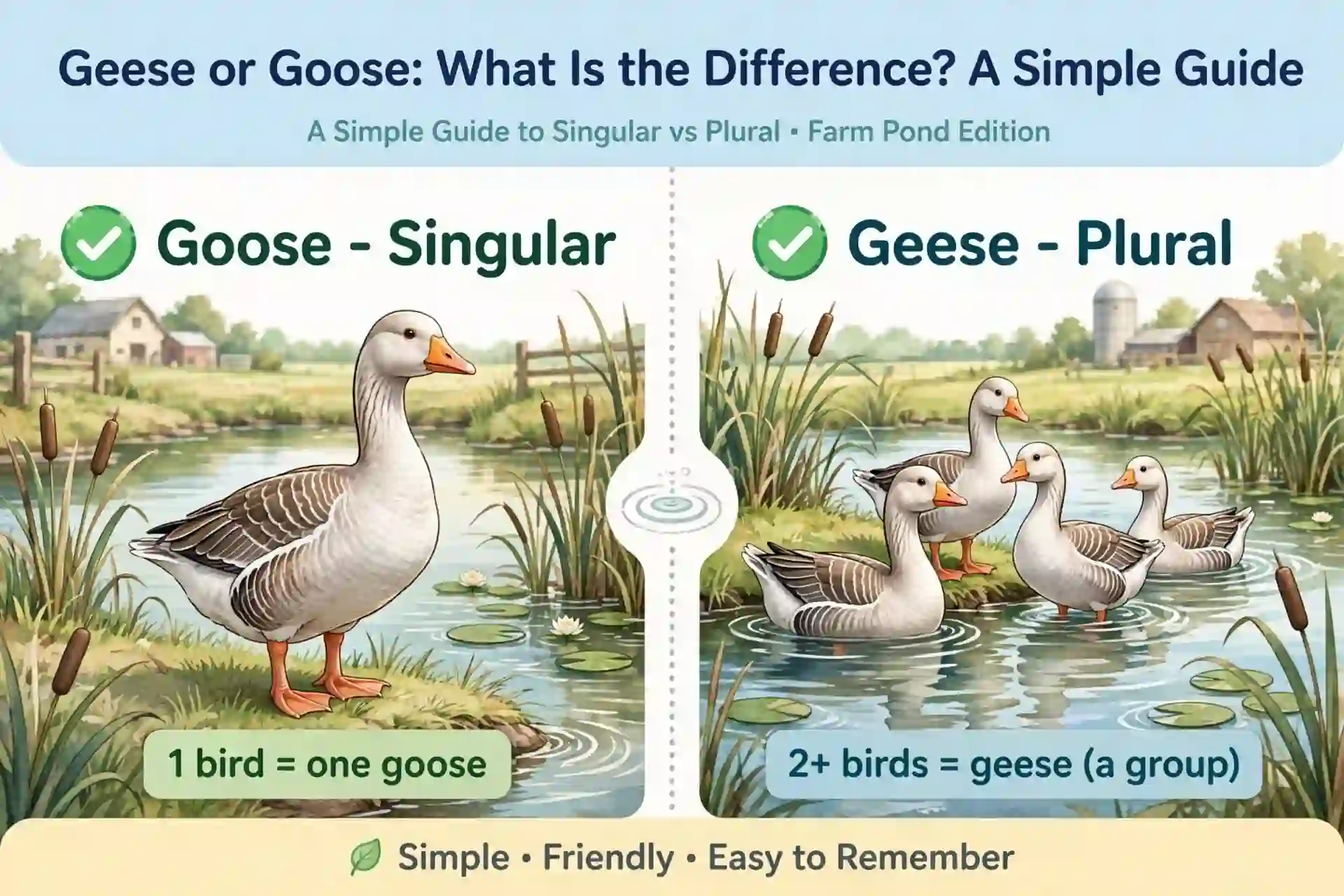
The main difference between these words is their number. One refers to a single bird, while the other describes two or more birds. Both forms are correct in English.
- Goose: The singular form. Use it when talking about one bird.
- Geese: The plural form. Use it when talking about two or more birds.
For example:
- I saw a goose near the lake.
- Three geese were swimming in the pond.
- A goose walked across the road.
- Several geese flew over our house.
The important thing to remember is that geese does not mean a different type of bird. It is simply the plural form of goose.
English has many words that follow this pattern. For example, foot becomes feet, and tooth becomes teeth. These words change their internal vowel instead of adding a regular plural ending.
What Does geese or goose Mean?
A goose is a waterbird with a long neck, a broad body, webbed feet, and a wide bill. It belongs to the bird family Anatidae, which also includes ducks and swans.
People often see geese near lakes, rivers, parks, farms, and wetlands. Some species live in the wild, while farmers raise domestic geese for eggs, meat, feathers, and other purposes.
Definition of Goose
The word goose is a noun. It refers to one bird from the group commonly known as geese.
Here are some basic facts about a goose:
- It has a long neck.
- It has webbed feet for swimming.
- It usually has a broad bill.
- Many species eat grass, seeds, roots, and aquatic plants.
- Some geese migrate between different regions.
- Many species make loud honking sounds.
The word can also appear in informal expressions. For example, the phrase “silly goose” describes someone who acts playfully or foolishly. It usually sounds friendly rather than insulting.
Examples of Goose in Sentences
The best way to understand a singular noun is to see how people use it in everyday writing.
- A goose rested beside the small pond.
- My grandmother keeps a white goose on her farm.
- The goose made a loud noise when I came closer.
- We watched a goose swim across the lake.
- A hungry goose searched for food in the grass.
- The farmer gave the goose fresh water.
- One goose stood near the wooden fence.
- A wild goose flew above the trees.
- The goose followed its young across the field.
- I took a picture of a beautiful goose.
Each sentence describes one bird. That is why the singular form works in every example.
What Does Geese Mean?
Geese is the plural form of goose. It refers to two or more birds of this kind. You can use it when describing a group of birds swimming, walking, feeding, resting, or flying together.
Geese often travel in groups. Many species form social groups and communicate through calls and body movements. Some migrate in large flocks during seasonal changes.
Definition of Geese
The word geese is a plural noun. It follows an irregular plural pattern because it changes its vowel rather than adding an -s or -es ending.
Consider these examples:
- One goose.
- Two geese.
- Five geese.
- A flock of geese.
- Several geese.
The word does not change when the number increases. You can use geese for any number greater than one.
For example, “There are two geese in the garden” and “There are twenty geese in the garden” both use the same plural form.
Examples of geese or goose in Sentences
These examples show how to use the plural form naturally.
- The geese are swimming in the lake.
- Several geese walked across the farm.
- We saw a flock of geese near the river.
- The geese flew south during the colder months.
- Two geese were resting under a tree.
- The children watched the geese near the pond.
- Wild geese often travel in groups.
- Many geese gathered around the farmer.
- The geese made loud honking sounds.
- A group of geese crossed the open field.
Each example describes more than one bird. The plural form also requires a plural verb in ordinary sentences.
Geese or Goose: Singular and Plural Grammar Rules
Understanding singular and plural nouns makes English writing easier. These two words follow an irregular pattern, so you cannot form the plural by simply adding an -s.
The basic rule is simple: use goose for one bird and geese for multiple birds.
Rule 1: Use Goose for One Bird
A singular noun describes one person, animal, place, or thing. Use goose when you are talking about only one bird.
Examples:
- A goose is sitting near the water.
- The goose looks hungry.
- I found a goose in the garden.
- That goose has white feathers.
You can also use articles such as a and the before the singular noun.
For example:
- A goose is eating grass.
- The goose is walking toward the pond.
Both sentences describe one bird.
Rule 2: Use Geese for Two or More Birds
A plural noun describes more than one person, animal, place, or thing. Use geese when you refer to multiple birds.
Examples:
- Two geese are swimming together.
- The geese look healthy.
- Many geese live near this lake.
- Those geese are making noise.
Do not add an extra -s to the plural form. The word geeses is incorrect in standard English.
Why Does geese or goose correct Instead of Gooses?
English has two common ways to form plural nouns. Most regular nouns take an -s or -es ending. Irregular nouns follow different patterns.
The word goose belongs to the second group. Its plural form changes the vowel inside the word.
Understanding Irregular Plural Nouns
An irregular plural noun does not follow the usual rule of adding -s or -es.
Here are some common examples:
| Singular | Plural |
| Goose | Geese |
| Mouse | Mice |
| Foot | Feet |
| Tooth | Teeth |
| Man | Men |
| Woman | Women |
| Child | Children |
| Louse | Lice |
These changes may seem unusual, but they have historical roots in the English language.
The plural form geese comes from an older Germanic pattern called i-mutation or umlaut. In earlier forms of English, a vowel in the plural changed because of a sound in the ending. Over time, that ending disappeared, but the changed vowel remained.
This historical pattern explains why goose becomes geese rather than gooses.
Is Gooses Ever Correct?
In normal English, gooses is not the standard plural of goose. The correct plural is geese.
However, gooses can appear as a verb form in informal or specialized contexts. For example, the verb to goose can mean to poke or prod someone playfully.
You might also see unusual forms in jokes, creative writing, or discussions about grammar. These uses do not change the standard plural rule.
Remember these examples:
- Incorrect: I saw three gooses.
- Correct: I saw three geese.
- Incorrect: Five goose are swimming.
- Correct: Five geese are swimming.
Geese or Goose: Common Mistakes to Avoid
Many English learners confuse these words because their plural forms look different from regular nouns. A few simple rules can prevent most mistakes.
Mistake 1: Using Goose for Multiple Birds
Some writers use the singular form even when they describe several birds.
Incorrect: There are four goose near the pond.
Correct: There are four geese near the pond.
The number four tells you that the sentence needs a plural noun.
Mistake 2: Adding -S to Geese
The word geese already expresses a plural meaning. Adding another -s creates an incorrect form.
Incorrect: The geeses are flying.
Correct: The geese are flying.
Do not add another plural ending to an irregular plural noun.
Difference Between geese or goose
The words goose, geese, and gander all relate to the same group of birds. However, each word has a different meaning. Learning these terms can improve your vocabulary and help you describe birds more accurately.
Goose
Goose is the general singular term for one bird. It can refer to a male or female when the sex does not matter.
Example: A goose is resting near the river.
Geese
Geese is the plural form. It describes two or more birds, regardless of whether they are male or female.
Example: The geese are walking across the field.
Quick Comparison between geese or goose
| Word | Meaning | Example |
| Goose | One bird | A goose is swimming. |
| Geese | More than one bird | The geese are swimming. |
| Gander | An adult male goose | The gander is guarding the group. |
| Gosling | A young goose | The gosling follows its mother. |
These words describe different aspects of the same bird group. A gosling is a young bird, while a gander is an adult male.
How to Use geese or goose in Everyday English
Both words appear in conversations, school assignments, stories, nature writing, and everyday descriptions. The right choice depends on what you want to describe.
Here are some practical situations that show how to use each form.
Talking About Animals
Use goose when you see one bird. Use geese when you see several.
Examples:
- A goose is standing by the water.
- The geese are eating grass.
- I saw a goose at the wildlife park.
- Several geese were flying overhead.
Writing About Farms
Farmers often raise domestic geese for different purposes. You can use both forms when describing farm animals.
Examples:
- The farmer owns a goose.
- The farm has six geese.
- A goose is sitting near the barn.
- The geese are walking around the yard.
Describing Nature and Migration
Many wild geese migrate between breeding and wintering areas. They may travel in groups and use different habitats throughout the year.
Examples:
- A wild goose flew over the wetlands.
- The geese migrate during certain seasons.
- We watched a goose land on the river.
- Large groups of geese gathered near the lake.
Using Goose in Common Expressions
The word goose also appears in several English expressions. These phrases may have meanings that differ from the literal meaning of the bird.
Some common examples include:
- Silly goose: A playful way to describe someone who acts foolishly.
- Wild goose chase: A search or task that is unlikely to produce a useful result.
- What’s good for the goose is good for the gander: A saying about fairness and equal treatment.
- Cook someone’s goose: An informal expression meaning to ruin someone’s plans or chances.
Understanding these expressions helps you recognize the word in everyday conversation.
Quick Tips to Remember the Difference between geese or goose
Use these simple memory tips whenever you feel unsure:
- Think of goose as one bird.
- Think of geese as a group of birds.
- Remember that goose has an irregular plural form.
- Never write geeses as the standard plural.
- Match singular nouns with singular verbs.
- Match plural nouns with plural verbs.
Reading these words in complete sentences can also improve your grammar skills. Try making your own examples with numbers such as one, two, five, and ten.
Frequently Asked Questions
These common questions explain the main grammar rules, spelling differences, and everyday uses of these words. Use the answers as a quick reference when writing.
1. Is Geese or Goose Correct?
Both words are correct. The choice depends on the number of birds. Use goose for one bird and geese for two or more birds. For example, “I saw a goose” describes one bird, while “I saw three geese” describes multiple birds.
2. What Is the Plural of Goose?
The plural of goose is geese. It is an irregular plural noun because it changes its internal vowel instead of adding -s. For example, one goose becomes two geese. The form gooses is not the standard plural in English.
3. Can I Say Two Goose?
No. The correct phrase is “two geese.” The number two refers to more than one bird, so you need the plural form. For example, write “Two geese are swimming in the lake.”
4. Why Is Goose Plural Geese?
The word comes from an older Germanic plural pattern known as i-mutation or umlaut. A vowel changed in the plural form because of an earlier ending. The ending later disappeared, but the vowel change remained. This explains the unusual spelling.
5. What Is a Baby Goose Called?
A baby goose is called a gosling. The term applies to a young goose before it reaches adulthood. For example, “The gosling followed its mother across the grass.” The plural form is goslings.
6. Is a Gander the Same as a Goose?
A gander is an adult male goose. The word goose can refer to an individual bird without specifying its sex. A female goose may also be called a goose. The word gander gives more specific information about the bird.
Final Thoughts
Learning the difference between Geese or Goose is simple once you understand singular and plural nouns. Both words describe the same type of bird, but they serve different purposes in English sentences.Use goose when you talk about one bird. Choose geese when you describe two or more birds.
Remember that this word follows an irregular plural pattern, so you should never add an extra -s to form its standard plural.Pay attention to subject-verb agreement, too. Write “The goose is swimming” for one bird and “The geese are swimming” for multiple birds. These small grammar choices make your writing clearer and more accurate.
