


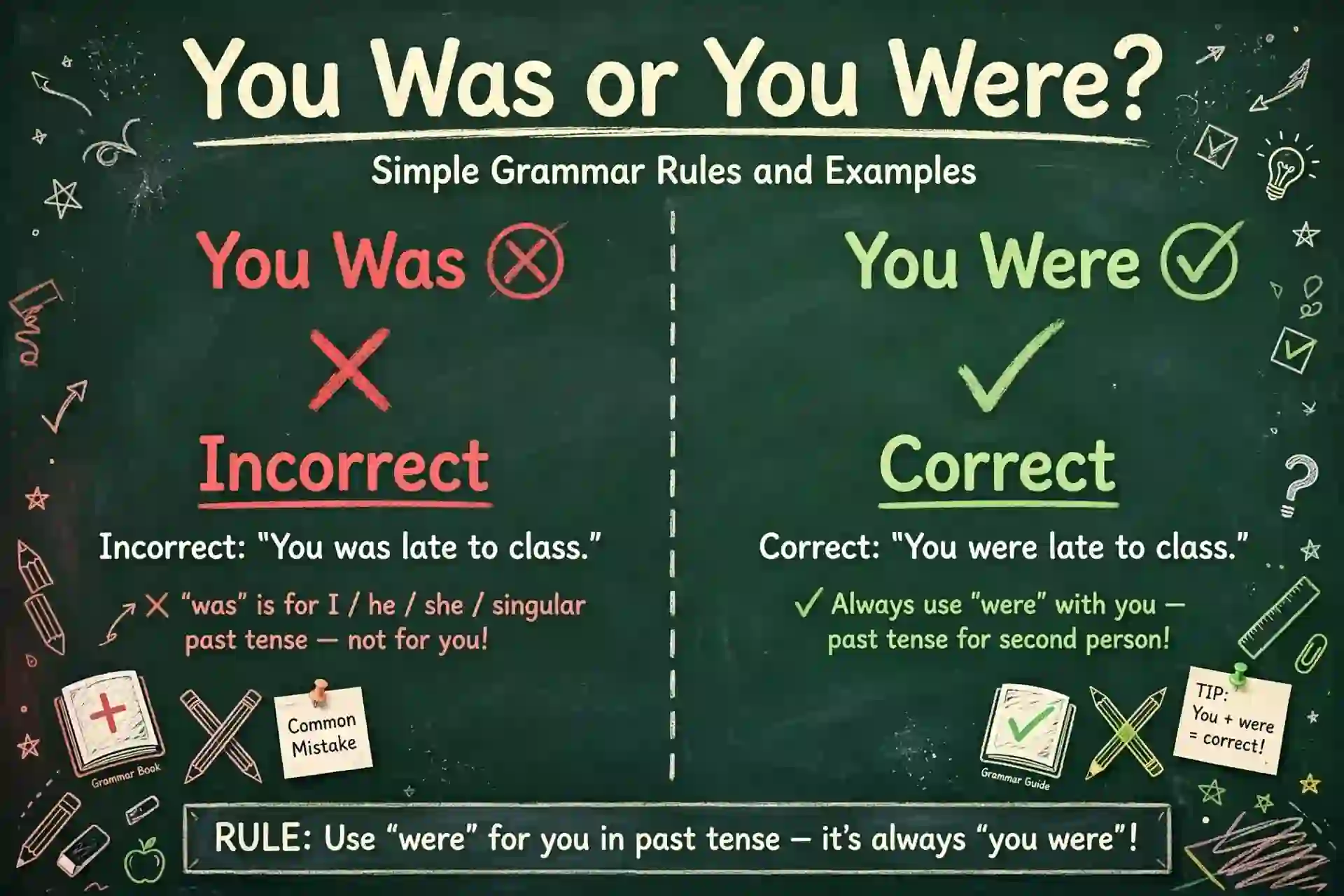
When it comes to English grammar, small differences between words can change the meaning of a sentence. One common question among English learners is whether to say “you was or you were”. Both expressions appear in conversations, songs, movies, and informal writing. However, standard English grammar accepts only one form in most situations.
Understanding the difference helps you speak naturally, write correctly, and avoid common grammar mistakes. This guide explains the correct expression, the grammar rules behind it, and how to use it in everyday conversations. You will also find simple examples, comparisons, and answers to frequently asked questions.
You Was or You Were: Which One Is Correct?
The correct expression in standard English is “you were.” It is the proper past-tense form of the verb “to be” when the subject is “you.”
For example:
- Correct: You were happy yesterday.
- Incorrect in standard English: You was happy yesterday.
The verb “to be” changes depending on the subject. In the past tense, English uses “was” with I, he, she, and it. It uses “were” with you, we, and they.
Here is a simple comparison:
| Subject | Correct past-tense form | Example |
| I | Was | I was tired. |
| You | Were | You were tired. |
| He | Was | He was tired. |
| She | Was | She was tired. |
| It | Was | It was cold. |
| We | Were | We were ready. |
| They | Were | They were busy. |
The rule remains the same whether you speak to one person or several people.
Examples:
- You were at school yesterday.
- You were my best friend.
- You were very helpful.
- You were right about the answer.
- You were late for the meeting.
Remember that “you” always takes “were” in standard past-tense statements.
Why Do People Say You Was Instead of You Were?
People sometimes use “you was” in casual conversations, songs, movies, and certain regional dialects. This usage does not always mean the speaker lacks knowledge of grammar.
Language changes across communities. Different dialects have their own patterns, expressions, and grammatical structures. Some speakers use “you was” as part of their everyday speech.
Here are a few reasons why this expression appears.
1. Regional Dialects
Some regional English dialects use different verb patterns from standard written English. Speakers may naturally say “you was” because their community follows that pattern.
For example:
- You was there last night.
- You was looking good.
- You was talking to him.
These sentences may appear in particular dialects. However, standard English grammar uses “you were” in each example.
2. Informal Conversations
People often speak quickly and use familiar expressions with friends. They may not think about formal grammar during everyday conversations.
You might hear someone say:
- You was funny yesterday.
- You was supposed to call me.
- You was acting differently.
These expressions can appear in casual speech. They are not suitable for formal essays, professional emails, or academic writing.
3. Influence of Music and Popular Culture
Songs, films, television shows, and social media can spread informal expressions. Artists sometimes use nonstandard grammar to match a character, rhyme, rhythm, or cultural identity.
Listeners may repeat those expressions in their own conversations.
This does not change the standard grammar rule. It simply shows how spoken language can differ from formal written English.
You Was or You Were in Different Sentence Types
Understanding how to use “you were” in different sentence structures makes the grammar easier to remember. The correct form works in statements, questions, negative sentences, and everyday expressions.
1. Positive Statements
Use “you were” when describing something that happened in the past.
Examples:
- You were very kind to me.
- You were at the library yesterday.
- You were my favorite teacher.
- You were excited about the trip.
- You were the first person to arrive.
These statements describe past situations, feelings, actions, or conditions.
2. Negative Statements
Use “you were not” or its shorter form, “you weren’t,” to make a negative sentence.
Examples:
- You were not ready.
- You weren’t at home yesterday.
- You were not listening to me.
- You weren’t happy with the decision.
- You weren’t supposed to leave early.
Both “were not” and “weren’t” are grammatically correct.
Use the full form in formal writing when appropriate. The shorter form sounds natural in everyday conversations.
3. Questions
Place “were” before “you” when asking a question about the past.
Examples:
- Were you at school yesterday?
- Were you busy last night?
- Were you happy with the results?
- Were you waiting for me?
- Were you aware of the problem?
Notice the word order. A normal statement says “You were busy.” A question changes the order to “Were you busy?”
4. Short Answers
You can also use “were” when giving short answers.
Examples:
- Were you tired? Yes, I was.
- Were you at home? Yes, I was.
- Were you ready? No, I wasn’t.
- Were you happy? Yes, I was.
- Were you there? No, I wasn’t.
One important detail is that short answers use “I was” when the speaker talks about themselves. The question uses “you were” because it addresses another person.
You Was or You Were in Everyday English Conversations
Everyday conversations often include questions about past experiences, activities, and feelings. Using the correct past-tense form makes your sentences clearer and more natural.
Here are practical situations where you can use “you were.”
Talking About Yesterday
Use this expression to describe someone’s location or condition the previous day.
Examples:
- You were at work yesterday.
- You were sleeping when I called.
- You were very quiet last night.
- You were busy with your assignments.
- You were absent from class.
Talking About Childhood
You can use “you were” to describe someone’s past personality, habits, or experiences.
Examples:
- You were very shy as a child.
- You were always curious.
- You were good at mathematics.
- You were a talented football player.
- You were happier when you lived here.
Talking About Past Relationships
The expression also works when discussing memories and relationships.
Examples:
- You were always there for me.
- You were my closest friend.
- You were important in my life.
- You were kind when I needed help.
- You were someone I trusted.
Talking About Past Mistakes
Use “you were” to explain something someone did or experienced incorrectly.
Examples:
- You were wrong about the situation.
- You were careless with your words.
- You were supposed to inform me.
- You were late for the appointment.
- You were not paying attention.
you was or you were: Important Grammar Differences
The main difference between these expressions is their grammatical status in standard English. Understanding this distinction helps you recognize correct sentences and avoid common mistakes.
| Grammar feature | You were | You was |
| Standard English | Correct | Nonstandard |
| Past-tense verb | Correct form | Not the standard form |
| Formal writing | Appropriate | Avoid |
| Academic writing | Appropriate | Avoid |
| Casual dialect speech | Common | Used in some dialects |
| Grammar exams | Correct answer | Usually marked incorrect |
Is You Was Ever Grammatically Correct?
In standard English, “you was” is considered grammatically incorrect. However, some established English dialects use this construction as part of their own grammatical systems.
It is useful to understand the difference between standard grammar and dialect grammar.
Standard English is the form commonly expected in schools, professional communication, formal documents, and most published writing. Dialects may follow different rules that are meaningful within their communities.
Therefore, you should not automatically judge someone’s language skills based on dialect speech. Choose the form that suits your audience and situation.
Should You Use You Was in Writing?
Avoid “you was” in formal and academic writing. Teachers, editors, and professional readers generally expect the standard form.
Use “you were” in:
- School assignments.
- Business emails.
- Professional reports.
- Academic essays.
- Job applications.
- Formal conversations.
You may encounter “you was” in dialogue, song lyrics, fictional characters, or writing that intentionally represents a particular dialect. In those cases, the wording may serve a creative purpose.
Common Mistakes When Using you was or you were
Many English learners understand the basic rule but still make mistakes when writing questions, negative sentences, and conditional statements. Learning these patterns can improve your grammar.
Mistake 1: Using Was With You
Incorrect: You was very tired yesterday.
Correct: You were very tired yesterday.
Explanation: The subject “you” always takes “were” in standard past-tense statements.
Mistake 2: Using Was in Questions
Incorrect: Was you at the party?
Correct: Were you at the party?
Explanation: Place “were” before “you” when asking a standard past-tense question.
Mistake 3: Using Was in Negative Sentences
Incorrect: You wasn’t ready.
Correct: You weren’t ready.
Explanation: The correct negative form is “you were not” or “you weren’t.”
Mistake 4: Forgetting Were in Conditional Sentences
Incorrect: If you was here, I would feel better.
Correct: If you were here, I would feel better.
Explanation: English often uses “were” in hypothetical situations. This is known as the subjunctive mood.
Mistake 5: Confusing Were and We’re
Incorrect: Were going to the park.
Correct: We’re going to the park.
Explanation: “We’re” is a contraction of “we are.” “Were” is the past-tense form of “are.”
These words sound similar in many accents, but their meanings and grammatical roles differ.
The Difference Between you was or you were
Both expressions describe a person’s condition or situation, but they refer to different times. “You are” describes the present, while “you were” describes the past.
Compare these examples:
| Present tense | Past tense |
| You was happy. | You were happy. |
| You was busy. | You were busy. |
| You was at home. | You were at home. |
| You wasmy friend. | You were my friend. |
| You was ready. | You were ready. |
When Should You Use You Are?
Use “you are” when describing something that is true now.
Examples:
- You are very helpful.
- You are my best friend.
- You are doing a great job.
- You are ready for the exam.
When Should You Use You Were?
Use “you were” when describing something that happened or was true in the past.
Examples:
- You were very helpful yesterday.
- You were my best friend in school.
- You were doing a great job.
- You were ready for the exam last week.
The time reference helps you choose the correct verb.
How to Remember the Correct Grammar Rule
You do not need to memorize complicated grammar explanations to use the correct past-tense form. A few simple techniques can help you remember when to use “were.”
1. Memorize the Basic Verb Pattern
Learn this simple pattern:
- I was.
- You were.
- He was.
- She was.
- It was.
- We were.
- They were.
Read these examples aloud several times. Repetition helps you recognize the correct form.
2. Practice With Past-Tense Sentences
Write five sentences about things you did yesterday.
For example:
- You were at school.
- You were with your friends.
- You were happy.
- You were very busy.
- You were ready for dinner.
Try changing the subject to understand how the verb changes.
3. Use Questions to Test Yourself
Ask yourself questions such as:
- Were you tired yesterday?
- Were you at work?
- Were you happy?
- Were you ready?
If your sentence begins with “you” and describes a standard past-tense condition, remember to use “were.”
4. Read English Regularly
Reading books, articles, and reliable English resources helps you recognize correct sentence patterns. Pay attention to how writers use “was” and “were.”
You can also practice with grammar exercises and short writing activities.
Frequently Asked Questions
1. Is It You Was or You Were?
“You were” is correct in standard English. Use it when talking about something that happened in the past. For example, “You were at home yesterday” is grammatically correct.
2. Why Do Some People Say You Was?
Some people use “you was” in regional dialects and informal speech. Music, movies, and cultural expressions also help spread this construction. However, standard English uses “you were.”
3. Is You Was Incorrect Grammar?
In standard English, yes. The subject “you” takes “were” in the past tense. However, some English dialects use “you was” as part of their established grammatical patterns.
4. Can I Use You Were for One Person?
Yes. “You” takes “were” whether you address one person or several people. For example, “You were my best friend” is correct when speaking to one individual.
5. What Is the Negative Form of You Were?
The negative form is “you were not” or “you weren’t.” Both are correct. For example, “You weren’t at school yesterday” is a natural negative sentence.
6. Is Were Always Used With You?
In standard English, “were” is used with “you” in ordinary past-tense statements. It also appears in hypothetical expressions, such as “If you were here, we could talk.”
Conclusion
Understanding the difference between these two expressions makes English grammar much easier. The correct form in standard English is “you were.” It works in positive statements, negative sentences, questions, and conversations about past experiences.The expression “you was” appears in some regional dialects, songs, and informal conversations. You may hear it in everyday speech, but you should avoid it in formal writing, school assignments, and professional communication.
Remember the basic rule: use “was” with I, he, she, and it. Use “were” with you, we, and they. Practice with simple sentences, read regularly, and pay attention to verb patterns.The next time you wonder whether to say you was or you were, remember that standard English always uses “you were” for ordinary past-tense statements. A little practice can help you speak and write with greater confidence.
