


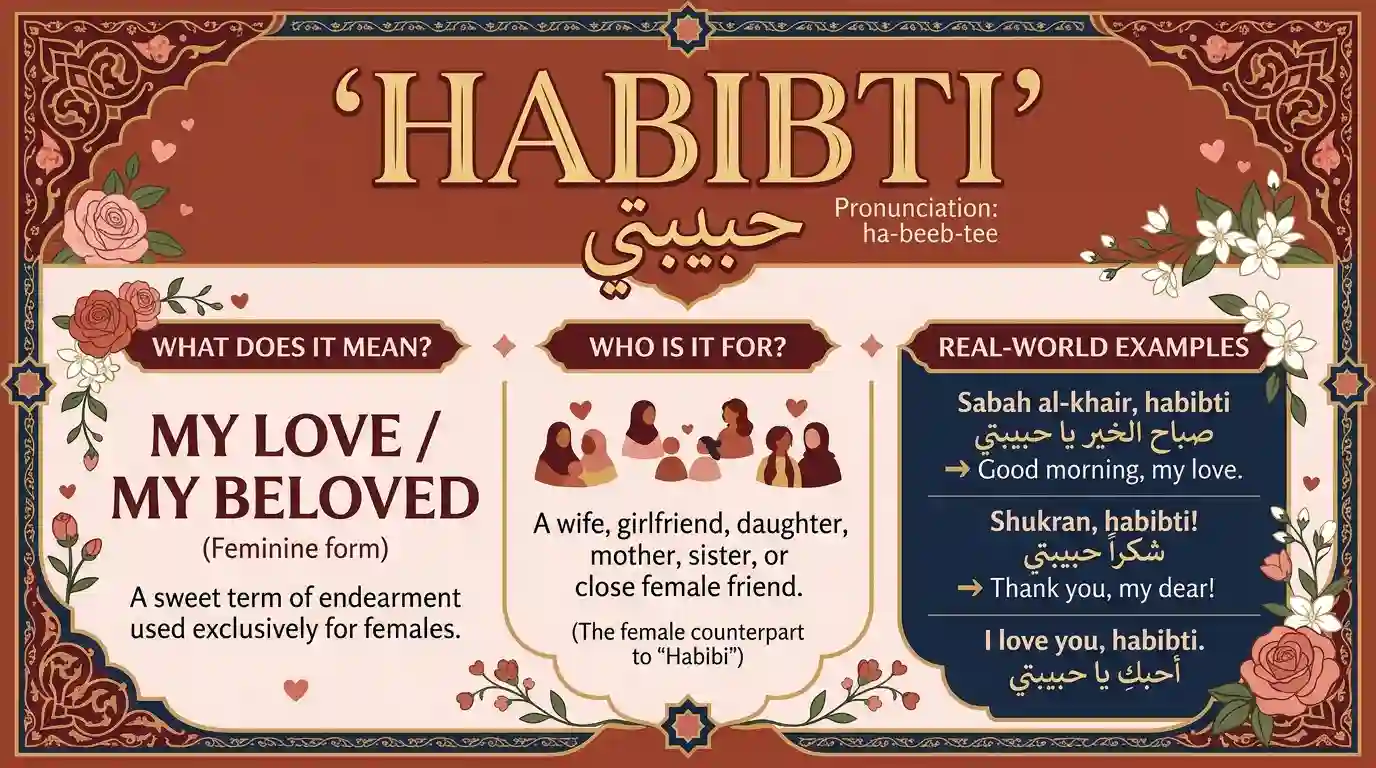
The habibti meaning in English is “my love,” “my darling,” or “my dear” when speaking to a female. It is a popular Arabic term of endearment used to express love, warmth, and affection. You may hear this word between romantic partners, family members, and close friends. Although it can sound romantic, its meaning depends on the relationship between the people using it.
Habibti is written in Arabic as حبيبتي and comes from a word associated with love and being beloved. It is commonly used in everyday conversations across Arabic-speaking communities. People may use it in greetings, text messages, caring conversations, and loving expressions. Its friendly sound and affectionate meaning have also made it familiar to people who do not speak Arabic.
Understanding this word involves more than learning its English translation. Its pronunciation, Arabic origin, gendered form, and cultural use all help explain how it works. In this guide, you will learn what habibti means, how to pronounce it, how it differs from habibi, and how to use it in everyday sentences.
What Does Habibti Mean in English?
The habibti meaning is usually translated as “my love,” “my dear,” “sweetheart,” or “my darling.” It is used when addressing a female with affection. The most suitable English translation depends on the situation and the relationship between the speaker and the listener.
For example, a romantic partner might say “Good morning, habibti” to express love. A mother might use the same word when speaking gently to her daughter. A close friend may also use it as a warm and friendly expression.
The word does not automatically suggest romantic attraction. Instead, it communicates affection, care, or closeness. Understanding the surrounding conversation helps you identify the intended meaning.
Habibti Meaning and Arabic Origin
Habibti comes from Arabic and is connected to the root ḥ-b-b (حب), which relates to love and affection. Several Arabic words connected with loving or caring for someone come from this root.
The word habib refers to a beloved or dear person. The form habibti is commonly used when addressing a female, while habibi is commonly used when addressing a male. These forms help speakers express affection while addressing someone according to grammatical gender.
Arabic terms of endearment often carry cultural meaning beyond their direct translation. Depending on the speaker, habibti can sound romantic, caring, friendly, or reassuring. It is widely understood in many Arabic-speaking settings, although pronunciation and conversational habits may vary by region.
Different English Translations of Habibti
There is not always one perfect English translation for an Arabic term of endearment. The meaning can shift slightly according to tone, context, and the relationship between two people.
| Arabic Expression | English Translation | Common Context |
|---|---|---|
| Habibti | My love | Romantic or affectionate conversation |
| Habibti | My darling | Loving and personal conversations |
| Habibti | My dear | Friendly or caring conversations |
| Habibti | Sweetheart | Family or close relationships |
| Habibti | My beloved | Deep affection or romantic expression |
| Habibti | Dear one | Gentle or comforting conversation |
For instance, when a mother says habibti to her daughter, “sweetheart” may sound more natural in English than “my love.” When a romantic partner uses it, “my darling” or “my love” may fit better.
These translations share a sense of affection, but they do not always have exactly the same tone. Choosing the right translation requires considering the situation in which the word is used.
Habibti vs. Habibi: What Is the Difference?
Habibti and habibi have similar meanings, but they are generally used when addressing people of different genders.
Both words can express love, friendship, and affection. Neither is limited to romantic relationships. Their meaning depends on who is speaking, who is being addressed, and the circumstances of the conversation.
| Feature | Habibti (حبيبتي) | Habibi (حبيبي) |
|---|---|---|
| Commonly addressed to | A female | A male |
| General meaning | My love, my dear | My love, my dear |
| Grammatical form | Feminine | Masculine |
| Romantic use | Addressing a female partner | Addressing a male partner |
| Family use | Daughter, sister, or female relative | Son, brother, or male relative |
| Friendly use | Female friend or someone close | Male friend or someone close |
| Example | Good night, habibti | Good night, habibi |
Examples in conversation:
- A husband may say, “You look beautiful, habibti,” to his wife.
- A woman may say, “Thank you, habibi,” to her husband.
- A parent may use either expression when speaking affectionately to a child.
The main difference is the grammatical form used to address the person. The level of affection can be equally strong in both expressions.
How to Pronounce Habibti Correctly
Habibti is commonly pronounced ha-BEEB-tee in English. The middle syllable usually receives the strongest emphasis. However, pronunciation may vary slightly between Arabic dialects and individual speakers.
You can practise the word by dividing it into three parts:
- Ha: Start with the opening sound.
- Beeb: Emphasize this middle syllable.
- Ti: Finish with a short “tee” sound.
When spoken naturally, the syllables flow together rather than sounding completely separate. Listening to Arabic speakers can help you become more familiar with the natural rhythm.
The Arabic spelling is حبيبتي. Learning both the written form and the spoken pronunciation can make it easier to recognize the word in conversations, songs, videos, and messages.
When Do People Use Habibti?
People use habibti in many situations to express affection or show that someone is important to them. It can appear in romantic relationships, family conversations, friendships, and casual greetings.
Common situations include:
- Romantic relationships: A partner may use it as a loving nickname.
- Family conversations: A mother or another relative may use it with a girl or woman in the family.
- Friendships: Close female friends may use it to express warmth.
- Greetings: Someone might say “Hello, habibti” as an affectionate greeting.
- Comforting conversations: It can make reassuring words sound gentler.
- Messages and calls: People may include it in texts or spoken conversations.
- Showing appreciation: It may accompany a thank-you or a kind remark.
The word is not reserved for one particular setting. Its meaning depends on the relationship and tone. If you hear someone use it, consider the context rather than assuming it always has a romantic meaning.
Habibti Examples in Everyday Sentences
Learning the word through examples can help you understand how it works in real conversations. In each sentence, habibti adds an affectionate tone to the message.
| Example Sentence | Meaning in English |
|---|---|
| Good morning, habibti. | Good morning, my love. |
| How are you, habibti? | How are you, my dear? |
| Thank you, habibti. | Thank you, sweetheart. |
| Come here, habibti. | Come here, darling. |
| Don’t worry, habibti. | Don’t worry, my dear. |
| I missed you, habibti. | I missed you, my love. |
| You look lovely, habibti. | You look lovely, sweetheart. |
| Sleep well, habibti. | Sleep well, darling. |
| I am proud of you, habibti. | I am proud of you, my dear. |
| Have a safe trip, habibti. | Have a safe trip, sweetheart. |
These examples show how the same word can fit different situations. The translation changes according to what sounds natural in English, but the affectionate feeling remains.
Is Habibti a Romantic Word?
Habibti can be romantic, but it is not exclusively romantic. Couples may use it to express tenderness, similar to calling someone “darling” or “my love” in English. In that context, it can be a loving nickname.
However, parents, relatives, and friends can also use it. A mother calling her daughter habibti is expressing care, not romantic interest. Likewise, a friend may use the word simply to sound warm and affectionate.
If someone calls you habibti, it is helpful to consider your relationship, the person’s tone, and the conversation. The word alone does not prove that someone has romantic feelings for you.
Is Habibti the Same as “My Love”?
Habibti is often translated as “my love,” but the two expressions are not identical in every situation. Habibti is an Arabic term with its own cultural and grammatical features, while “my love” is an English expression.
Depending on the context, habibti may be translated as “sweetheart,” “my dear,” “darling,” or “my beloved.” Each English phrase has a slightly different tone. For example, “my dear” can sound gentle and friendly, while “my darling” may sound more intimate.
When translating a sentence, it is better to focus on the speaker’s intended meaning rather than choosing the same English phrase every time. This helps preserve the warmth and natural feeling of the original expression.
Common Misunderstandings About Habibti
People who are unfamiliar with Arabic may misunderstand the word or assume it has only one meaning. Knowing a few basic facts can help you interpret it correctly.
- It is not always romantic: Family members and friends may use it affectionately.
- It is generally used for females: Habibi is the common masculine counterpart.
- It has several English translations: Context determines the best wording.
- It is an Arabic expression: It is used across many Arabic-speaking communities.
- Pronunciation can vary: Regional dialects may affect the way it sounds.
- It expresses affection: The exact level of closeness depends on the relationship.
- It does not automatically mean attraction: A person may use it in a friendly or caring way.
These details make it easier to understand the word without making assumptions about the speaker’s intentions.
Can You Use Habibti in a Text Message?
Yes, habibti can be used in text messages when you want to sound affectionate or caring. It may appear in a greeting, a supportive message, a loving note, or a casual conversation with someone close to you.
For example, you could write, “Good luck today, habibti!” to encourage someone. A romantic partner might send, “Sleep well, habibti,” as a loving goodnight message. A close friend might use it while offering comfort or support.
It is important to consider whether the other person is comfortable with affectionate language. If you are unsure, start with a simple greeting and follow the other person’s communication style. Using the word naturally is more meaningful than forcing it into every message.
Conclusion
The habibti meaning in English is “my love,” “my darling,” or “my dear” when addressing a female. This Arabic expression comes from a root associated with love and affection, and it can be used in romantic, family, and friendly relationships. Its masculine counterpart is habibi, which is commonly used when addressing a male. The word is pronounced approximately “ha-BEEB-tee,” although regional variations exist. Understanding its origin, pronunciation, and everyday usage makes it easier to recognize the expression and appreciate its cultural meaning. Most importantly, remember that context determines whether habibti sounds romantic, friendly, or simply caring.
