


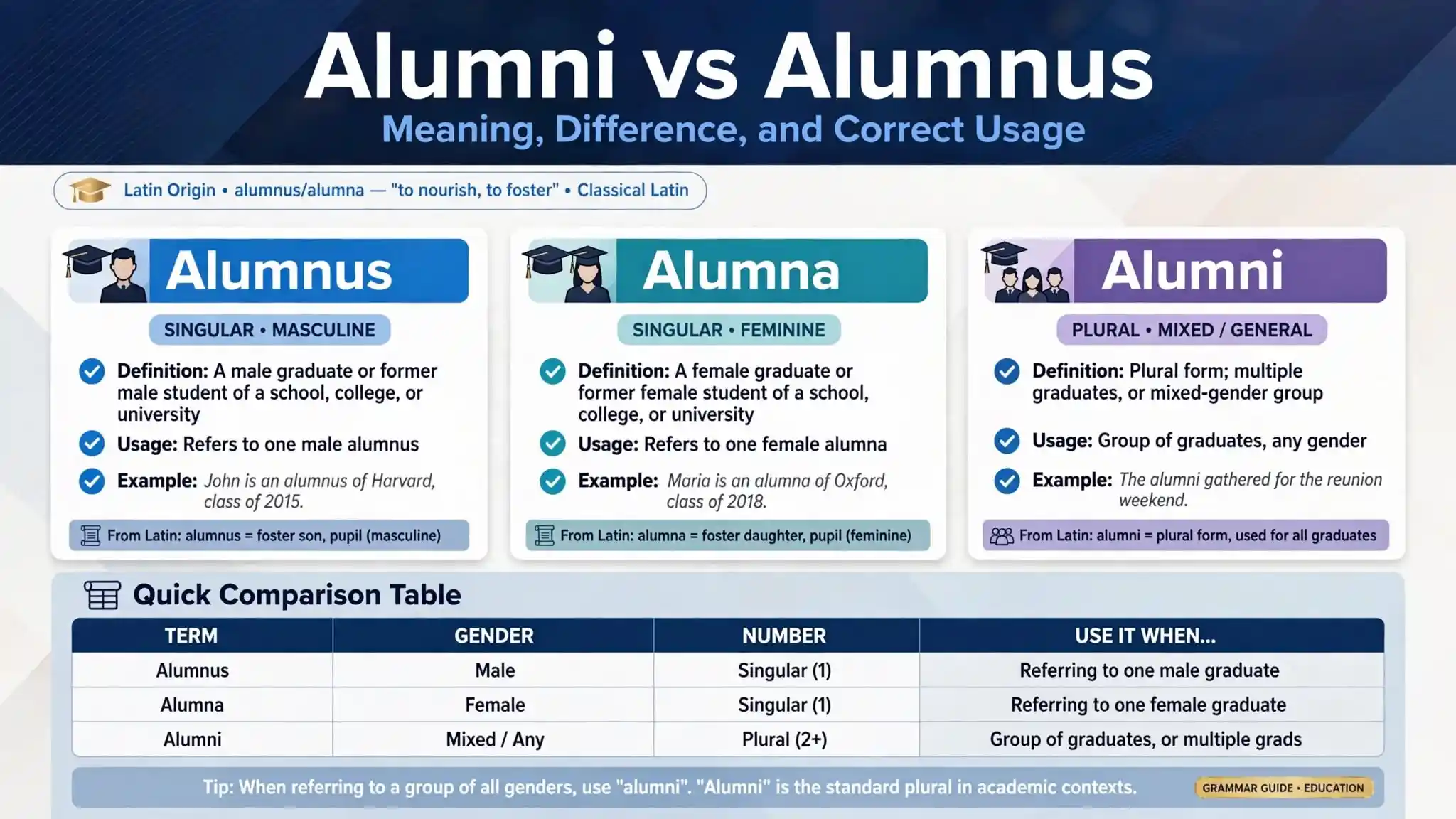
Alumni vs alumnus is a question of one person versus many. An alumnus is one male graduate or former student of a school, college, or university. Alumni is the plural: two or more graduates, or a mixed group of men and women. So you can say “He is an alumnus of Oxford” and “They are alumni of Oxford,” but never “He is an alumni.”
The confusion is easy to understand. Both words look nearly identical, both come from Latin, and in everyday speech people often blur them. Add the female forms, alumna and alumnae, and you have four words that all seem to mean the same thing. They do share one meaning, a former student, but each one changes with number and gender.
In this guide you will learn what each word means, how to pronounce them, where they come from, and how to pick the right form every time. The alumni vs alumnus choice becomes simple once you see the pattern, and you will find examples, a memory trick, common mistakes, practice questions, and FAQs below.
What Does Alumnus Mean?
Alumnus means a male former student of a particular school, college, or university. It is singular. In careful writing, it usually refers to someone who graduated, although many people also use it for someone who simply attended.
- “The senator is an alumnus of Harvard.”
- “As a proud alumnus, he donates to the school every year.”
So when people ask what an alumnus means, the short answer is: one man who studied at a school and has since left it. It is pronounced uh-LUM-nus.
What Does Alumni Mean?
Alumni is the plural form. It means two or more former students, and it is also the standard word for a group that includes both men and women.
- “Alumni from the class of 2010 gathered for a reunion.”
- “The university wrote to all its alumni.”
When readers ask what alumni means, the answer is simple: former students, more than one. It is pronounced uh-LUM-nye. Because it is already plural, it never takes an “a” or “an” before it, and it takes a plural verb: “The alumni are invited,” not “The alumni is invited.”
What About Alumna and Alumnae?
Latin gives these words gender, and English kept that system. The female forms are:
- Alumna means one female former student (singular).
- Alumnae means two or more female former students (plural), pronounced uh-LUM-nee.
Here are all four forms side by side.
| Singular | Plural | |
|---|---|---|
| Male | alumnus | alumni |
| Female | alumna | alumnae |
| Mixed group | none | alumni |
Notice the last row. For a mixed group, traditional usage takes the masculine plural, so a class of men and women together are alumni.
Alumni vs Alumnus: Key Differences
| Feature | Alumnus | Alumni |
|---|---|---|
| Number | Singular | Plural |
| Meaning | One male former student | Two or more former students, or a mixed group |
| Pronunciation | uh-LUM-nus | uh-LUM-nye |
| Article | “an alumnus” | no article (“the alumni”) |
| Verb | is | are |
| Example | “He is an alumnus.” | “They are alumni.” |
If you remember only one line, make it this: alumnus is one, alumni is many.
Where the Words Come From
Alumnus is a Latin word. It originally meant a foster child or pupil, someone who was nourished and brought up by others. It comes from the Latin verb alere, which means “to nourish.” The idea is that a school nourishes its students, and the students remain connected to it afterwards. English has used the word for former students since the 1600s.
Alumnus has nothing to do with “alum,” the mineral salt used in cooking and chemistry. They only look alike.
The Plural of Alumnus and the Latin Pattern
The plural of alumnus is alumni, not “alumnuses.” The change follows a standard Latin pattern: nouns ending in -us often become -i in the plural.
| Singular | Plural |
|---|---|
| alumnus | alumni |
| cactus | cacti |
| nucleus | nuclei |
| stimulus | stimuli |
| fungus | fungi |
| syllabus | syllabi |
Many of these also have English plurals now (cactuses, syllabuses), but “alumnuses” is not recognised as standard. When you need the plural of alumnus, use alumni. The plural of alumna is alumnae, which follows a second Latin pattern, where -a becomes -ae.
How to Pronounce Each Word
Pronunciation is where many people trip. All four words share the “uh-LUM” start, and only the ending changes:
- Alumnus: uh-LUM-nus
- Alumna: uh-LUM-nuh
- Alumni: uh-LUM-nye
- Alumnae: uh-LUM-nee
A helpful rule: -i sounds like “eye” in alumni, but -ae sounds like “ee” in alumnae. The two endings are often swapped by mistake.
Examples in Context
Seeing the words in real sentences makes the choice easier.
- One man: “My father is an alumnus of the University of Karachi.”
- One woman: “She is an alumna of Wellesley College.”
- Several men or a mixed group: “The school invited all alumni to the centenary dinner.”
- Several women: “The college’s alumnae raised funds for a new library.”
- Employers: “Many Google alumni have gone on to found their own startups.”
- Informal: “A few of my high-school alums showed up at the match.”
Notice that alumni is not limited to schools. Companies, programmes, and teams also talk about their alumni when they mean former members.
Alma Mater: A Related Word
You will often see alumnus next to another Latin phrase, alma mater. It means the school, college, or university a person attended, as in “Karachi University is my alma mater.” The phrase translates roughly as “nourishing mother,” and it comes from the same family as alumnus. The school is the nourishing mother, and the former student is the one nourished. A simple way to connect them: your alma mater is your school, and you are its alumnus or alumna.
Alumni Association and Everyday Terms
Alumni appears in several familiar phrases. The most common is the alumni association, an organisation of former students that keeps them connected to their school. A typical alumni association runs reunions, mentoring programmes, job boards, and fundraising drives. Related terms include:
- alumni network: the community of former students, often used for career contacts
- alumni magazine: the publication a school sends to its graduates
- alumni day: an event where former students return to campus
- alumni donors: graduates who give money to their school
You will also see “alumni association” used by schools around the world, so the phrase is safe in both formal and casual writing. A school that serves only women may call its group the alumnae association.
Writing Alumni Names in Formal Documents
Schools and magazines often add the graduation year after a former student’s name, usually in a short form. You may see “Ayesha Khan ’10,” “Class of 2010,” or “BA 2010.” The year always refers to the graduation year, not the start year. For lists of former students, use the plural that matches the group: “alumni” for mixed groups, “alumnae” for an all-female group. If a document must work for any reader, “graduates” or “former students” is a safe, neutral alternative.
Alum: The Short and Casual Option
In everyday speech, many people use alum (plural alums) as a short, informal, gender-neutral word. It is handy when you do not know someone’s gender or want to avoid the masculine-by-default rule: “She’s a Stanford alum.” Some schools now prefer “alum” or simply “graduate” in official writing for the same reason. Alum is widely accepted in conversation and general writing, but formal documents usually still use alumnus, alumna, alumni, or alumnae.
Alumni vs Graduate vs Former Student
The words overlap, but they are not identical.
- A graduate has completed a degree or course.
- A former student attended, whether or not they finished.
- An alumnus or alumna traditionally means a graduate, though modern usage often includes anyone who attended.
If precision matters, as in a biography or a legal document, use “graduate” when someone finished and “former student” or “attended” when they did not. Alumni is the friendlier, more general word.
Using These Words on a Resume or Profile
On a resume, LinkedIn page, or personal website, the safest choice is to say where you studied instead of labelling yourself. Write “BSc, University of Lahore, 2018” rather than “alumnus of the University of Lahore.” If you do want to mention the connection, “alum” or “graduate” sounds natural and avoids the gender question. Many schools also invite you to join their alumni network, and a short line such as “Member, Lahore University alumni network” signals that you are still connected. Use alumnus or alumna only when the sentence is about one specific person and the gender is clear.
How to Remember the Difference
Here are two quick memory tricks.
- Look at the ending. Alumnus ends in -us, which sounds like “us,” a single person. Alumni ends in -i, which looks like a row of people standing together: i i i.
- Match the pairs. Alumnus goes with alumna (one person), and alumni goes with alumnae (many people). The “-us” and “-a” words are singular, and the “-i” and “-ae” words are plural.
Whenever you doubt the alumni vs alumnus choice, count the people first. One means alumnus (or alumna), and more than one means alumni (or alumnae).
Common Mistakes
Most mistakes in alumni vs alumnus come from treating the plural as a singular.
- “He is an alumni.” Wrong. Alumni is plural, so use “He is an alumnus.”
- “The alumni is invited.” Wrong. Use the plural verb: “The alumni are invited.”
- “Alumnuses.” Not standard. Use alumni.
- “Alumni” for one woman. For a single woman, use alumna, not alumni.
- Mixing up the endings. Alumni ends in -i and alumnae ends in -ae. Do not swap them.
- “Alumnis.” Wrong. Alumni is already plural, so adding an “s” makes a double plural.
Tricky Cases
A few alumni vs alumnus situations are less clear.
- A mixed group: use alumni, even if only one man is in the group, or use “alums” or “graduates” if you prefer neutral wording.
- An all-female group: use alumnae.
- One person of unknown gender: use alum, “graduate,” or “former student” instead of guessing.
- A women’s college: the official term is often alumnae, so match the institution’s own style.
- A company or club: “alumni” works for former employees or members, as in “Microsoft alumni.”
- Non-binary people: some institutions use alum, alumni as a neutral plural, or newer forms like “alumnx.” If you are writing about a specific person or school, follow their preferred term.
Quick Practice
Test your alumni vs alumnus skills. Fill in the blank with the correct word: alumnus, alumna, alumni, or alumnae.
- My brother is an ___ of this college.
- The ___ of the women’s college met in the main hall.
- Hundreds of ___ attended the reunion.
- She is an ___ of the medical school.
- The class of 2015, men and women together, are now ___.
Answers: 1 alumnus, 2 alumnae, 3 alumni, 4 alumna, 5 alumni.
FAQs
What is the difference in alumni vs alumnus? Alumnus is one male former student. Alumni is the plural, for two or more former students or a mixed group.
What is the meaning of alumnus in simple words? It means one man who studied at a school and has since left.
What is the meaning of alumni in simple words? It means former students, more than one, including mixed groups.
What is the plural of alumnus? It is alumni.
Is “alumni” singular or plural? Plural. Never say “an alumni.” Use “an alumnus” for one man.
What is the female form of alumnus? The female singular is alumna, and the female plural is alumnae.
Can I say “alum” instead? Yes. Alum is a casual, gender-neutral word that is widely used in conversation.
What is an alumni association? It is an organisation of former students that runs events, fundraising, and networking for graduates.
Is “alumni” used for company employees too? Yes. Companies often call former employees alumni, as in “Google alumni.”
Conclusion
The alumni vs alumnus question comes down to counting. One male former student is an alumnus, one female is an alumna, and when there is more than one, you use alumni for men or a mixed group and alumnae for women. Remember the Latin pattern, where -us becomes -i, and the plural of alumnus will never trip you up again. When you want something simpler or gender-neutral, “alum” is always a safe choice in everyday writing.
