


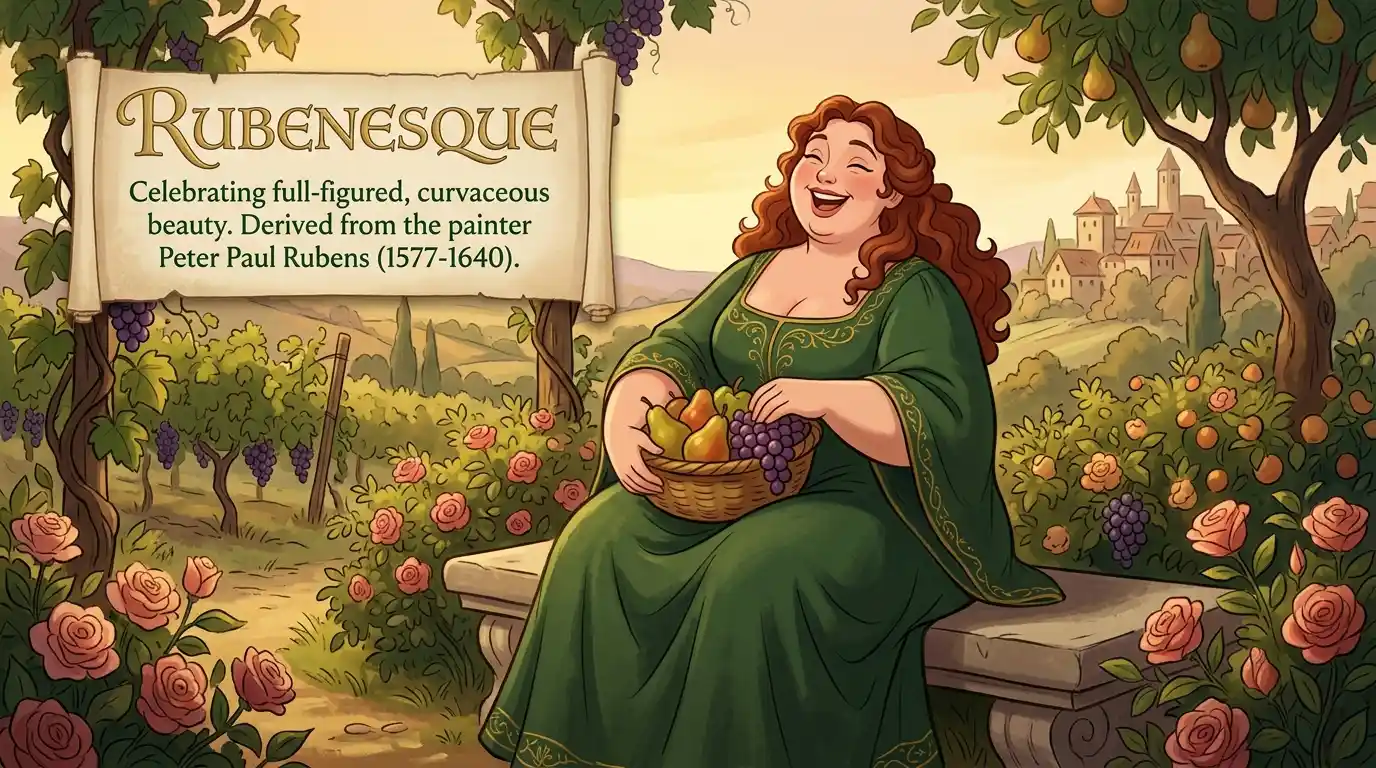
Rubenesque meaning is connected to the famous Flemish painter Peter Paul Rubens, whose paintings often showed women with soft, rounded, and voluptuous figures. Over time, the word developed into an English adjective used to describe a similar body type or artistic appearance.
The word rubenesque is used to describe a person, figure, or artistic style associated with a full, rounded, and curvy body shape. It is often used when talking about beauty, paintings, fashion, sculpture, or artistic representations of the human body. While the word may look unusual at first, its meaning becomes much clearer when you know where it comes from.
This guide explains the rubenesque meaning, its origin, English definition, pronunciation, variations, synonyms, examples, and common ways the word is used.
Rubenesque Meaning
Rubenesque means having a full, rounded, voluptuous, or curvy figure, especially one resembling the figures commonly seen in the paintings of Peter Paul Rubens.
In simple English, you can understand it as:
Rubenesque = full-figured, rounded, or voluptuous in appearance.
The word is usually associated with a feminine body shape, although its broader artistic meaning can refer to figures or styles inspired by Rubens.
For example:
She had a rubenesque figure that reminded the artist of classical paintings.
Here, rubenesque describes a rounded and curvy body shape.
Rubenesque Definition in English
The English definition of rubenesque is an adjective describing someone or something as resembling the style or physical characteristics associated with the paintings of Peter Paul Rubens.
It can refer to:
- A full-bodied figure
- A rounded body shape
- A voluptuous appearance
- Curvy proportions
- Artistic figures inspired by Rubens
- A style associated with Rubens’ paintings
The word is more specific than simply saying “curvy” because it carries an artistic and historical reference.
Rubenesque Meaning in Simple Words
In simple words, rubenesque means having a full, rounded, and curvy appearance similar to the figures portrayed by Rubens.
For example:
The sculpture has a rubenesque form.
This means the sculpture has a rounded, full-bodied appearance associated with Rubens’ artistic style.
Another simple example is:
The painting features a rubenesque woman.
This suggests that the woman in the painting has a full and voluptuous figure.
| Term | Meaning |
|---|---|
| Rubenesque | Full, rounded, or voluptuous in appearance |
| Origin | Peter Paul Rubens |
| Word Type | Adjective |
| Main Context | Art, beauty, fashion, literature |
| Simple Meaning | Full-figured or curvy |
| Pronunciation | roo-BEN-esk |
| Tone | Usually descriptive; context matters |
Rubenesque vs. Similar Words
| Word | Main Meaning | Key Difference |
|---|---|---|
| Rubenesque | Full and rounded figure | Has an artistic connection to Rubens |
| Curvy | Body with noticeable curves | Common modern expression |
| Voluptuous | Full and attractive curves | Focuses more on physical attractiveness |
| Full-figured | Larger or fuller body shape | More neutral body description |
| Rounded | Soft or curved shape | Broader and less specific |
Rubenesque in Different Contexts
| Context | What Rubenesque Means |
|---|---|
| Art | Figures resembling the style of Rubens |
| Fashion | Fuller or curvier body shapes |
| Literature | An artistic description of someone’s appearance |
| Beauty | A fuller, rounded form of beauty |
| Sculpture | Rounded and substantial human forms |
| History | Body representations associated with classical European art |
Origin of the Word Rubenesque
The word rubenesque comes from the name of Peter Paul Rubens, a famous Flemish painter who lived from 1577 to 1640.
Rubens became well known for paintings featuring figures with rounded, soft, and voluptuous forms. His artistic style became so recognizable that the adjective “rubenesque” developed from his surname.
The suffix -esque is commonly used in English to mean “in the style or manner of.” Therefore, rubenesque can be understood as:
Rubens + -esque = resembling Rubens or his artistic style.
The word later became associated not only with art but also with descriptions of body shape.
Rubenesque in Art
The word has a strong connection with art history.
Rubens’ paintings often featured women with fuller bodies than the slim beauty ideals that became popular in some later periods. His figures were portrayed with soft curves, rounded forms, and substantial proportions.
Because of this artistic association, critics and writers may describe a painting, sculpture, or figure as rubenesque when it resembles that visual style.
For example:
The artist used rubenesque figures throughout the painting.
This does not necessarily mean the work is a direct copy of Rubens. It can simply mean that the figures have a similar rounded and voluptuous appearance.
Rubenesque Meaning in Beauty and Fashion
In modern discussions of beauty and fashion, rubenesque can describe a fuller or curvier body type.
The word may appear in articles about:
- Body shape
- Fashion history
- Plus-size fashion
- Art-inspired beauty
- Classical paintings
- Body representation
- Historical beauty standards
For example:
The designer created dresses for women with rubenesque figures.
Here, the word refers to a fuller, curvier body shape.
The meaning is usually descriptive, but the way it feels to the person being described depends on the situation and tone.
Rubenesque Meaning in Literature
Writers may use rubenesque to create a detailed description of a character’s appearance.
Instead of saying:
She was very curvy.
A writer might say:
She had a rubenesque figure that gave her an elegant, classical appearance.
This gives the description an artistic or historical tone.
Because the word is less common than “curvy” or “voluptuous,” it can also make descriptive writing sound more literary.
Rubenesque Meaning in Modern English
In modern English, rubenesque is still understood, but it is not one of the most common everyday words.
You are more likely to see it in:
- Books
- Art criticism
- Fashion writing
- Historical discussions
- Literary descriptions
- Beauty discussions
- Essays about body image
In casual conversation, people are more likely to use words such as curvy, full-figured, or voluptuous.
That does not make rubenesque incorrect. It simply gives the word a more artistic or literary feel.
Rubenesque vs. Curvy
Rubenesque and curvy can have similar meanings, but they are not exactly the same.
Curvy is a broad modern term for a body shape with noticeable curves.
Rubenesque is more specific and carries a historical connection to Rubens and his art.
For example:
She has a curvy figure.
This is a simple modern description.
She has a rubenesque figure.
This adds an artistic or classical association.
Therefore, rubenesque is more specialized than curvy.
Rubenesque vs. Voluptuous
Voluptuous generally describes a body with full, attractive, rounded curves.
Rubenesque can also describe a full and rounded body, but it specifically carries the connection to Rubens’ artistic style.
For example:
The model has a voluptuous figure.
This focuses mainly on physical appearance.
The portrait shows a rubenesque figure.
This suggests both physical shape and an artistic connection.
The two words can overlap, but their connotations are different.
Rubenesque Synonyms
Several words can be used as alternatives to rubenesque, depending on the context.
Common synonyms and related terms include:
- Curvy
- Full-figured
- Voluptuous
- Rounded
- Plump
- Well-rounded
- Ample
- Full-bodied
- Busty
- Stout
However, these words are not perfect replacements in every sentence. Rubenesque has a unique artistic reference that ordinary body-shape adjectives do not always carry.
Rubenesque Variations and Related Forms
The main word is rubenesque, but you may come across several related expressions.
Rubenesque Figure
A rubenesque figure refers to a full, rounded, curvy body shape associated with Rubens’ artistic representations.
Rubenesque Beauty
A rubenesque woman is a woman described as having a full or voluptuous figure similar to figures represented in Rubens’ paintings.
Rubenesque Style
Rubenesque Form
A rubenesque form can describe a rounded or full-bodied figure in art, sculpture, or literature.
These variations allow the word to be used in different contexts without changing its central idea.
Examples of Rubenesque in Sentences
Here are some examples showing how the word can be used naturally.
- The portrait featured a rubenesque woman surrounded by flowers.
- The artist preferred a rubenesque style for the human figures.
- Her rubenesque figure was beautifully represented in the painting.
- The sculpture had a soft, rubenesque form.
- The fashion collection celebrated rubenesque beauty.
- The novel describes the character as having a rubenesque appearance.
- The painting contains several rubenesque figures.
- The artist was inspired by the rounded forms of Rubens.
- The character was portrayed with a classic rubenesque beauty.
- The museum displayed several works featuring traditionally rubenesque figures.
Rubenesque Meaning in Different Contexts
The meaning can slightly change depending on where you encounter the word.
In Art
It usually means resembling the full-bodied figures or artistic style associated with Rubens.
In Fashion
It may describe clothing, models, or body shapes associated with fuller and curvier figures.
In Literature
It can be used as an elegant or artistic description of someone’s physical appearance.
In Beauty Discussions
It may refer to a fuller body type or a historical concept of beauty.
In History
It can describe body representations connected with European art traditions.
Understanding the surrounding context helps you determine whether the word refers mainly to body shape, artistic style, or both.
Is Rubenesque a Positive Word?
The word itself is generally descriptive rather than automatically positive or negative.
Its tone depends on how it is used.
In an art-history discussion, it may be completely neutral:
The artist used rubenesque figures in the composition.
When used to describe a person’s body, the word may be intended positively, but not everyone will interpret body-related descriptions in the same way.
For that reason, context and personal preference matter when using the word about another person.
Is Rubenesque Offensive?
Rubenesque is not inherently an offensive word. It is an established adjective with an artistic and descriptive meaning.
However, using any body-shape term to describe someone without knowing how they feel about such descriptions can be uncomfortable.
In formal writing about art, the word is usually straightforward and descriptive. When talking directly about someone’s body, a more neutral or respectful description may be appropriate depending on the situation.
How to Pronounce Rubenesque
Rubenesque is commonly pronounced approximately as:
roo-BEN-esk
The emphasis is generally placed on the second syllable.
Breaking it down can make the word easier to say:
Ru-ben-esque
The final -esque sounds similar to the ending in words such as “picturesque.”
What Does Rubenesque Mean in Art History?
In art history, rubenesque refers to the visual characteristics associated with the human figures in the works of Peter Paul Rubens.
Rubens is particularly known for paintings with dramatic compositions, rich colors, movement, and figures with rounded and substantial forms.
As a result, the word became a convenient way to describe similar artistic representations.
The term therefore has a stronger meaning than simply “large” or “curvy.” It connects physical appearance with a specific artistic tradition.
Why Is the Word Rubenesque Used?
The word is useful because it combines a physical description with a historical reference.
Instead of simply saying:
The figure is full-bodied.
An art writer can say:
The figure is rubenesque.
This can communicate that the figure is not only full-bodied but also visually resembles the type of figure associated with Rubens.
It is especially useful when discussing paintings, sculptures, fashion history, literature, and artistic representations of beauty.
Common Mistakes About Rubenesque
There are a few misunderstandings surrounding this word.
Mistaking It for a General Synonym for Beautiful
Rubenesque specifically relates to fullness, rounded proportions, or Rubens-inspired artistic style. It does not simply mean beautiful.
Thinking It Only Refers to Paintings
The word can describe paintings and sculptures, but it is also used for people, fashion, literature, and body shapes.
Assuming It Always Has a Negative Meaning
The word is not inherently negative. Its tone depends on context and intention.
Assuming It Means “Fat”
That is an oversimplification. Rubenesque usually suggests a full, rounded, or voluptuous figure and also carries an artistic reference.
Using It Without Considering Context
Because it can describe someone’s body, it is better to consider whether the context makes the description appropriate.
Rubenesque Meaning in Simple Example
Suppose someone says:
“The painting shows a rubenesque woman.”
The meaning is that the woman in the artwork has a full, rounded, and voluptuous figure associated with the style of Peter Paul Rubens.
Another example:
“The designer celebrates rubenesque beauty.”
This means the designer is highlighting a fuller, curvier form of beauty.
The simplest definition to remember is:
Rubenesque = full, rounded, and curvy in a way associated with Rubens or his artistic style.
FAQs About Rubenesque Meaning
What does rubenesque mean?
Rubenesque means having a full, rounded, or voluptuous appearance associated with the figures and artistic style of Peter Paul Rubens.
Where does the word rubenesque come from?
The word comes from the surname of Flemish painter Peter Paul Rubens, whose artwork often featured rounded and voluptuous human figures.
Is rubenesque a compliment?
It can be used as a compliment, especially when referring to artistic beauty or a fuller body type, but the effect depends on context and the person being described.
What is a rubenesque figure?
A rubenesque figure is a full, rounded, or curvy body shape associated with the figures commonly represented in Rubens’ artwork.
Is rubenesque the same as curvy?
They can overlap, but rubenesque has a specific connection to Rubens and art history, while curvy is a broader modern term.
Is rubenesque the same as voluptuous?
They have similar meanings when describing body shape, but rubenesque also suggests an artistic or historical connection to Rubens.
Can rubenesque describe men?
The word is most commonly associated with fuller female figures, but its broader artistic meaning can describe figures of different kinds when they resemble Rubens’ style.
Is rubenesque a formal word?
Rubenesque is a recognized English adjective, but it is more common in art, literature, fashion, and descriptive writing than in everyday conversation.
How do you pronounce rubenesque?
Rubenesque is commonly pronounced roo-BEN-esk.
What is another word for rubenesque?
Depending on the context, related words include curvy, full-figured, voluptuous, rounded, and full-bodied. These do not always carry the same artistic meaning.
Final Thoughts
The rubenesque meaning is connected to a full, rounded, and voluptuous appearance inspired by the artistic style of Peter Paul Rubens. The word comes from Rubens’ surname and became an English adjective used to describe figures that resemble the people represented in his artwork.
Today, rubenesque can appear in art criticism, fashion, literature, beauty discussions, and descriptions of body shape. It often carries an artistic or classical tone that makes it different from simple words such as “curvy.”
The word is not automatically positive or negative. Its effect depends on the context, tone, and person being described.
The easiest way to remember it is:
Rubenesque = full, rounded, and curvy in the style or tradition associated with Rubens.
Once you understand its connection to Peter Paul Rubens, the meaning and different uses of the word become much easier to recognize.
