


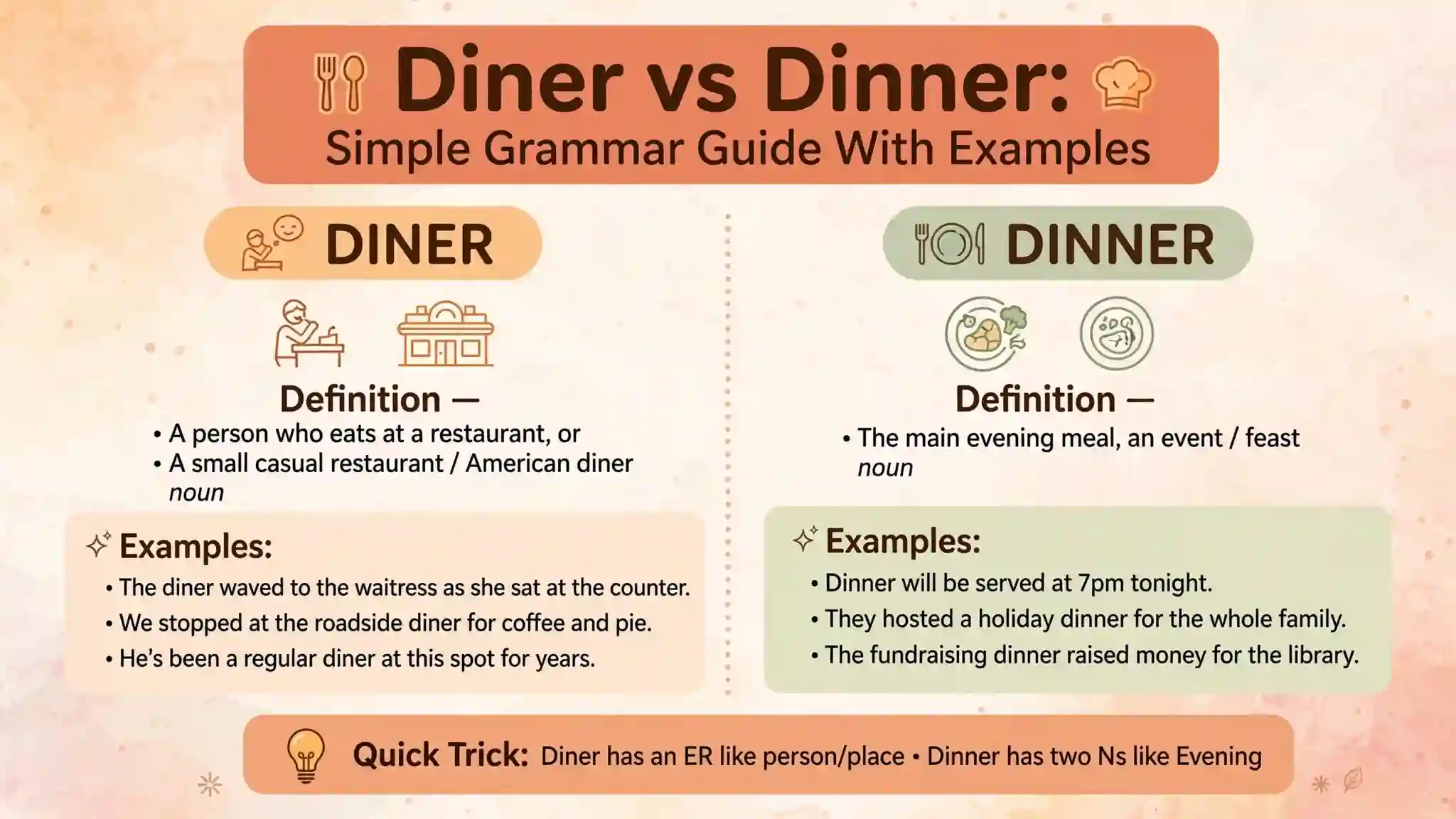
Dinner vs diner is the difference between a meal and a person or place. Dinner is a meal, typically the main meal of the day and often eaten in the evening. Diner has two main uses: it is a person who is eating a meal, especially at a restaurant, and it is a casual, retro-style restaurant, such as a classic American roadside diner. It can also mean the dining car on a train. The example that shows all three: “The diner sat down to eat dinner at the diner.”
Most people who mix up these words do not lack vocabulary. They simply type fast, trust autocorrect, or rely on how the word looks instead of how it works. Because the two words differ by only one letter, the mistake slips through spell checkers and often reaches the final page.
This guide takes a rules-based approach. Instead of one long explanation, you will learn five short rules, each with examples, plus a look at the history of the diner, a quick vocabulary list, and practice questions. By the end, the dinner vs diner choice will feel automatic.
Rule 1: If You Can Eat It, Write Dinner
The first rule is the simplest. When you mean the food or the meal, write dinner, with two n’s.
- “Dinner is on the table.”
- “We had rice and chicken for dinner.”
- “He skipped dinner because he was busy.”
Dinner can also mean an organised event, such as a farewell dinner or a company dinner. The test is always the same: if the word could be replaced with “the evening meal,” it is dinner. So what does dinner mean at its simplest? It is the meal you eat in the evening, or the event built around that meal.
Rule 2: If It Is a Person Eating, Write Diner
When you mean someone who is eating or who has come to a restaurant to eat, write diner, with one n.
- “The diner at table three asked for more water.”
- “Every diner left a tip.”
- “Hungry diners filled the room.”
The word is built from the verb dine plus -er, the same ending as in eater, driver, and worker. An -er word often names the person who does the action, so a diner is the person who dines.
Rule 3: If It Is a Casual Restaurant or Train Car, Write Diner
The word diner also names certain places.
- A casual restaurant: a small, informal eatery with a counter, booths, and a menu of comfort food. The classic image is a roadside diner with chrome and neon.
- A train carriage: the carriage where passengers can eat while travelling.
- “We stopped at a diner for pancakes.”
- “The train’s diner served hot soup.”
If you can replace the word with “restaurant” or “dining car,” it is diner. So what does diner mean as a place? It is a casual, retro-style restaurant, or the carriage on a train where meals are served.
Rule 4: Listen to the Vowel
This rule uses your ears. The two words sound different.
- Dinner: DIN-er, with a short “i.”
- Diner: DYE-ner, with a long “i.”
Doubled consonants keep a vowel short, and a single consonant lets it stay long. Pairs like hopping and hoping, supper and super, and latter and later follow the same pattern. If you say the word aloud and hear “eye,” use one n. If you hear “ih,” use two.
Rule 5: Check the Context Words Around It
Certain words travel with dinner, and others travel with diner. If you spot the neighbours, you can spot the word.
Words that travel with dinner:
- dinner party
- dinner table
- dinner time
- dinner plate
- dinner guest
Words that travel with diner:
- roadside diner
- railway diner
- diner counter
- diner booth
- fellow diner
A quick check: “dinner party” and “dinner table” are always about the meal. “Diner counter” and “diner booth” are always about the place.
Dinner vs Diner at a Glance
| Feature | Dinner | Diner |
|---|---|---|
| Category | Meal | Person, restaurant, or train car |
| Letters | Two n’s | One n |
| Sound | DIN-er | DYE-ner |
| Plural | dinners | diners |
| Typical context | Menus, invitations, family life | Reviews, travel, American culture |
| Example | “Dinner was ready.” | “The diner paid the bill.” |
A Short History of the Diner
The word dinner comes from the Old French disner, meaning “to dine” and, originally, “to break a fast.” It is related in idea to breakfast. In older English, dinner was the main meal and was often eaten around midday.
The restaurant called a diner has a different story. In the late 1800s, vendors sold food from horse-drawn lunch wagons to workers who needed an inexpensive meal. Over time, these wagons gave way to buildings that looked like railway dining cars, with long counters and stools. They became popular in American towns and beside highways, which is why we still say “roadside diner” today. The original meaning of diner is older and simpler: it is just the verb dine with -er added.
Dinner Around the World
Dinner does not mean exactly the same thing everywhere. In many homes, the family gathers at the dinner table in the evening, and the meal is the largest of the day. In other places, dinner is the midday meal, especially when it is a big weekend meal such as Sunday dinner, and the lighter evening meal is called supper or tea. Because of this, the word always points to a main meal, but the clock time depends on local habits. If you are writing for readers in different countries, a quick phrase such as “the evening meal” removes any doubt.
What Makes a Diner a Diner?
A diner is easy to recognise. It usually has a long counter with stools, booths along the windows, a large but simple menu, and opening hours that run late or around the clock. Many serve breakfast all day, with eggs and pancakes next to burgers and milkshakes. The building is often shiny, with chrome trim and bright signs, and the mood is relaxed. Regulars know the staff, and coffee refills arrive without asking. This feeling of comfort and nostalgia is why the word diner suggests more than just a restaurant.
Writing About Dinner and Diners: Tips for Students and Bloggers
If you write essays, reviews, menus, or invitations, a few habits help you use these words well.
- Pick the word before you type. Decide whether you are naming food or a person and place.
- Use dinner for the meal in menus. “Dinner menu” is a menu for the meal, not for a restaurant type.
- Use diner for customers in reviews. “The diners praised the soup” reads smoothly.
- Mind your audience. The restaurant meaning of diner is mostly American, so a British reader may prefer “café.”
- Keep names as written. If a restaurant is called “Sam’s Diner,” copy it exactly.
- Proofread aloud. Reading a sentence out loud lets your ear catch a wrong word.
Everyday Vocabulary With Dinner and Diner
Dinner family:
- Dinner party: a social event where guests share a meal.
- Dinner date: a meal out as a couple.
- Dinner jacket: the British name for a formal evening jacket.
- TV dinner: a frozen meal that is heated at home.
- Dinner bell: a bell rung to call people to a meal.
Diner family:
- Diner food: simple, hearty dishes such as burgers, eggs, and fries.
- Diner coffee: the refillable, no-fuss coffee served in diners.
- Greasy spoon: an informal British term for a cheap, casual café that is similar in spirit to a diner.
- Dining car: the railway carriage where meals are served.
Notice that the verb behind both words, dine, and related words such as dining and dined, all use a single n. Only the noun dinner uses two.
Real Examples of Dinner vs Diner
- “We are hosting a farewell dinner on Friday.”
- “Please set the dinner table before our guests arrive.”
- “A weary diner dropped into the nearest booth.”
- “The corner diner serves breakfast all day.”
- “Passengers can enjoy lunch in the train restaurant.”
- “The diner ordered a coffee and waited for dinner.”
The Autocorrect Trap
Many errors in dinner vs diner happen because of technology. A phone sees “diner” as a valid word and leaves it alone, even when you meant “dinner.” The same happens in reverse. Here are three quick fixes.
- Read your sentence aloud. The mistake often shows up when you hear it.
- Search for the word. Use Find to check every use of dinner or diner in a long document.
- Ask what the word names. If it names food, use dinner. If it names a person or place, use diner.
Common Mistakes
- “What’s for diner?” Wrong. It should be “What’s for dinner?”
- “We had breakfast at a dinner.” Wrong. Use “diner” for the restaurant.
- “The dinners complained about the wait.” Wrong. People are diners.
- “Diner party.” Wrong. Use “dinner party.”
- Different sounds, same word. Dinner is DIN-er, diner is DYE-ner. They are not interchangeable in speech either.
Tricky Cases
A few dinner vs diner situations need extra care.
- Both in one sentence: “The diner ordered dinner at the diner” is correct. The first diner is a person, the second is a place.
- British vs American use: the restaurant meaning of diner is mostly American. In Britain, diner more often means a person.
- Dinner at noon: in some regions, dinner is the midday meal and supper is the evening one.
- Business names: copy the spelling on the sign, even if it is unusual.
A Quick Word on Dine
Behind both words stands the verb dine, which means to eat a meal, often in a polished or pleasant way. It gives us dining, dined, and dining room. Every one of these words has a single n, just like diner. Only the noun dinner doubles the letter. That makes the double n a useful signal: when you see two n’s, you are looking at the meal itself.
One-Minute Recap
- Food or event: dinner (two n’s, DIN-er).
- Person who eats: diner (one n, DYE-ner).
- Casual restaurant: diner.
- Train carriage for meals: diner.
- Still stuck? Say the word aloud and listen to the vowel.
Quick Practice
Test your dinner vs diner skills. Fill in each blank with dinner or diner.
- The ___ at table four asked for the menu.
- We ate ___ at eight.
- A small ___ sits beside the highway.
- Please set the ___ table.
- Each ___ received a glass of water.
- The ___ party was a big success.
Answers: 1 diner, 2 dinner, 3 diner, 4 dinner, 5 diner, 6 dinner.
FAQs
What is the difference between dinner vs diner? Dinner is a meal. A diner is a person who eats, a casual restaurant, or a train restaurant carriage.
What does dinner mean? It means the main meal of the day, usually eaten in the evening.
What does diner mean? It means a person who dines, or a casual restaurant with a retro style.
Is “diner” ever a meal? No. For the meal, use dinner.
Why is dinner spelled with two n’s? The double n keeps the first vowel short, giving the sound DIN-er.
What is a dining car? It is the railway carriage where meals are served, sometimes called the diner.
What is a classic diner? It is a casual restaurant, often beside a road or highway, usually with a counter and booths.
Conclusion
The dinner vs diner question has a clear answer once you know the five rules. If you can eat it, write dinner. If it is a person eating, a casual restaurant, or the restaurant carriage of a train, write diner. Listen to the vowel, check the neighbouring words, and watch out for autocorrect. A dinner party, a dinner table, a roadside diner, and a dining car each point to the right spelling, and a quick check will keep your writing sharp.
