



Bear vs bare comes down to what the word is doing in the sentence. Bear is mainly a verb that means to carry, endure, or produce, and it is also the name of the animal. Bare means uncovered, empty, or stripped down, as in bare feet or bare walls. So you “bear a burden” but you “bare your teeth,” and you “bear with me” but never “bare with me.”
The two words are homophones, which means they sound the same, so your ear cannot help you. Both are pronounced like “bair.” Because bear has several different meanings, and bare works as both an adjective and a verb, writers often grab the wrong spelling when they are typing quickly.
In this guide, you will learn what each word means, how to tell them apart with a simple test, and which phrases trip people up most. The bear vs bare choice is easy once you know the pattern, and you will find examples, idioms, common mistakes, practice questions, and FAQs below.
Why Bear and Bare Get Mixed Up
Bear and bare are homophones, which are words that sound the same but have different spellings and meanings. English has many of them, such as flour and flower, or sea and see, and spelling mistakes are common because the ear gives no clue. A spell checker will also miss the error, since both words are real. The only reliable fix is to know what each word means.
What Does Bear Mean?
Bear has several meanings, and all of them are different from bare. The main ones are:
- To carry or support a weight. “The bridge can bear heavy trucks.”
- To endure or tolerate. “I can’t bear this noise.”
- To produce or give birth to. “The tree bears fruit every summer.”
- To hold in mind or take on. “She must bear the cost of the repairs.”
- To turn in a direction. “Bear left at the roundabout.”
- The animal. “A bear walked out of the forest.”
So when people ask what bear meansss, the answer depends on context. As a verb, it is about carrying, enduring, or producing. As a noun,, it is the large furry animal, and in finance it is also a pessimistic investor in a “bear market.”
The verb is irregular: bear, bore, borne. “She bore the pain” (past), and “He has borne the cost” (past participle).
What Does Bare Mean?
Bare also has more than one meaning, but all of them are about being uncovered or reduced to the minimum.
As an adjective, bare means:
- Uncovered: “She walked on the beach in bare feet.”
- Empty: “The room had bare walls and a single chair.”
- Basic or minimal: “We have only the bare essentials.”
As a verb, bare means to uncover or reveal: “The dog bared its teeth.” “He bared his soul in the interview.” The forms are bare, bared, and baring.
When readers ask whas bare means, remember this: if something is naked, empty, plain, or stripped down, bare is the word. It is also the root of the adverb barely, meaning “only just,” as in “I barely made it.”
Bear vs Bare: Key Differences
| Feature | Bear | Bare |
|---|---|---|
| Part of speech | Verb or noun | Adjective or verb |
| Main meaning | Carry, endure, produce; also the animal | Uncovered, empty, minimal; to uncover |
| Sound | /bair/ | /bair/ |
| Past tense | bore, borne | bared |
| Typical phrases | bear with me, bear in mind, bear fruit | bare minimum, bare feet, bare bones |
| Example | “I can’t bear the noise.” | “The shelves were bare.” |
Both are pronounced the same, so only the spelling and context tell them apart.
A Simple Synonym Test
When you are stuck, replace the word with a synonym and see which one fits.
- If carry, endure, tolerate, produce, or give birth to fits, use bear.
- If naked, uncovered, empty, plain, orexposedde fits, use bare.
Try it in a sentence: “I can’t (bear/bare) the heat.” Replace it with “endure,” and it works: “I can’t endure the heat.” So the answer is bear. Now try “The cupboard was (bear/bare).” Replace it with “empty”: “The cupboard was empty.” So the answer is bare.
If the word is the animal, it is always spelled bear.
Where the Words Come From
Bear (the verb) and bear (the animal) look the same but have different origins. The verb comes from Old English beran, meaning “to carry,” and it is related to words like “birth” and “burden.” The animal comes from Old English bera, which means “the brown one.” The two senses simply ended up with the same spelling.
Bare comes from Old English bær, meaning naked or uncovered. It is not related to either bear, which is why the spelling is different.
Common Phrases With Bear
Many fixed phrases use bear, and each one is spelled this way every time.
- Bear with me: be patient while I do something. “Please bear with me while I find the file.”
- Bear in mind: remember, take into account. “Bear in mind that the shop closes at six.”
- Bear fruit: to produce results. “Her hard work finally bore fruit.”
- Bear the cost (or expense): to pay for something. “The small shop could not bear the cost of a new roof.”
- Bear weight: to support a load. “The beams were built to bear weight for decades.”
- Bear the pain: to endure pain. “Take a tablet if you cannot bear the pain.”
- Bear the thought: to cope with an idea. “She could hardly bear the thought of selling her old car.”
- A burden to bear: a heavy duty or worry. “Guilt can be a heavy burden to bear.”
- Bear a grudge: to keep resentment. “He still bears a grudge against his old boss.”
- Bear witness: to give evidence or show proof. “These ruins bear witness to a long history.”
- Bear responsibility: to accept the duty. “The manager must bear responsibility for the error.”
- Grin and bear it: to endure something unpleasant without complaining.
- Bear down: to press or advance with force. “The storm is bearing down on the coast.”
- Bear hug: a tight, strong hug.
- Bear market: a period when stock prices fall.
Common Phrases With Bare
The bare phrases are about being uncovered or reduced to basics.
- Bare minimum: the smallest amount that will do. “He did the bare minimum and went home.”
- Bare bones: only the most basic parts. “It was a bare-bones website with no extras.”
- Bare necessities: only the essential things. “They lived on the bare necessities.”
- Barefoot or bare feet: without shoes.
- Bare hands: without gloves or tools. “He opened the jar with his bare hands.”
- Bare your teeth: to show teeth in a threat. “The dog bared its teeth.”
- Bare your soul or bare your heart: to reveal your deepest feelings. “After a long silence, she bared her heart to a stranger.”
- The cupboard is bare: there is nothing left. “We went to make dinner, but the cupboard was bare.”
- Lay bare: to expose or reveal. “The report laid bare the company’s mistakes.”
- Bare-faced: shameless or open, as in a bare-faced lie.
Bear Arms vs Bare Arms
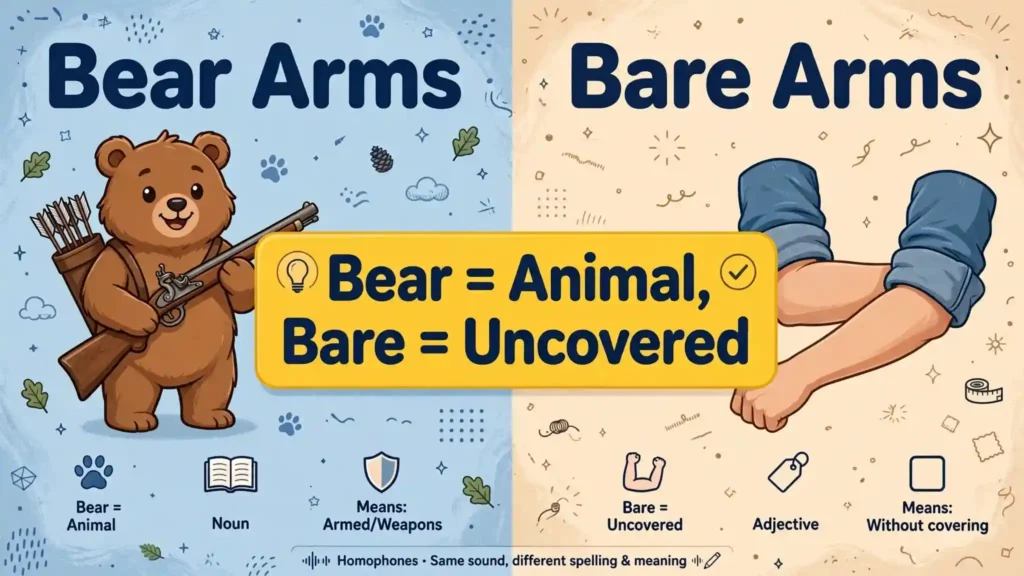
This pair shows how a single letter can change the whole meaning. To bear arms means to carry weapons, as in the well-known phrase “the right to bear arms.” To have bare arms means your arms are uncovered, as in “She wore a sleeveless dress with bare arms.” A famous joke plays on this, picturing a person with bare arms as having the “right to bare arms.” It is only a pun, and it is not correct for the weapons meaning. The reverse slip is also common: writing “it was too cold to go out with bear arms” when you mean uncovered arms. That sentence needs bare.
Born vs Borne
Because bear is an irregular verb, it has two past participles, and they are not interchangeable.
- Born is used for birth: “She was born in 1995.”
- Borne is used for carrying, enduring, or giving birth in the active voice: “He has borne the cost,” “She has borne three children,” “The pain was borne with patience.”
A quick rule: if you see “was born” or “were born,” use born. In most other cases, use borne.
Examples in Context
Reading the words in real sentences makes the difference clear.
- Bear (carry): “These shelves can bear up to 50 kilograms.”
- Bear (endure): “I can’t bear waiting in long queues.”
- Bear (produce): “The mango tree bears fruit in June.”
- Bear (turn): “Bear right after the petrol station.”
- Bear (animal): “The brown bear caught a fish in the river.”
- Bare (uncovered): “The children ran across the grass in bare feet.”
- Bare (empty): “The new flat had bare walls.”
- Bare (minimal): “The hotel provides only the bare essentials.”
- Bare (verb): “He bared his teeth in a smile.”
How to Remember the Difference
Here are three quick tricks.
- Use the synonym test. If you can swap in “carry” or “endure,” it is bear. If you can swap in “naked” or “empty,” it is bare.
- Link the animal. The word bear is the animal, and the animal carries cubs, hunts, and endures cold winters. Anything about carrying or enduring fits the animal’s spelling. Bare is the plain word with nothing extra, just like a bare room.
- Think of forbear. To forbear means to hold back or be patient when something annoys you. The word has bear built right inside it, and the “bear” in forbear is the same verb that means to endure. If you link the spelling of bear with the meaning of forbear, you will not mix it up with bare.
Whenever you doubt the bear vs bare choice, ask yourself: is something being carried or endured, or is something uncovered?
Common Mistakes
Most mistakes in bear vs bare come from the fixed phrases people type without thinking.
- “Bare with me.” Wrong. The correct phrase is “bear with me,” meaning be patient.
- “Bare in mind.” Wrong. Use “bear in mind.”
- “Bear minimum.” Wrong. Use “bare minimum,” meaning the least possible.
- “Bear bones.” Wrong. Use “bare bones.”
- “Grin and bare it.” Wrong. Use “grin and bear it.”
- “Bear feet” or “bear hands.” Wrong. Use “bare feet” and “bare hands.”
- “Bare fruit.” Wrong. Use “bear fruit.”
- “A heavy burden to bare.” Wrong. A burden is carried, so the spelling is “burden to bear.”
- “Bare the cost.” Wrong. Paying for something is “bear the cost.”
- Mixing born and borne. “He was borne in 1990” is wrong. Use “was born.”
Tricky Cases
A few bear vs bare situations are less obvious.
- Bare arms vs bear arms: one means uncovered limbs, the other means carrying weapons.
- Bear left or right: this uses bear, because it means “turn slightly,” not “uncover.”
- Barely: this comes from bare, not bear. Write “barely enough,” never “bearly.”
- Bear market and bull market: these use the animal spelling, because the bear is the symbol of falling prices.
- Bearable and unbearable: these come from the verb bear, so the spelling is “unbearable,” never “unbareable.”
- Bare-bones as an adjective: hyphenate it before a noun: “a bare-bones plan.”
- Bared vs bore: “she bared her teeth” (showed), but “she bore the pain” (endured).
Proofreading Tips
A spell checker will not catch this mistake, because both words are real. To proofread well, read the sentence aloud and swap in a synonym: carry, endure, or produce for bear, and naked, empty, or plain for bare. It also helps to search your document for “bare with” and “bear feet,” two of the most common slips. In formal writing, such as a report, a cover letter, or an exam answer, take a second look at every phrase that contains either word. These small errors are easy to fix and very noticeable to readers.
Quick Practice
Test your bear vs bare skills. Choose the correct word for each blank.
- Please ___ with me while I check the details.
- The children were playing in ___ feet.
- He can’t ___ the thought of leaving.
- The room had ___ walls and no furniture.
- Her patience finally ___ fruit.
- The dog ___ its teeth at the stranger.
Answers: 1 bear, 2 bare, 3 bear, 4 bare, 5 bore (a form of bear), 6 bared (a form of bare).
FAQs
What is the difference between bear vs bare? Bear means to carry, endure, or produce, and it is also the animal. Bare means uncovered, empty, or minimal.
Is it “bear with me” or “bare with me”? Bear. The phrase means be patient, and it uses the verb bear.
Is it “bear in mind” or “bare in mind”? Bear. It means to remember something.
Is it “bare minimum” or “bear minimum”? Bare. It means the smallest amount needed.
What is the meaning of bear in simple words? As a verb,, it means to carry, endure, or produce. As a no,un it is the animal.
What is the meaning of bare in simple words? It means uncovered, empty, or reduced to the basics.
What is the past tense of bear? The past tense is bore, and the past participle is borne or born, depending on meaning.
Is “bare” ever a verb? Yes. It means to uncover or reveal, as in “bare your teeth.” The forms are bare, bared, and baring.
Are bear and bare homophones? Yes. They sound identical but have different spellings and meanings.
Conclusion
The bear vs bare question is solved by asking what the word is doing. If something is carried, endured, produced, or it is the animal, use bear. If something is uncovered, empty, or stripped down, use bare. Remember the phrases that cause the most errors: “bear fruit” and “grin and bear it” use bear, while “bare bones,” “bare feet,” and “bare your soul” use bare. When in doubt, try the synonym test, and the right spelling will usually be clear.
